In 2016, Matt Murphy took charge of a semiconductor company whose future occupied a rather small corner of its present. Data center represented about 9 percent of Marvell’s revenue. Murphy chose to move toward it. A decade later, the business of helping enormous computing systems communicate has become central to his working life. The small corner has acquired quite a lot of furniture.
Retrospect gives business decisions an unfair advantage. Once AI fills the conversation, an investment in the machinery underneath it can look inevitable. Move back to the moment of decision, however, and the comfortable ending disappears. There are existing products to support, people to persuade and money that can only be spent once. Murphy’s story becomes more interesting when the dates stay attached.
He arrived at Marvell in July 2016. Cavium followed in 2018. A wireless connectivity business left in 2019. Inphi arrived in 2021. These were changes to the company’s actual equipment for making a living: its technology, its teams, its customers. By the time the AI buildout made infrastructure a familiar subject beyond the chip industry, Murphy had already spent years rearranging the business around it.
Twenty-two years before the corner office
Murphy brought a long apprenticeship to the job. Before Marvell, he had spent 22 years at Maxim Integrated, moving through business management and customer operations into wider responsibilities. His education included a Bachelor of Arts from Franklin & Marshall College and, later, the Stanford Executive Program. His route to leading a chip company ran through the commercial life of chips as well as the organizations that developed them.
From 2006 to 2011, he led worldwide sales and marketing at Maxim. He subsequently ran its Communications and Automotive Solutions Group. In his final role there, executive vice president of business units, sales and marketing, his remit extended across product development and the work of taking those products to customers.
That sequence helps explain the kind of executive Marvell hired. A product business contains several different conversations. Engineers discuss what can be built. Customers explain what they need, sometimes with useful precision and sometimes with an expensive change of mind. Salespeople encounter the distance between the two. A leader who has worked across those boundaries has had opportunities to see a promising idea meet its delivery date.
The move to Marvell gave Murphy responsibility for choosing among those ideas on a different scale. Board chair Rick Hill helped bring him into the company. When Murphy succeeded Hill as chairman in June 2023, he credited Hill’s mentorship of both himself and the management team. The leadership change had a history of its own.
A company changes by subtraction, too
The Cavium acquisition closed on July 6, 2018. It brought together capabilities in storage, processing, networking, wireless connectivity and security. For Murphy, the rationale extended beyond adding products to a catalogue. He was assembling a company directed at infrastructure, the systems behind the devices people actually notice.
At the close, he tied semiconductor growth to the data economy. His accompanying list included AI, 5G, cloud, automotive and edge computing. AI was already in the sentence. It shared the sentence with several other markets, a useful reminder of how the future looks before everyone agrees on its name.
A year later came a decision in the other direction. NXP agreed to acquire Marvell’s wireless connectivity portfolio in a transaction valued at $1.76 billion. The assets included Wi-Fi and Bluetooth technology; the acquisition encompassed approximately 550 people worldwide. It closed in December 2019.
There is a temptation to tell a corporate transformation through purchases alone. An acquisition supplies a date, a price and a photograph of people looking pleased. A divestiture asks a more awkward question: which part of the existing company belongs in somebody else’s future? Murphy’s record includes both kinds of choice.
“The next wave of semiconductor growth will be fueled by advancements in the data economy.”
Matt Murphy, July 2018
Inphi joined Marvell on April 20, 2021. Its high-speed electro-optics capabilities fit the growing emphasis on moving data. The transaction also established the combined Marvell Technology as a company domiciled in the United States. Murphy welcomed Inphi’s team and pointed to the capabilities and scale that the combination would bring.
Place the transactions beside one another and a pattern appears. Cavium expanded infrastructure capabilities. The wireless sale narrowed the portfolio. Inphi strengthened the technology for high-speed connections. The pattern is this article’s reading of those decisions: a company becoming more particular about where it intended to compete, while broadening the tools it could bring to that chosen ground.
There is considerable work concealed between signing a transaction and delivering a product. Teams need to cooperate. Designs need to fit customer requirements. The acquired capability must become something the combined business can use. A completed deal ends one negotiation and begins a much longer organizational assignment.
One Marvell, one note at a time
Murphy’s public conversations give that organizational assignment a human scale. On A Bit Personal with Jodi Shelton, he discussed his “One Marvell” philosophy and the weekly personal note he sends to the workforce. For an executive whose company deals in advanced connections, it is an agreeably ordinary communication device. Someone still has to sit down and write.
The habit fits a problem that a portfolio diagram cannot solve. People joining through different businesses bring different histories. A shared corporate name does not automatically provide a shared understanding of priorities. Repeated communication gives a leader a way to explain what the decisions add up to, and employees a way to recognize the direction across separate assignments.
Murphy has also been explicit about the people he relied on. In June 2026, as Marvell announced Dan Durn’s appointment as chief financial officer, he recalled that outgoing CFO Willem Meintjes had arrived just weeks before him in 2016. Murphy described leaning on Meintjes from the early days onward and credited him with helping establish the finance organization.
That acknowledgment adds a colleague to the familiar CEO narrative. A transformation requires the capacity to fund plans, account for performance and maintain operational credibility. Those responsibilities have names attached to them. Murphy’s tribute to Meintjes made visible some of the work that usually disappears beneath a chief executive’s photograph.
His interests extend to developing the people who will follow. Mentorship and early-career development recur in his public leadership agenda. He has also served as a trustee of the U.S. Olympic and Paralympic Foundation, bringing him into another setting where preparation, resources and sustained effort precede the public performance.
The patience of a long race
Endurance sport supplies part of Murphy’s own vocabulary for that effort. He has competed in triathlons and Ironman races, and his interviews return to the importance of preparation. The connection to semiconductor work is easy to understand: the result arrives after a long accumulation of decisions, and enthusiasm at the start cannot do the work of training.
His discussion with Shelton also contains a quieter account of managing time. As a global sales leader at Maxim, he recalled leaving the office early on Mondays, taking calls with colleagues in Asia around dinner and bedtime with his children. Work resumed later in the evening. The schedule was an arrangement built around people on opposite sides of the world and people in the next room.
It is a specific anecdote, which makes it more revealing than a declaration about balance. There is a clock in it. There are calls to make, children to spend time with and another stretch of work afterward. The solution depended on rearranging the day. It offers a glimpse of the practical negotiation behind an executive career that can otherwise be reduced to a succession of titles.
Across these accounts, preparation and repetition keep reappearing: in a race, in a weekly note, in the relationship with a long-serving colleague. They suggest a public leadership style attentive to the work between major announcements. That is an interpretation of the record, rather than a claim to know what Murphy is like away from it.
At the next bottleneck
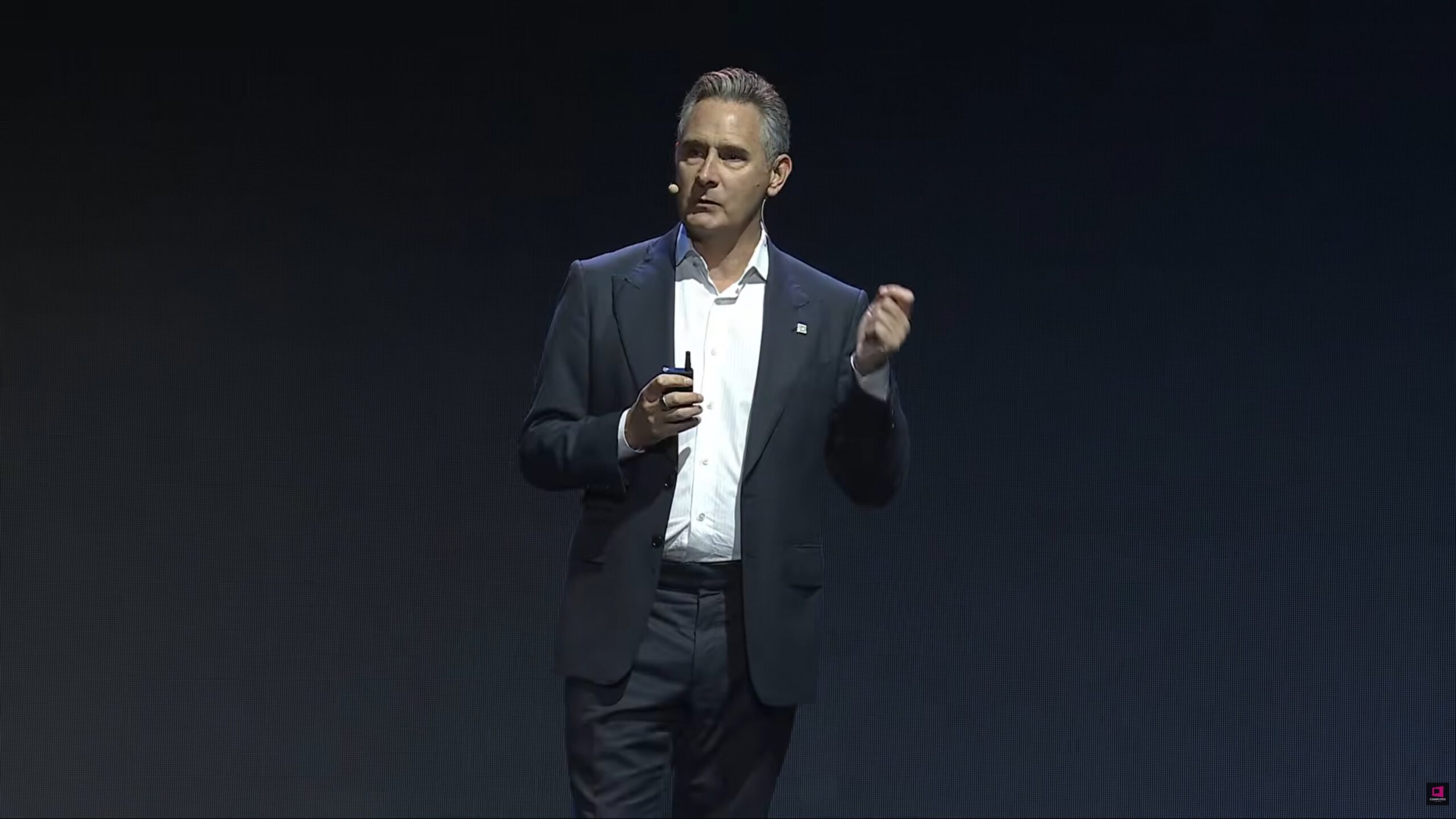
At COMPUTEX in June 2026, Murphy’s argument centered on connectivity. As AI infrastructure grows across servers, racks and data centers, moving information efficiently becomes part of the challenge of making the whole system useful. His keynote placed Marvell’s technology in those links, from connections close to the processor to networks spanning much greater distances.
Every step makes data movement part of the computing problem.
Conceptual illustration - distances and performance are not to scale.The stage also illustrated how many organizations are involved. NVIDIA’s Jensen Huang and ASE’s Tien Wu joined him. In a subsequent LinkedIn post, Murphy thanked both and emphasized the ecosystem being built together. A company selling connections has good reason to pay attention to its own.
That scene leads back to the choices of 2016. Murphy could choose a direction for Marvell; he could not schedule the world’s eventual enthusiasm for AI. The decisions had to make sense as investments in infrastructure before their present context was fully visible. Acquisitions, divestitures and relationships gave the strategy physical and organizational substance.
In October 2026, he and Marvell’s leadership team took that discussion to Investor Day in New York. The continuing task is to turn the assembled capabilities into products customers can deploy, while keeping the company coordinated as its ambitions expand. The next presentation will have a date. Much of the work will happen between dates, where Murphy has already spent a considerable part of his career.