A new phone gets a stage, a spotlight and an audience prepared to applaud a thinner rectangle. The equipment that helped establish whether it could communicate gets rather less ceremony. Satish Dhanasekaran has worked on both sides of that arrangement. Before he ran Keysight Technologies, he helped design and lead the development of first-generation smartphones at Motorola. He went on to make a career in the business of asking difficult questions of other people’s inventions.
There is a pleasing reversal here. The engineer who once helped produce the device became an executive selling the means to examine it. Today, as Keysight’s president and chief executive, he oversees a company whose design, emulation and test tools sit behind communications networks, semiconductor development and other engineering projects. His professional story follows the movement from making a particular thing to helping whole industries establish what their things can do.
The distinction matters because the public version of technological progress tends to skip the examination. A product is announced. A new generation is named. The future acquires a number and a marketing budget. In between, engineers need evidence. Dhanasekaran’s business lives in that interval, where an attractive possibility has to become a repeatable result.
His training includes a master’s degree in electrical engineering from Florida State University and executive education at Wharton. The combination suits the career that followed: technical work, customer-facing responsibilities, business leadership and eventually a company-wide remit. The published record gives us an engineer’s route into management, with successive increases in responsibility rather than a founder’s departure into a new venture.
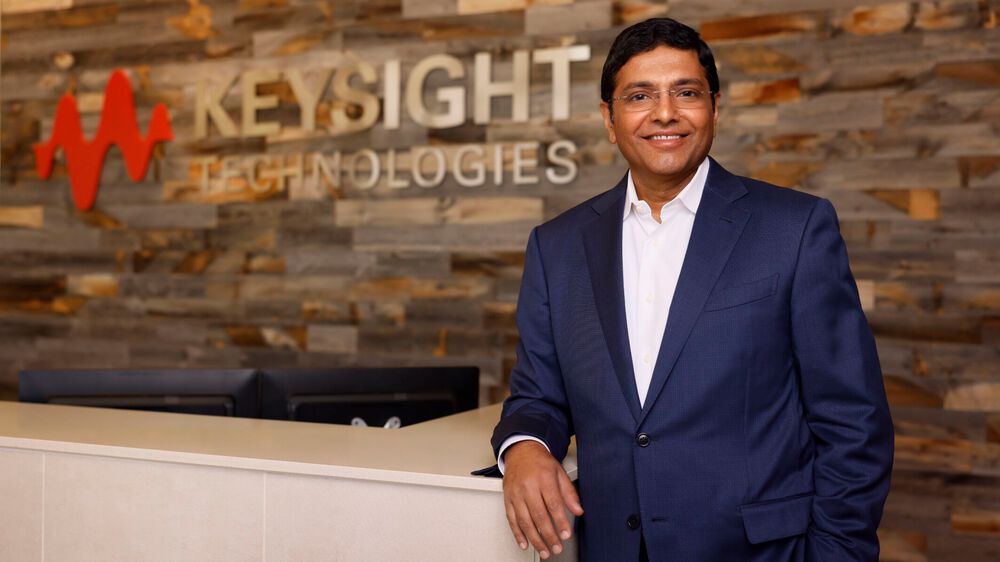
He joined Agilent in 2006. Keysight emerged as an independent company from Agilent in 2014, carrying a test-and-measurement lineage that reaches back through Hewlett-Packard. Dhanasekaran was therefore building a career inside an established engineering business while its corporate identity changed around him. The instruments had a history; the independent company still had choices to make.
A promotion through the layers
His early responsibilities make that later strategy easier to understand. He worked in wireless 4G business development and application engineering, then took on larger commercial and product roles. These positions connected what engineers could build with what customers were trying to accomplish. The technical and commercial parts of his career developed together, rather than waiting to meet in the chief executive’s office.
In June 2015, he became general manager of the Mobile Broadband Operation. In May 2016, he moved to vice president and general manager of the Wireless Devices and Operators business. The following July, he became president of the Communications Solutions Group. Mobile broadband had become a much broader responsibility spanning communications and aerospace and defense.
One earlier assignment is particularly revealing. In the wireless devices business, he led a shift in the portfolio toward testing software layers in mobile devices. A phone’s behavior could not be understood simply by looking at its physical components. The business had to follow the complexity of the product. That experience foreshadows the broader emphasis on software that appears throughout his subsequent leadership.
In October 2020, he became chief operating officer. His remit reached across research, development, services, marketing and sales, with growth in orders and recurring revenue among his responsibilities. On May 1, 2022, he succeeded Ron Nersesian as president and chief executive and joined Keysight’s board. Nersesian initially remained executive chairman, giving the transition continuity at the top.
The succession announcement emphasized a software-centered solutions strategy. It was a continuation of work Dhanasekaran already knew. The interesting question was how far the company could extend its role in a customer’s engineering process. Selling an instrument answers one requirement. Combining hardware, software and services opens a longer conversation about the problem the customer is trying to solve.
- 2006Joins Agilent
- 2017Leads Communications Solutions
- 2020Chief operating officer
- 2022President & CEO
The name has more than one letter
Corporate biographies can make a person sound as though he has spent his life being appointed to things. A small exchange in November 2022 provides a welcome interruption. At a Credit Suisse technology conference, after the moderator introduced him, Dhanasekaran thanked him for attempting his surname. “Most people stop with D,” he said. A room convened to discuss technology economics briefly had a more manageable subject: pronunciation.
The joke is modest, and that is its charm. It offers a glimpse of ease in an otherwise formal setting without requiring a grand theory of his personality. His public remarks usually return to customers, engineering and the work of adoption. The humor fits between those subjects; it does not need to carry a claim about the private person.
His view of talent also comes through in the places he discusses. In a November 2022 interview, he described India as central to Keysight’s worldwide strategy, pointing to four research and development sites whose work entered products used internationally. The argument extended beyond selling into a growing market. He was describing where engineering was being done, and why access to technical talent mattered to the company’s plans.
By 2023, another board wanted that experience. Zebra Technologies elected him a director effective May 11. Its executive chair, Anders Gustafsson, highlighted Dhanasekaran’s experience moving hardware businesses toward software and solutions. Dhanasekaran, in turn, connected Zebra’s work in digitizing and automating workflows with his interest in technology adoption. The invitation reflected a problem familiar beyond Keysight: how an established hardware business changes what it offers.
“Most people stop with D.”Satish Dhanasekaran, on attempts at his surname, November 2022
Tomorrow needs a test plan
Dhanasekaran’s horizon extends beyond the generation of wireless technology already being sold. In his writing about 6G, he considers the prospect of networks coordinating transportation, manufacturing, agriculture and energy systems. The ambition gives connectivity a practical assignment: help people use resources more efficiently. Speed is part of the proposition, but so are the decisions that better-connected systems might make possible.
Those ideas remain aspirations. His 2022 essay placed expected commercialization around 2030, a timetable rather than an accomplished fact. Reading it as a statement of intent is more useful than treating each imagined application as a prediction certain to arrive. It shows what he wants the research effort to account for while there is still room to shape it.
He also operates in the less theatrical world of standards and industry groups. He sponsors Keysight’s participation in the Federal Communications Commission’s Technological Advisory Committee, and his biography identifies membership in the NextG Alliance. Such work brings technology companies into conversations about the systems they will eventually have to support. The future has committees as well as keynote speeches. Someone must attend both.
That gives his career a recurring timing problem. A supplier of tools for an emerging technology has to prepare before customers can fully deploy it. Wait until the market looks obvious and the necessary development may already be late. Commit early and the commercial return remains uncertain. The attraction of Dhanasekaran’s position is also its difficulty: the work must precede the event that makes it legible to everybody else.
At a September 2026 investor conference, he described early 6G investment during the wireless downturn and the collaboration involved in building the technology base. “We’ve invested ahead,” he said. He also acknowledged that considerable work remained. That qualification gives the statement its weight. Being early establishes a starting position; execution still has to follow.
The next examination is his own
The financial record shows why that patience is subject to scrutiny. In his January 2026 letter to shareholders, Dhanasekaran described fiscal 2025 as a return to growth. Annual revenue reached $5.4 billion, up 8 percent. The phrase is a useful reminder that an engineering company can participate in long technological transitions and still experience ordinary business cycles along the way.
The company also expanded its capabilities through acquisitions. Its fiscal fourth-quarter 2025 remarks identified Spirent, Synopsys’ Optical Solutions Group and Ansys’ PowerArtist. Positioning, photonics and power optimization broaden the range of problems Keysight can address. For Dhanasekaran, the managerial task is to turn a wider collection of technologies into work customers can use together.
His account of the business increasingly includes AI infrastructure, with demand reaching across compute, networking, memory and power. In the same fourth-quarter remarks, he described collaboration with Broadcom to validate next-generation 1.6-terabit networking silicon and custom AI accelerators. Here, the distance between the public excitement about AI and the engineering needed to support it becomes tangible: data has to move through physical systems that can be designed, measured and tested.
The latest reported quarter available for this profile offers a more immediate scorecard. On August 18, 2026, Keysight reported fiscal third-quarter revenue of about $1.85 billion and orders of about $2.09 billion. Revenue a year earlier had been about $1.35 billion. These are reported company totals, including the enlarged business, rather than a measure of one individual’s contribution or a pure comparison of organic growth.
A chief executive’s work becomes visible through such numbers, but it also sits in the choices that precede them. Which research continues through a downturn? Which capabilities belong together? How closely should a supplier work with customers before a market has fully formed? Dhanasekaran’s career has carried him toward those questions, from the device itself to the organization supplying the tools behind it.
The early smartphones and the future 6G network belong to different periods of the communications story. His role connects them through a practical concern: turning a design into something whose behavior can be understood. The next product launch will have its applause. Somewhere before that, an engineer will have needed an answer. Dhanasekaran has put a substantial portion of his working life into the business of helping that answer arrive.