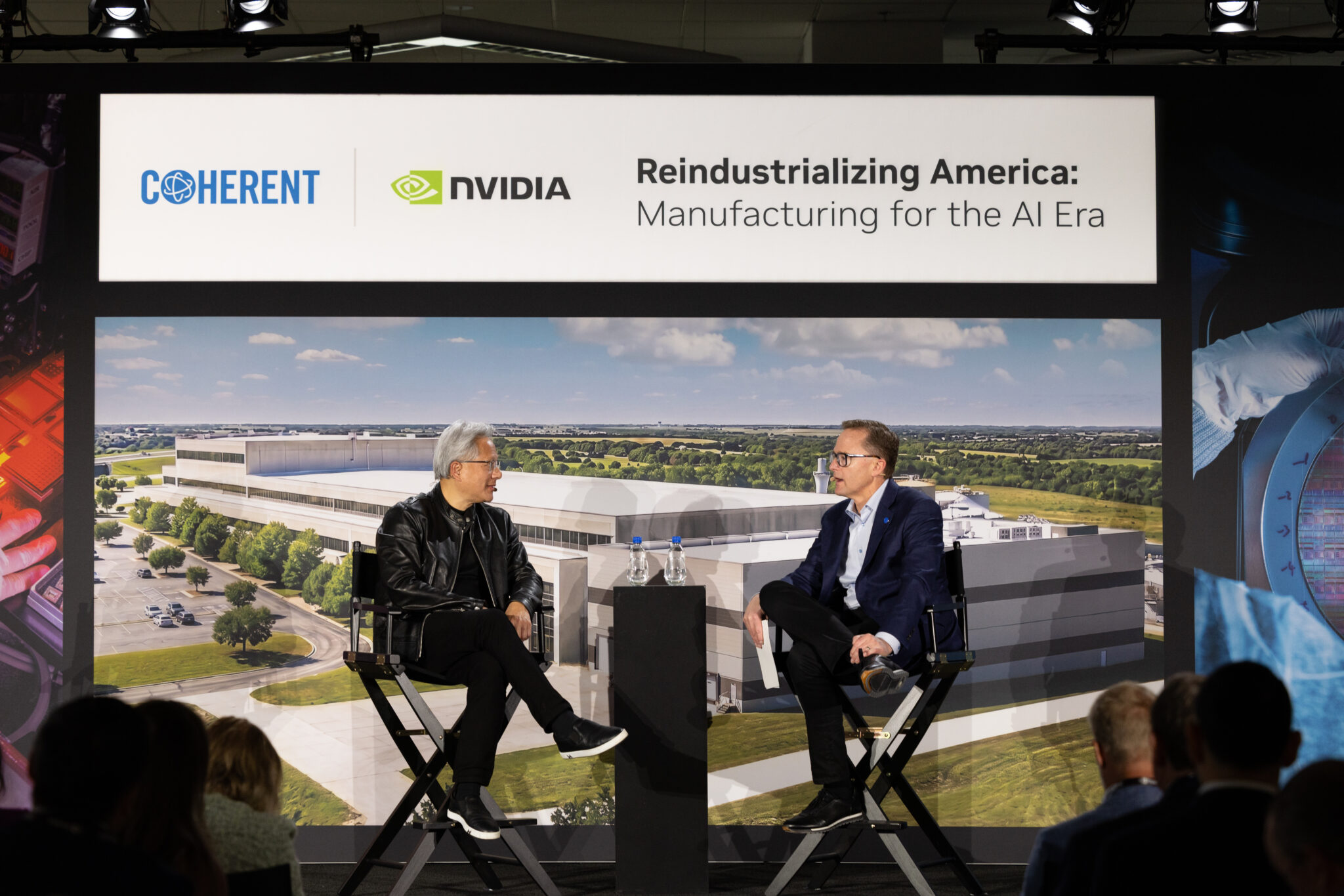
Jim Anderson is sitting opposite Jensen Huang in Sherman, Texas, with a factory expansion pictured behind them. Huang wears his familiar leather jacket. Anderson wears a blue jacket and glasses. The subject is artificial intelligence, though the setting has rather more to do with manufacturing than with the conversational tricks of a chatbot. There are buildings to expand, wafers to process and customers waiting for things they can actually plug in.
The June 2026 conversation captures a turn in Anderson’s career. He once ran AMD’s computing and graphics business, where the processor was the obvious object of attention. Now he runs Coherent, whose optical components help processors communicate. Follow his working life and the spotlight moves from the chip to the distance between chips. It is a small change in where you look, with considerable consequences for what you see.
A processor can be wonderfully fast and still spend time waiting for information. Multiply that problem across a data center and communication becomes a constraint of its own. Anderson’s current business occupies that awkward interval. The intelligence may appear on a screen as a sentence. Behind it sits an industrial problem involving materials, lasers, production equipment and delivery schedules. Someone has to make the light.
The engineer before the corner office
Anderson’s education crosses three institutions and two kinds of discipline. He earned a bachelor’s degree in electrical engineering at the University of Minnesota and a master’s in electrical engineering at Purdue. At MIT, he added a master’s in electrical engineering and computer science alongside an MBA. That combination puts the circuit and the business case in the same educational history. It is a useful pairing for a career spent translating technical possibilities into products.
His early work included microprocessor architecture at Intel. Later responsibilities took him through LSI and Avago, across engineering, strategy, marketing, sales and general management. By the time AMD hired him in June 2015, he had also overseen the acquisition and integration of Avago’s Axxia processor business into Intel. AMD credited him with four patents in computer architecture. Before the executive titles accumulated, there was an inventor’s record.
At AMD he reported to Lisa Su and took responsibility for the computing and graphics group’s strategy, business management, engineering and sales. The remit required more than a good product presentation. Engineering choices had to reach customers through a working business. His appointment put someone with experience on both sides of that equation in charge of a group whose products would be judged quite publicly.
From the launch stage to programmable logic
In May 2017, AMD was laying out an expanding Ryzen product family, including plans for Ryzen Threadripper and mobile processors. Anderson was one of the executives explaining the company’s direction. The moment belongs in his story because it shows him working at the point where a technical roadmap becomes a commercial promise. A launch is a date. Delivering a family of products is a sequence of dates that must hold together.
The attraction of that work is easy to understand without inventing an origin myth for him. Processors are exacting products with impatient audiences. Their development takes years; their reception can arrive in an afternoon. A business leader in that environment has to keep several clocks running together: engineering, manufacturing, customer commitments and the market’s appetite for something new. Anderson’s next appointment widened the responsibility to an entire company.
Lattice Semiconductor named him president and CEO effective September 4, 2018. Its focus included low power field-programmable gate arrays, or FPGAs. These are chips whose logic can be configured after manufacture. The company sold into markets including industrial equipment, communications, computing and automotive applications. Anderson moved from managing a major business group to directing a company with its own product choices, investment decisions and competitive position.
By 2023, Lattice reported annual revenue of $737.2 million, up 12 percent, and a GAAP gross margin of 69.8 percent. Those numbers give substance to the period before Coherent. They describe a business selling programmable devices at a margin that reflected more than the physical material in the package. The value lay in what customers could make those devices do, and in the products and support that made them usable.
There is a temptation in executive profiles to turn a successful company into the work of a single person. Lattice’s results were the work of a company. Anderson’s role was to lead it. That distinction makes the subsequent recruitment more intelligible: Coherent was hiring someone with experience choosing a direction and organizing people around it, rather than borrowing the glamour of a semiconductor launch.
A familiar colleague, a different set of materials
On June 3, 2024, Anderson became Coherent’s CEO and joined its board. The new job brought together materials, networking and lasers. His career had already crossed several semiconductor businesses, but photonics gave him a different set of technical questions. The common thread was the work of turning specialized engineering into products that other companies could build around.
One consequential connection followed him. In October 2024, Coherent appointed Sherri Luther as CFO and treasurer. She had worked with Anderson at Lattice, where she had been CFO since 2019. She also knew Coherent’s acquired laser business from an earlier 16-year tenure. For Anderson, that meant a finance partner with shared operating experience; for Luther, it was a return to a business she already understood.
The pairing is a reminder that a career has a human infrastructure as well as a technical one. People learn how colleagues assess a forecast, challenge a spending proposal and respond when a plan slips. Reuniting two executives does not guarantee an outcome. It does remove some of the introductions. In a company trying to turn technical capability into more reliable execution, that familiarity has a practical purpose.
Applied Materials added Anderson to its board in July 2025, also appointing him to its Strategy and Investment Committee. The role extended his involvement across the semiconductor ecosystem, from the products companies sell to the equipment used to manufacture them. His professional connections now include the processor business, programmable logic, photonics and semiconductor manufacturing equipment. The route has been broad, while remaining close to the underlying engineering.
Two billion dollars meets the factory calendar
In March 2026, NVIDIA and Coherent announced a multiyear agreement covering advanced optics, manufacturing capacity and research. NVIDIA committed to invest $2 billion in Coherent. The agreement also included a separate multibillion-dollar purchase commitment and future access and capacity rights for laser and optical networking products. It was nonexclusive. The distinction matters: investment capital and orders perform different jobs, even when they arrive in the same announcement.
For Anderson, the agreement connected a customer’s future requirements with the means to prepare for them. Research needs funding before a finished product exists. Factories need capacity before all the orders can be shipped. A buyer promising demand and supplying capital helps bridge that interval. The remaining work still involves machines, materials and people. A purchase commitment cannot personally operate a cleanroom.
By June, the story had reached Sherman. Coherent announced an expansion intended to double manufacturing production space and quadruple wafer production capacity. It also signed a letter of intent for up to $50 million in proposed direct CHIPS Act funding. Those were plans and proposed support, with construction and execution ahead. At completion, the project was expected to create more than 550 direct manufacturing, engineering and technical roles.
The material at the center of the project is indium phosphide, a compound semiconductor used in optical devices. The factory makes components for moving information through networks. This is where Anderson’s career acquires a pleasing symmetry: an executive who once worked on processors is now responsible for supplying parts of the communication system that lets many processors work together.
What permission to move faster looks like
Anderson has described a leadership conference where his final slide carried just two words: “Go faster.” His example was risk production: beginning manufacture before a customer finishes testing, when the team has sufficient confidence in the product. It can bring revenue forward, but may also leave material needing rework. He said teams were given room to make those mistakes. The instruction becomes more interesting when it includes permission to absorb the cost.
“Go faster.”Jim Anderson’s final leadership-conference slide
That is a recognizable management choice. Waiting provides information. Starting provides a chance to meet demand sooner. Neither comes free. The judgment lies in deciding which uncertainty a company can afford to carry. For someone leading a manufacturing business into expanding demand, speed has to become a decision about real inventory and production time. Otherwise it remains an attractive word on a slide, where words enjoy unusually low manufacturing costs.
The next delivery
In August 2026, Coherent reported quarterly revenue of $2.05 billion, up 34 percent from a year earlier on a reported basis. Its GAAP gross margin was 38.5 percent. Anderson pointed to customer demand, expanding production capacity and the transition toward optical connectivity in AI data centers. The figures marked progress; his description of the opportunity also set out the work still ahead.
His aspirations are visible in those commitments: more capacity, new optical products and a company able to deliver them. They are unusually physical ambitions for a business associated with artificial intelligence. They require buildings and equipment, technical specialists and repeatable processes. The factory photograph helps restore that scale. Behind the two seated executives is an architectural rendering, a picture of something that still has to be made.
Anderson’s route from computer architecture to photonics gives the scene its meaning. He has spent his career close to the machinery of computing, while moving among the different jobs required to sell it. In Sherman, the gap between processors has become a place to invest, build and hire. His next chapter will be measured partly in how much information can cross that gap, and partly in whether the promised components arrive on time.