The distance between two data centers can look unremarkable on a map. A few towns, a stretch of highway, perhaps the length of a morning commute. For Sachin Gandhi, that space is a business proposition. His company, Retym, is developing the chips that help large quantities of information travel between computing facilities. The AI conversation tends to gather around the machines doing the thinking. Gandhi has chosen the connections that let those machines work together.
It is a fitting assignment for someone whose career has involved several kinds of connection: engineering and marketing, a young company and its investors, a chip design and the customer willing to build it into a product. Before becoming Retym’s co-founder and CEO, Gandhi worked inside established networking businesses and helped start two companies that were subsequently acquired. His professional story lives in the space between having a technical idea and making a business capable of delivering it.
There is a small joke in the name. Retym is pronounced “re-time.” In an industry that sells speed, Gandhi’s latest venture invites you to slow down long enough to say it correctly.
The education of a chip operator
Gandhi studied electrical engineering in Mumbai, then pursued graduate engineering studies at the University of South Florida. His early career took him to Cisco and Marvell. The work included hardware engineering and semiconductor verification, the painstaking business of checking whether a design behaves as intended. It is an appropriate starting point for a founder whose eventual customers need a component to work inside a much larger system.
Verification offers a useful lens on the rest of his career. An attractive diagram is a beginning. Someone still has to examine the assumptions, test the awkward cases and establish that the thing will hold together. A company has its own awkward cases: a funding gap, a hiring decision, a customer whose requirements refuse to fit neatly on the presentation slide. Gandhi’s later responsibilities would put him on both sides of that divide.
At Xpliant, where he was co-founder and chief operating officer, his remit covered finances, investor relationships, spending and investment flow. He also helped assemble the team responsible for delivering the product. That is a particularly revealing combination. A semiconductor startup needs technical ambition, but it also needs enough money and enough people to keep that ambition alive through development. The balance sheet gets a vote in the architecture meeting, even when nobody invites it.
Reading those responsibilities together suggests a career built around execution across departments. Gandhi’s work extended from implementation to the commercial life of a chip. The title COO can conceal this range. In a young hardware business, the distance between the spreadsheet and the engineering schedule is often shorter than either department would prefer.
An acquisition still leaves work to do
In July 2014, Cavium announced an agreement to acquire Xpliant. The final closing followed in April 2015. The distinction matters because an acquisition is a process with its own engineering: agreements, financing, integration and the continuing obligation to deliver. A neat line in a biography can compress months of work into a single year.
The product itself gives this chapter substance. In September 2014, Cavium and Xpliant introduced a programmable Ethernet switch family scaling to 3.2 terabits per second. The announced architecture was designed to provide flexibility in how network packets were handled while retaining high throughput. Network operators wanted room to change their systems without discarding the benefits of specialized silicon. Programmability was part of the proposition.
Gandhi became director of marketing for Cavium’s switch platform group. His responsibilities included launching the Xpliant product and securing equipment-maker wins. This put him in the commercially demanding part of chipmaking: persuading another company to place your component inside its own design. The customer inherits the consequences of that decision. A sale therefore requires more than a pleasing specification.
He later co-founded dryv.io and served as its COO before its acquisition by Synaptics in 2019. By the time Retym began, he had already experienced the progression from startup operations into a larger company. Those two earlier ventures provide the practical background to his current role. Retym is another attempt to carry a component from an engineering proposition into somebody else’s working infrastructure.
A bet made before the crowd arrived
Gandhi founded Retym with Dr. Roni, also known as Aharon, El-Bahar in 2021. El-Bahar became CTO. Their starting point was optical communications, at a moment when coherent technology was finding applications across shorter distances between data centers. The founders saw room for an independent supplier of the digital signal processors that make those links possible.
That timing gives the story its turn. Retym began before the subsequent surge of attention around generative AI. Kleiner Perkins led its seed round in 2021. Looking back at the company’s public launch, investor Mamoon Hamid described a mission that had already focused on high-speed optical connections within and between data centers. The market’s enthusiasm changed; the underlying communications problem was already there.
The distinction is useful when considering Gandhi’s choices. A founder can pursue an urgent demand that everyone can see, or start work on a constraint whose importance may grow. Retym’s founding dates place its work in the second category. That does not guarantee the business outcome. It does mean the company had begun developing its answer before AI infrastructure became such a crowded subject of public conversation.
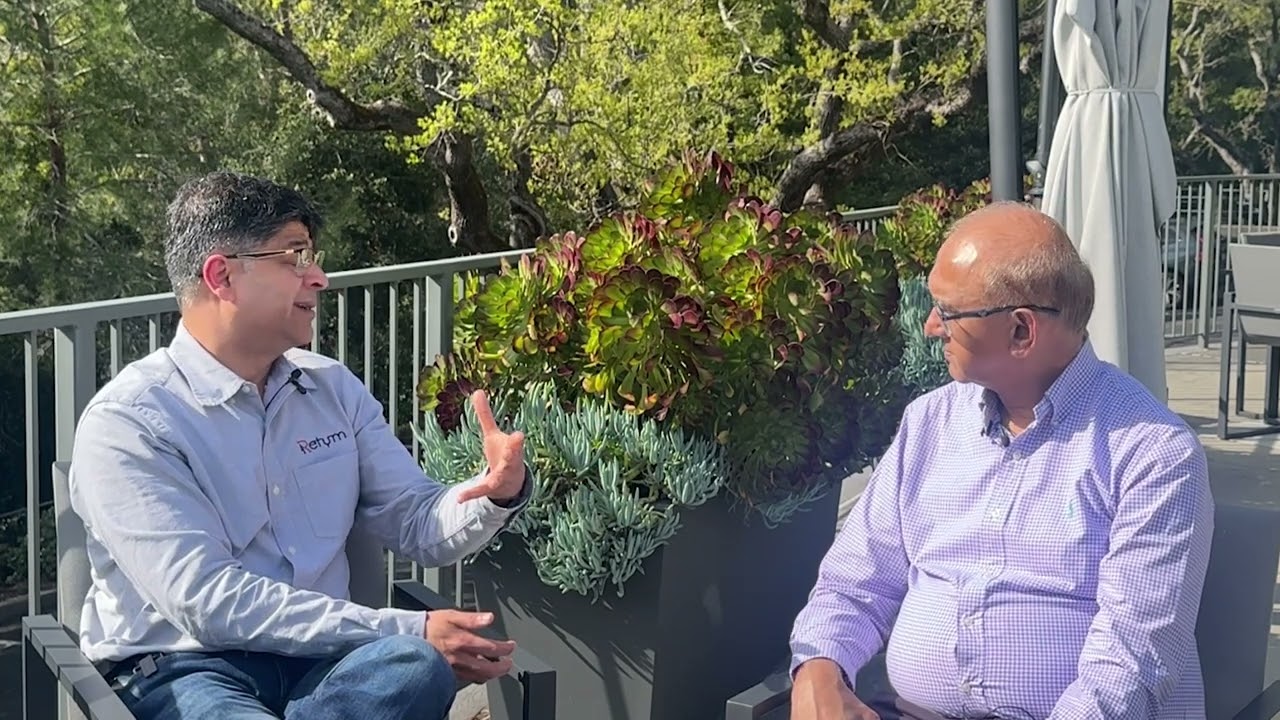
In his OFC 2025 interview with Nitin Dahad, Gandhi discusses Retym’s formation, technology and route to market. The interview setting offers a welcome change from the usual semiconductor imagery: two chairs, daylight and an impressive gathering of succulents. The subject remains the practical business of moving information. Silicon can have a surprisingly pleasant backdrop.
The opportunity between buildings
Retym’s focus is the coherent DSP, a digital signal processor used in optical communications. Think of it as part of the machinery that makes a fast optical link usable. Information has to be transmitted and recovered reliably; the electronics and the optical connection must work together. Retym is developing programmable chips for that job, with power consumption and performance central to its pitch.
The founders also identified a business-model problem. In El-Bahar’s account of Retym’s origins, some established suppliers sold components while competing with the companies buying them. Retym’s answer is to position itself as a neutral DSP provider. A customer building an optical product could buy its chip without taking the same relationship with a supplier that also wants to sell a competing finished product.
That is a concrete commercial argument. “Openness” becomes more interesting when it affects who supplies a part and who competes for the final order. Gandhi’s company is asking equipment and transceiver makers to consider both the chip and the incentives of the organization selling it. For a CEO with experience in engineering, operations and marketing, the proposition brings those previous jobs into one conversation.
process the signals
El-Bahar describes investment in mixed-signal analog design and DSP algorithms, including the converters that bridge digital and analog signals. The technical ambition is system-level efficiency. The commercial ambition is to give customers another supplier. Both have to work: a cooperative business model cannot compensate for a component that fails the engineering requirements, and an effective chip still needs a reason for customers to adopt it.
Four years behind the curtain
Retym emerged from stealth on March 31, 2025. Its announcement put total funding above $180 million, including a $75 million Series D led by Spark Capital. Kleiner Perkins, Mayfield and Fidelity Investments also participated. James Kuklinski of Spark joined the board. The scale of the financing made the public debut substantial, but its stated purpose was distinctly practical: production scaling and continued product development.
Total funding across multiple rounds
Included in the total above
The network around Gandhi includes people familiar with the economics of semiconductor companies. Retym lists Mamoon Hamid, Navin Chaddha, Syed Ali and Kuklinski on its board. Ali’s presence also creates a connection to Gandhi’s Cavium chapter. These are relationships surrounding a specific undertaking: financing and developing communications silicon, then bringing it into customers’ systems.
“We’re excited to collaborate with customers and ecosystem partners to integrate our DSPs into high-speed transceiver designs.”
Sachin Gandhi · March 2025
The telling word in that launch statement is “integrate.” Gandhi’s product has to become part of another product before it can perform its intended role. A transceiver maker’s design, a network operator’s requirements and Retym’s own silicon must meet. The CEO’s task is therefore partly organizational: align the parties whose separate decisions determine whether the connection works.
Getting the next connection to work
Gandhi’s career offers a less theatrical account of entrepreneurship than the customary flash of inspiration. Its recurring activities are assembling teams, managing money, launching products and winning places in customers’ designs. They are specific, demanding jobs. They also explain why his engineering background and his commercial responsibilities belong in the same story.
Retym puts that experience against a problem measured in bandwidth, power and the practical distance between buildings. Gandhi’s aspiration is visible in the business he has chosen to build: make coherent communications more efficient and offer customers an independent source of DSP silicon. The work will be judged where his earlier work was judged, inside a product that someone else depends on. The map may show only a short journey. Getting the information across it is the whole enterprise.