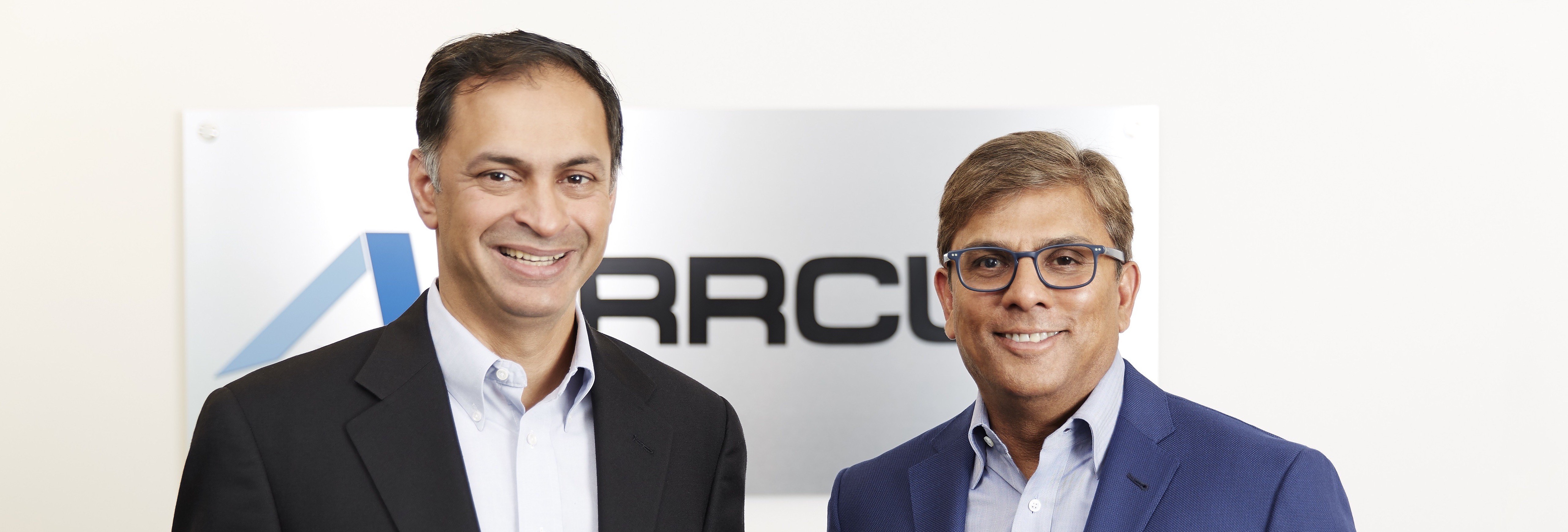
The dog got there first. At the start of a video conversation in 2020, the interviewer’s dog began barking loudly, interrupting a discussion with Arrcus co-founders Devesh Garg and Keyur Patel. Garg welcomed the diversion. “Dogs are good,” he said. “We’re a dog-friendly zone.” Later came photographs of the founders’ own dogs. Garg’s were called Orion and Kato. For a moment, the people building the machinery of connection had a simpler subject to connect over.
The interruption is a useful introduction to Garg. His professional biography runs through semiconductors, venture capital, processors, and network operating systems. It can resemble a map drawn for people who already know the roads. The barking dog supplies a front door. Behind it is someone whose working life has involved repeatedly entering a business from a different direction, then learning what that new position allows him to see.
He helped found Tilera, invested through Bessemer Venture Partners, became president of EZchip, and co-founded Arrcus. Each role changed his relationship with technology. An engineer asks whether something works. An operator has to get it delivered. An investor must decide whether the company can make the opportunity count. Garg has had professional reasons to ask all three questions.
Learning both sides of the desk
His education paired electrical engineering at San Jose State University with an MBA at Santa Clara University. That combination fits the career that followed: technical enough to understand the product, commercially involved enough to care how it reaches a customer. His early work included National Semiconductor, LSI Logic, and Synopsys. He moved from engineering toward the business side, carrying an interest in the meeting point between the two.
Broadcom added the experience of an expanding chip company. Garg joined before its stock-market debut and eventually served as general manager of its security business. The work placed him inside a company selling the components beneath other companies’ products. That position provides a particular education. A chip can be impressive on its own terms while remaining one part of a customer’s much larger problem.
In February 2003, he joined Bessemer. The following year, he co-founded Tilera, whose processors brought multiple computing cores together on a chip. Its technical roots lay in work associated with MIT’s Anant Agarwal. Garg became founding CEO. The company joined an argument about how to get more useful computing from a processor, with networking among the applications that made the question commercially interesting.
His first CEO tenure ended in October 2007. He moved to Mumbai and worked as a Bessemer managing director before returning to lead Tilera, a return publicly announced in January 2012. The sequence gives his résumé an unusual rhythm. He helped start the business, watched it from an investor’s position, then took responsibility for running it again. The return came with a new processor family and customers to serve.
The software problem follows him home
EZchip acquired Tilera in 2014. Garg went on to serve as EZchip’s president; EZchip was subsequently acquired by Mellanox. A processor company had given him another close view of the distance between technical capability and a usable product. That distance would help explain his next move.
After years spent around chips and systems, he wanted to do something entrepreneurial in software. The attraction was practical. Increasingly capable networking components needed software that could make their capabilities useful. Anyone buying infrastructure ultimately needs the whole arrangement to function. A fast component sitting beneath awkward software creates work for the customer. A founder looking for his next business can see an opening in that work.
A mutual acquaintance introduced him to Keyur Patel, then a distinguished engineer at Cisco. Patel brought detailed knowledge of routing and a view of how a modern network operating system should be built. Derek Yeung joined as a co-founder and chief architect. Arrcus began in 2016. The combination put Garg’s operating and business experience alongside engineers who knew the network’s protocols and its practical demands.
The premise was to let customers choose independent network software across supported hardware. In an industry accustomed to buying tightly combined systems, that made the purchase itself part of the product argument. A customer could consider the operating system separately from the box beneath it. Arrcus would still have to build software capable of earning that decision.
Selling freedom by the port
Arrcus emerged from stealth on July 16, 2018, introducing ArcOS and announcing $15 million in Series A financing. General Catalyst led the round, with participation from Clear Ventures. The company’s public debut connected a technical proposition to a familiar business desire: having more control over what you buy and whom you buy it from.
The network operating system is a less visible part of daily computing than the applications on a screen. It helps govern the equipment moving data between places. Arrcus was asking organizations to entrust that work to a new supplier while choosing from supported hardware platforms. That is a demanding introduction. Novelty gets a meeting; dependable operation has to carry the relationship afterward.
Garg explained the appeal of choice in ordinary language: “Fundamentally, in every area of life, we all want choice.” His argument also allowed for different kinds of buyers. Some wanted software alone. Others preferred equipment and software delivered together. Independence could mean giving a customer options about the transaction, as well as about the underlying technology.
“Fundamentally, in every area of life, we all want choice.”
Devesh Garg, 2020
In July 2019, Arrcus announced a $30 million Series B led by Lightspeed Venture Partners. Its reported total funding reached $49 million. Garg said the money would support customers, partnerships, and the reach of ArcOS. Those are less glamorous tasks than announcing a product, though a company’s ability to perform them determines whether the product becomes a business.
The product range widened. In July 2020, Arrcus announced virtualized distributed routing and multi-cloud networking solutions. ArcOS received TechTarget’s Network Innovation Award that February; the company’s multi-cloud networking work received a BIG Innovation Award in January 2021. The milestones describe a young supplier extending its responsibilities across more of a customer’s infrastructure.
There is a useful tension here. A company selling freedom to choose becomes one more supplier the customer must evaluate. The software needs to justify its place through performance, compatibility, support, and cost. Garg’s business case depended on those practical considerations. The freedom had to survive the procurement meeting and the working week.
A company is also a hiring decision
Garg’s account of early hiring gives the story a more intimate scale. The founders deliberately sought people whose abilities were already known through previous work. He described roughly the first 30 hires as handpicked. Experience supplied names to call, an understanding of their strengths, and some basis for judging whether they could build together.
His emphasis extended to collaboration. Technical depth mattered, and so did the way a person approached a team. He described personally interviewing incoming employees and treating a job offer as a decision with two participants. A candidate was choosing the company, too. It is an obvious point that can vanish remarkably quickly when a business starts describing people as resources.
He also gave the administrative beginnings of a startup their due: incorporation, legal advice, governance, a name, a domain. A company aspiring to alter an industry still has to fill in the forms. This attention to the ordinary is part of the attraction of his account. The operating work includes the things that rarely make a launch announcement, yet have to be correct before the announcement can matter.
His advice about a career was similarly incremental. He described seeking unfamiliar situations and learning through the responsibilities in front of him, rather than following a fully drawn plan. Read against his moves between companies and countries, that explanation has some weight. The chronology offers plenty of changes of direction without requiring a retrospective claim that every turn was inevitable.
The chair changes hands
On September 15, 2021, Arrcus appointed former VMware executive Shekar Ayyar as CEO and chairman. The announcement also introduced new strategic investors and its Arrcus Connected Edge vision. Garg’s tenure as the company’s founding CEO had ended. Reporting the following month described him as a shareholder and advisor.
The change belongs in a portrait of a founder. Starting a company and leading every subsequent stage are different responsibilities, and a business can acquire a new chapter while retaining the work of its earlier one. Arrcus continued under Ayyar. Garg’s public professional profile now lists a stealth startup, another move in a career already familiar with beginnings.
There was also a return to formal learning. His LinkedIn profile lists Stanford’s Executive Program for 2024-2025, and a classmate’s graduation post included him among the cohort. Decades after the engineering degree and MBA, the classroom had re-entered the itinerary.
Outside work, his public biography describes a sports enthusiast and adventure traveler who trekked to Everest base camp and explored more than 40 countries with his family. The details provide a welcome change of scenery after all those routers. They also belong beside Orion and Kato in a portrait that allows room beyond the boardroom.
The connecting thread is his willingness to change position: from the component to the system, from investing to operating, from an established role to a new venture. Each move brought a fresh set of obligations. The Arrcus years show what can happen when accumulated experience finds a specific problem and the people equipped to work on it. The dog, meanwhile, had needed no introduction at all.
Keep the conversation going
- Devesh Garg on LinkedIn
- Arrcus company website
- Garg’s launch-day essay
- The co-founders in conversation
- Watch: Devesh Garg and Steve Herrod on theCUBE (YouTube)
- Career and startup video interview
- The Cloudcast: The Rapidly Evolving Network
- The 2021 leadership announcement
- The ArcOS innovation interview