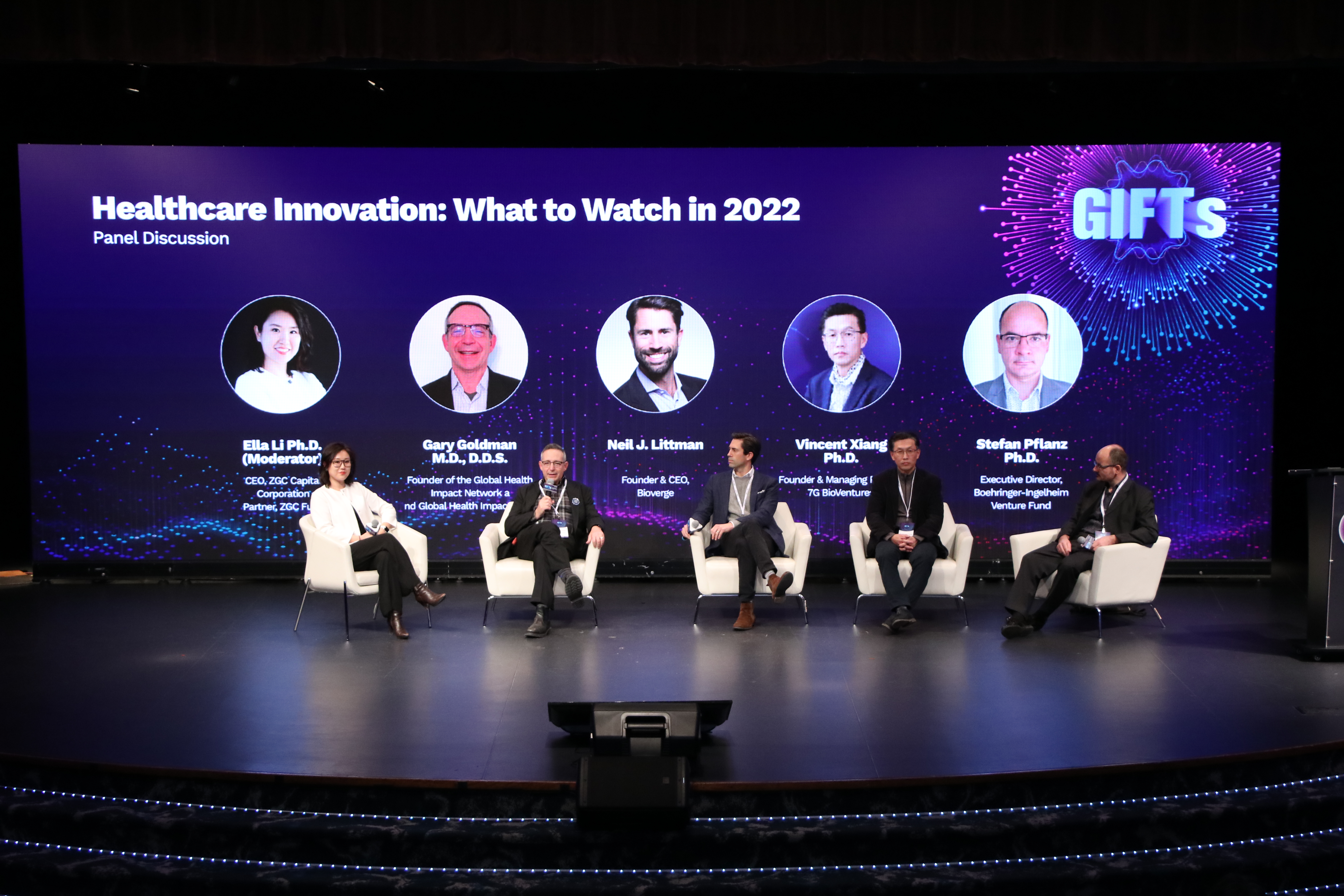
Five people sit in white chairs beneath a screen announcing “Healthcare Innovation: What to Watch in 2022.” The moderator is Ella Li, identified on the backdrop as ZGC Capital Corporation’s CEO. Beside her are investors whose organizations include a healthcare network, Bioverge and a pharmaceutical venture fund. The photograph offers a compact explanation of ZGC’s proposition: arrange the people, supply the setting, make a useful conversation possible.
- ZGC combines venture investing with workspace, startup support and events.
- Its U.S. story runs through Silicon Valley and Boston-Cambridge.
- Healthcare programming shows what specialized access can offer founders.
The interesting question is what happens after everyone gets up from those chairs. An introduction might become an investment, a partnership or an answer to a technical problem. It might also become another business card. ZGC’s business sits inside that uncertainty. Its innovation-center model makes a wager that repeated encounters, organized in the right place, can help technology become a business.
The address is part of the product
ZGC Capital began in 2014 as a U.S. subsidiary of Zhongguancun Development Group, the Beijing municipal government-backed organization. Its Silicon Valley innovation center opened in May 2016. C.M. Capital was a co-builder. Boston-Cambridge followed in 2018. These were deliberate locations: places where researchers, entrepreneurs and investors already had reasons to be.
Think of the offering as several businesses sharing a front door. There is venture investment, including direct investments and participation in funds. There are offices and coworking spaces. There are events, incubation and cross-border services. A 2017 Bay Area Council Economic Institute report described consulting and public relations among those services. Public investor profiles place its startup activity across seed, Series A and Series B.
“Local Hotspots, Global Networks”
ZGC Capital’s company tagline
The audience is broader than founders seeking checks. Investors need companies to meet. International organizations need local contacts. A startup entering another market needs people who understand how business gets done there. ZGC offers an environment in which those needs can overlap. The company’s real estate makes the proposition tangible; the quality of the connections determines whether it is useful.
Healthcare needs a different guest list
Healthcare gives this model a sharper purpose. A founder may need help understanding a clinical use case before an investor meeting becomes productive. The person who can evaluate the science and the person who can write a check may ask different questions. Bringing both into a program can expose a weak assumption earlier.
In 2021, ZGC promoted MedLabs, a three-month healthcare accelerator. Its advertised package included mentorship, workshops, clinical connections, private investor meetings and workspace. Global Health Impact Network & Fund was named as a co-builder. The offer paired business development with access to people who understood healthcare practice.
Advertised investment opportunity from Global Health Impact Fund for the most promising company after Demo Day. Selective funding, subject to selection.
That detail changes how a founder should read an accelerator advertisement. The funding opportunity belonged to a selection process; participation itself was no promise of a check. The immediate value had to come from the work: testing the pitch, finding a relevant expert and learning whether the business deserved further backing.
Li’s scientific background helps explain the emphasis. Her 2021 RESI conference biography describes biotech research experience, a doctorate from the University of Texas Health Science Center and postdoctoral work at Harvard Medical School. It also identifies her as a founding partner of MedLabs. Those credentials connect the investment conversation to the laboratory, where a promising claim still has to survive examination.
The network learns to travel
Community at ZGC also had a less solemn side. Its February 2021 Lunar New Year program mixed investor discussions and startup pitches with lucky draws. The company explicitly moved the gathering online in response to COVID-19. A recurring social occasion became a Zoom event without losing its mix of business and celebration.
By December, ZGC was hosting GIFTs at the Santa Clara Convention Center with an online audience too. Its retrospective reported more than 700 people attending or watching. The format illustrated a practical adjustment: a network built around physical places could distribute a conversation beyond the room. That figure measures participation, however, rather than investments or commercial results.
A building keeps its own score
The physical model brought financial exposure. A December 2022 Massachusetts court order records rent default by ZGC Boston Innovation Management LLC. The landlord sought recovery from its parent, ZGC Capital. The court allowed an amended judgment-enforcement claim to proceed and denied two other lease claims. The ruling did not finally establish parent liability.
The broader business lesson is straightforward: property obligations continue while introductions take time to produce results. A useful network and a workable building are separate operating challenges. Their combination needs attention to both. This is an interpretation of the model’s economics, rather than a claim about what caused the Boston default.
Copy the introduction, question the overhead
ZGC occupies the territory where venture investment meets accelerator support and workspace. Founders can compare different parts of its proposition with accelerators such as Techstars or Entrepreneurs First, startup networks such as Plug and Play, or a local coworking operator. The useful comparison depends on the problem a founder needs solved.
The copyable idea is to organize around that problem. Name the next uncertainty. Find the person qualified to challenge it. Arrange a conversation with a specific purpose and follow through. A network has less to offer when its participants are irrelevant, when nobody acts afterward, or when geography contributes little. Before paying for proximity, a founder should know which conversation is worth having.
Keep the conversation going
Company website ↗ · LinkedIn ↗ · YouTube channel ↗
Listen: Ella Li on precision medicine ↗
Read: the company’s GIFTs retrospective ↗