Before a scientist can test a promising idea, someone has to arrange the freezer. Then come the equipment orders, the safety arrangements and the lease. A company can have a compelling hypothesis and still spend its opening months becoming a competent buyer of laboratory furniture. Scientific ambition has a surprisingly domestic side.
- Rent a shared bench, a private lab or an office built for science.
- Three campuses serve biotech, healthtech and precision industry.
- 137 resident companies were reported at the end of 2025.
- Choose by time to first experiment, total cost and room to expand.
Switzerland Innovation Park Basel Area has built a business around that interval between an idea and a usable workplace. Six months is quite a long time to pay scientists to wait.
“Six months are a realistic time frame for setting up even a basic lab”
Cüneyt Kilic, facilities head · BaseLaunch, 2018
01 The bench comes before the building
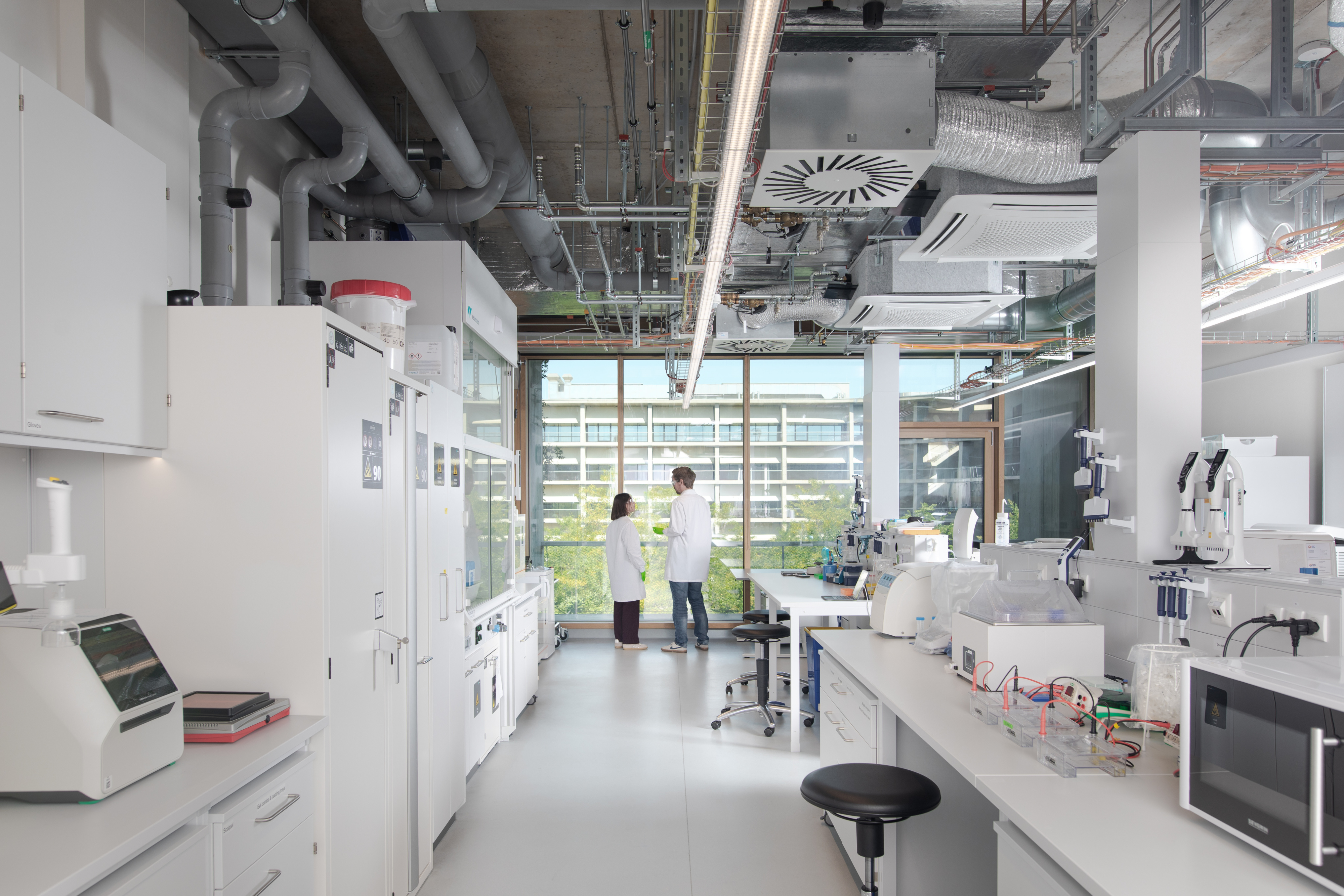
The Main Campus in Allschwil offers a dedicated bench inside a shared laboratory. Residents get allocated storage and access to instruments, maintenance and supporting infrastructure. The distinction matters: your workspace is yours; expensive equipment can serve several companies. The arrangement lets a small team begin without purchasing an entire laboratory’s worth of machinery.
The current shared-lab offer includes BSL-1 laboratory space, BSL-2 cell culture facilities and cold storage down to -80°C. That makes the park useful to university spin-offs and early biotech teams doing experimental work. It also gives founders a less glamorous advantage: fewer facilities decisions competing with the science for their attention.
02 What the head start costs
A May 2023 brochure listed a shared lab at CHF 2,300 per person per month, excluding VAT. That is a historical price, subject to change. Its value lies in making the comparison concrete: a recurring fee versus equipment purchases, installation work and a lease sized for a future company that may take longer to arrive.
Shared lab · excluding VAT · current quote required
The business model combines workspace rental and services with public ownership and private property development. Basel-Landschaft, Basel-Stadt and Jura own the legal company equally. Basel Area Business & Innovation operates the park; SENN and other property investors provide additional campus space. Calling it a biotech company would miss the point. It supplies the conditions in which biotech companies can work.
03 Success used to mean moving out
The first shared-lab tenants began work in May 2018. Within the following year, Skyhawk Therapeutics, Versameb and Polyneuron had grown beyond the shared setup and were moving into their own labs at Tech Park Basel. The early account is instructive: the constraint was capacity as teams expanded. A useful incubator must expect its residents to become inconveniently large.
Today, the park offers furnished private labs and custom spaces alongside shared benches. ALLabs, advertised for January 2027, adds another option: private units of 25 or 40 square metres with essential equipment already installed. These are different choices for different workflows. A founder can ask for more independence without assuming that every instrument must be bought immediately.
ALLabs adds pre-equipped private units, planned for January 2027.
04 A buyer, then a space problem
T3 Pharma makes the expansion question tangible. The University of Basel spin-out developed a platform using engineered bacteria to deliver therapeutic proteins. Boehringer Ingelheim announced its acquisition in November 2023 for up to CHF 450 million. That money concerned a resident company, not the park’s finances.
The park’s subsequent T3 account describes the practical response to rapid growth: ready-to-use furnished labs alongside space tailored to longer-term needs. Urgency and customization rarely keep the same calendar. Having both options gave the team a way to expand while continuing work. It is an operational example, rather than proof that an address caused an acquisition.
05 Three campuses, three kinds of neighbour
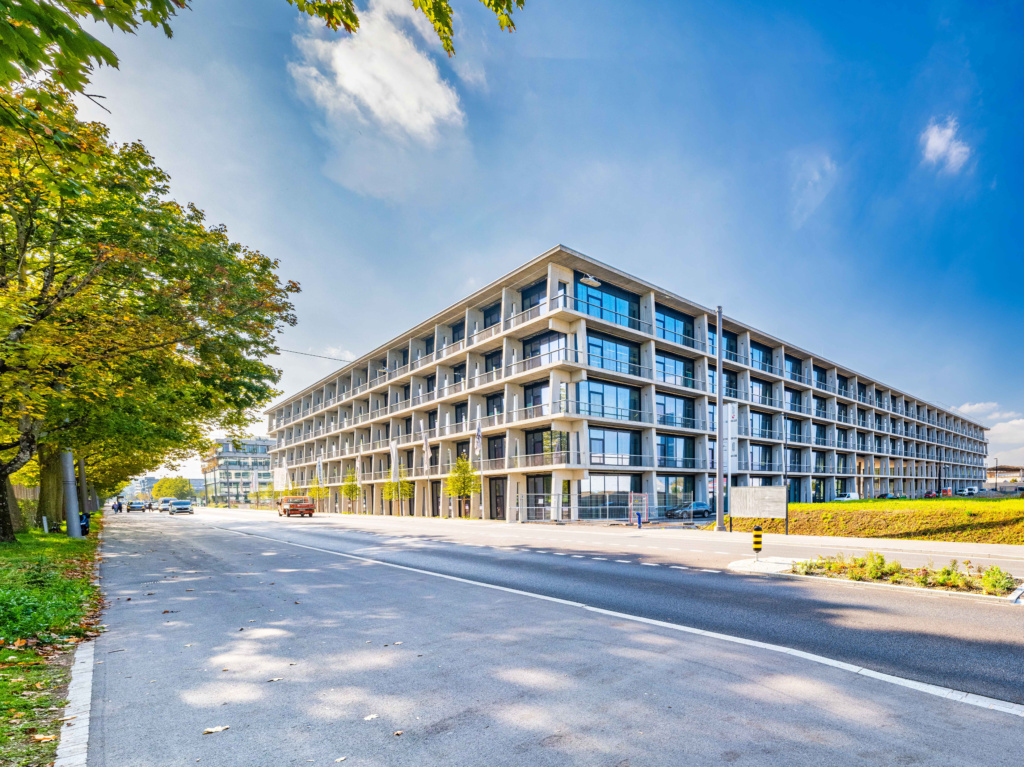
Allschwil concentrates laboratory-based life sciences. Novartis Campus puts healthtech teams into offices and coworking space within a pharmaceutical campus. The attraction is proximity to people working on related problems. It still takes an introduction, a useful proposal and someone else’s agreement to turn proximity into business.
In Courroux, Jura Campus draws on a different inheritance: watchmaking and precision manufacturing. Its workspace and prototyping facilities serve medtech suppliers, startups and industrial SMEs. The park’s expertise consequently extends beyond wet-lab operations to community management and matching teams with appropriate facilities and support. One campus’s useful neighbour might be another campus’s irrelevant one.
06 More companies does not mean every room is full
The 2025 annual report counted 137 resident companies, compared with 53 in 2020. It also recorded occupancy of 88% in directly operated Allschwil space, 62% at Novartis Campus and about 60% in Jura. Growth has a geography. More names on a directory do not necessarily fill every square metre.
Across the park’s sites. Company counts measure presence, not commercial outcomes.
Dufourstrasse coworking closed in April 2025, leaving Novartis Campus as the park’s Basel-Stadt location. Meanwhile, HORTUS opened in June with timber-clay construction and a planted courtyard. These changes show a property operation adjusting its footprint while adding buildings. The report also acknowledged difficult startup financing conditions. A fitted lab can save setup work; it cannot settle an investor’s doubts.
07 Ask about the experiment, then the rent
The copyable lesson is specific: equip shared infrastructure with early residents’ input, as the park did, and let teams pay for the capacity they need. Compare the date of the first usable experiment, the full operating bill and the cost of expansion. Tech Park Basel remains a local alternative; an academic lab or private lease may fit other teams better.
A founder should bring a workflow to the viewing, not merely a headcount. Check biosafety requirements, instrument availability, confidentiality and who handles maintenance. For ALLabs, proximity to the Botnar Institute of Immune Engineering does not automatically include access to its facilities. The best address is the one where the actual work fits. Even a handsome building needs to pass that rather unromantic test.