A biotech company can have a promising experiment and still be short of almost everything needed to build a business. A clinical collaborator. A manufacturing partner. Someone who understands the funding application. Someone willing to read the investor presentation before an investor does. Lyonbiopôle Auvergne-Rhône-Alpes has made that crowded space between discovery and delivery its working territory.
The French health competitiveness cluster organizes introductions, reviews projects and helps companies navigate public and private financing. Its member directory runs across therapeutics, diagnostics, medical devices and digital health. The proposition is practical: put people with different pieces of the development puzzle within reach of one another, then help them assemble a project worth pursuing.
For a scientist-founder, this can sound less exciting than another laboratory breakthrough. It can also be the work that makes the next experiment possible. Lyonbiopôle’s story turns on how much a regional network can accomplish - and how clearly it can explain the value of belonging.
First, get the right people in the room
Lyonbiopôle was created in 2005, during France’s push to establish competitiveness clusters linking industry and research. Its early industrial founders included Sanofi Pasteur, bioMérieux, Merial and Becton Dickinson. Infectious diseases gave the undertaking an organizing subject, with human vaccines, animal health and diagnostics already represented around the table.
That starting combination matters. The contemporary interest in “One Health”, connecting human, animal and environmental health, has a recognizable antecedent here. The founding industrial base already crossed the human-animal boundary. By 2014, Lyonbiopôle was publicly describing a broader remit that included cancer, nutrition, metabolic diseases and neuroscience.
Infrastructure was part of that earlier ambition. Accinov was promoted in 2014 as a biomanufacturing innovation platform backed by $25 million from the French state and local authorities. The history helps explain why manufacturing and industrial development remain part of the cluster’s vocabulary, alongside research partnerships.
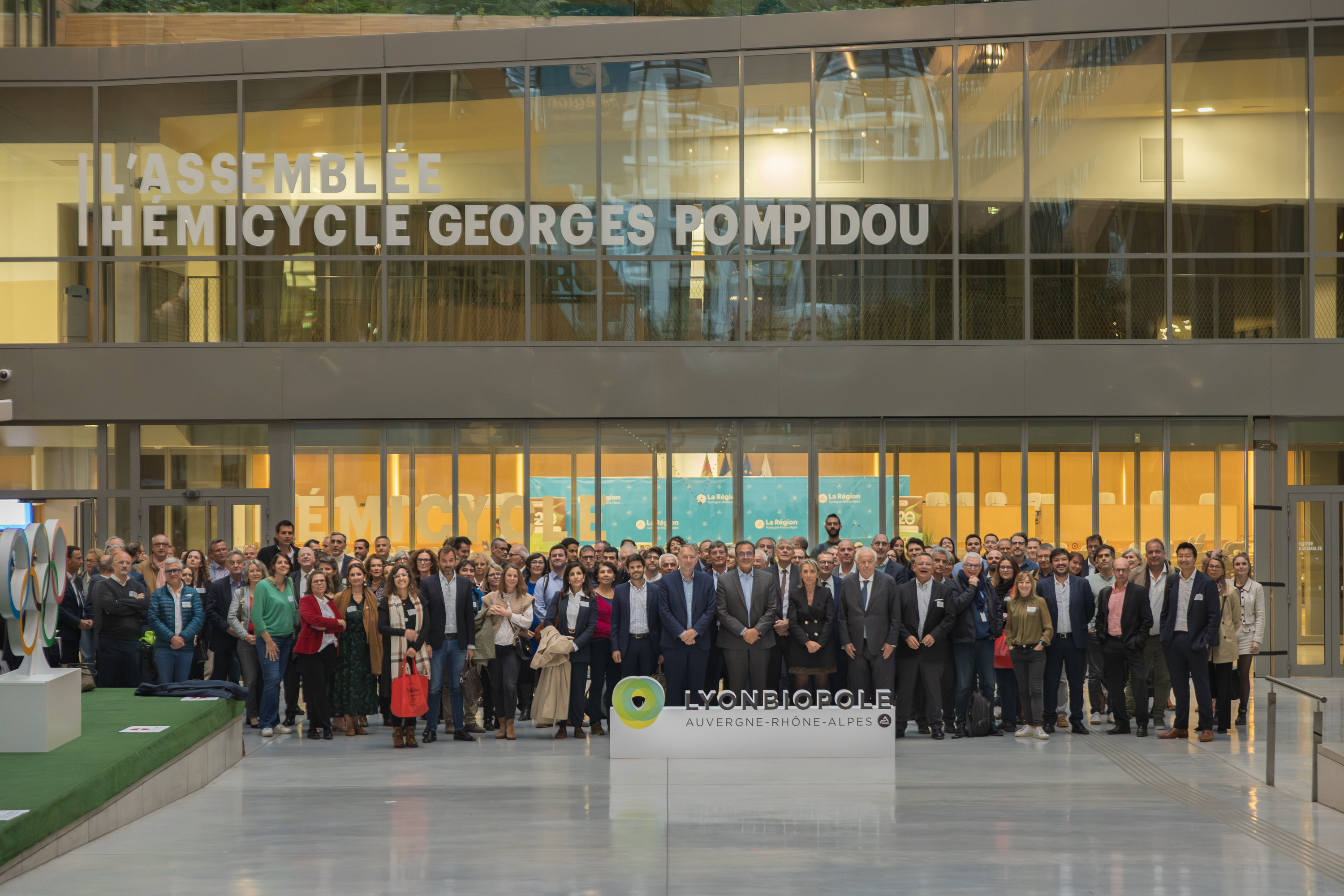
Today’s customer base is best understood as a membership community. Lyonbiopôle reported 236 members for 2025, including 181 SMEs, 23 large and mid-sized companies, research and training centres, and care and research establishments. Those members have different purchasing power and different needs. A young company may want funding guidance; an established industrial business may want access to an emerging technology.
A grant application has a calendar
The cluster’s project-support offer is unusually helpful in one respect: it puts a timetable around preparation. Maturation belongs two to four months before submission. Formalizing and strengthening the application belongs two to six weeks before the deadline. Communication continues during the project itself.
The sequence gives a founder something to copy immediately. Start with the funding programme and the project’s fit. Work out the missing capabilities and partners. Then strengthen the application. Waiting until a deadline appears in bold red type leaves less room to repair the underlying project.
There is a formal review mechanism, too. GTECH, Lyonbiopôle’s technical group, combines independent experts from industry and public laboratories. It examines projects seeking the cluster’s label and offers recommendations to improve their applications. This is a place to have a proposal challenged before it reaches a funding agency.
The label belongs within a larger funding process. France’s public digital-health guidance describes cluster labelling as an additional selection criterion in many public R&D calls. The funder still makes its decision. The useful service is a better-prepared application and access to relevant expertise; the scientific and commercial case must survive scrutiny.
The 2024 results show the breadth of this work. Lyonbiopôle reported supporting 185 R&D projects, including 38 European projects, with three successes in Horizon Europe. A Sanofi R&D Day brought together 150 participants and 26 external public and private organizations around possible vaccine partnerships. These are different kinds of intervention: one strengthens a funding bid; another lets researchers and companies investigate whether they have something useful to do together.
The price of admission is public
Standard membership requires health-related R&D, manufacturing or training activity in Auvergne-Rhône-Alpes. The published 2026 tariff makes room for very young companies: a business with fewer than 10 employees pays nothing in its first year of existence, €510 in its second and third years, and €970 from its fourth year. All figures exclude VAT.
A company with 10 to 49 employees pays €1,750. Associate membership, intended for organizations with a health interest but without regional health R&D, costs €15,000 and requires board approval. A consultancy or bank therefore enters through a different arrangement from a small biotech conducting research locally.
Membership is one part of the economics. Some project-support arrangements have a contract and success-based application fees. The published terms of the prevention innovation call make that explicit. A company assessing the offer should distinguish the annual subscription from the terms of a particular project or programme.
Planned 2026 budget
A Métropole de Lyon document puts the cluster’s forecast 2026 budget at €3,081,500. It includes approximately €1.38 million in subsidies, alongside member dues, founder contributions, services and other receipts. This is the machinery’s own spending plan. Separately, member companies raised €153.8 million from private investors in 2025. Keeping those figures apart is essential to understanding what the organization does.
Business help, with recurring appointments
Lyonbiopôle’s growth services include strategy and financing discussions, investor-pitch preparation and introductions to potential commercial partners. Its open-innovation programme starts with the requirements of large industrial groups and looks for relevant capabilities among startups, SMEs and laboratories. The match needs a technical reason to exist.
The offer also includes first-level guidance on intellectual property, market access, medical-device CE marking and entry into biotech clinical trials. For a small management team, identifying the next specialist it needs can be a useful service in itself.
The more intensive Programme d’Accélération Santé runs for 24 months. The 2026-2027 call invited five companies to receive tailored support, beginning with a jointly constructed roadmap and initial training. Monthly and quarterly reviews create repeated occasions to examine progress, ask awkward questions and organize specialist help.
“Supportive but demanding.”Lyonbiopôle’s description of its acceleration team, translated from French
That description is more useful than a promise to transform a company. A programme with recurring appointments asks managers to return to the same milestones after the introductory enthusiasm has faded. Lyonbiopôle also describes task-specific working groups and consulting sessions, with regional support available for selected companies’ outside services.
The international offer follows a similar logic. Its International Technology Partnership Programme helps businesses identify overseas partners for co-development, co-marketing or distribution, combining technical assistance with financial support. The broader bioXclusters alliance connects Lyonbiopôle with Biocat in Catalonia, BioM in Bavaria and BioPmed in Piedmont, with personalized medicine as a shared focus.
The network has to earn its place
There is visible pressure behind the activity. The cluster’s February 2026 review reported a 6 percent membership decline in 2025 despite 33 new arrivals. It linked the decline to economic strain, particularly among SMEs. Private fundraising by members was roughly stable against 2024 but remained well below earlier years.
Another pressure appeared in Grenoble’s June 2025 metropolitan deliberations. The document proposed not renewing support for Lyonbiopôle, citing constrained budgets, a focus on local organizations and the presence of Medicalps in the local health sector. That is a concrete illustration of the question any publicly supported network faces: does another organization already provide the service nearby?
Geography helps distinguish the alternatives. Medicen Paris Region, Eurobiomed and BioValley France serve other regional health communities. They also joined Lyonbiopôle in creating Enosis Santé in 2022. The same organizations can be comparable service providers and partners in national coordination. A company choosing support should begin with its location and specific need.
The national alliance gives that cooperation a formal home. Enosis Santé describes its role as connecting regional initiatives with national strategic sectors and contributing to France’s Health Innovation 2030 plan. For Lyonbiopôle, the arrangement extends its reach beyond one region while preserving its local relationships. That combination is part of the appeal for businesses whose research team is regional but whose prospective partners are spread across the country.
The model has limits that follow from its purpose. A connection cannot supply missing experimental evidence. A prepared pitch cannot compel an investor to invest. An organization outside the regional membership criteria needs another route in. The value increases when a company can name its immediate problem and commit time to resolving it.
The next door is commercial
Under president Erick Lelouche and chief executive Teddy Breyton, Lyonbiopôle began a strategic review in 2025. The resulting roadmap, published in June 2026, drew on regional workshops, member consultations and comparisons with European clusters. The reported needs included entrepreneurial development, financing, regulatory and commercial expertise, and stronger connections between companies and clinicians.
The response includes a proposed shared business-development capability for innovative SMEs, technologies maturing in laboratories and clinical expertise. It also calls for refreshed services and continued studies for a Biotech/Techbio innovation centre. These are announced workstreams; their practical value will depend on execution.
For a prospective member, the useful move is to arrive with a short, concrete brief: the next milestone, the missing expertise, the intended partner and the deadline. Ask which service fits that brief and what participation requires. Lyonbiopôle’s own preparation calendar makes the case for having that conversation early.
Twenty years of convening people creates a substantial contact book. The harder job is making the next introduction useful. Lyonbiopôle’s commercial emphasis puts that test close to the centre of its new strategy: help a promising piece of science find the people who can take it further.