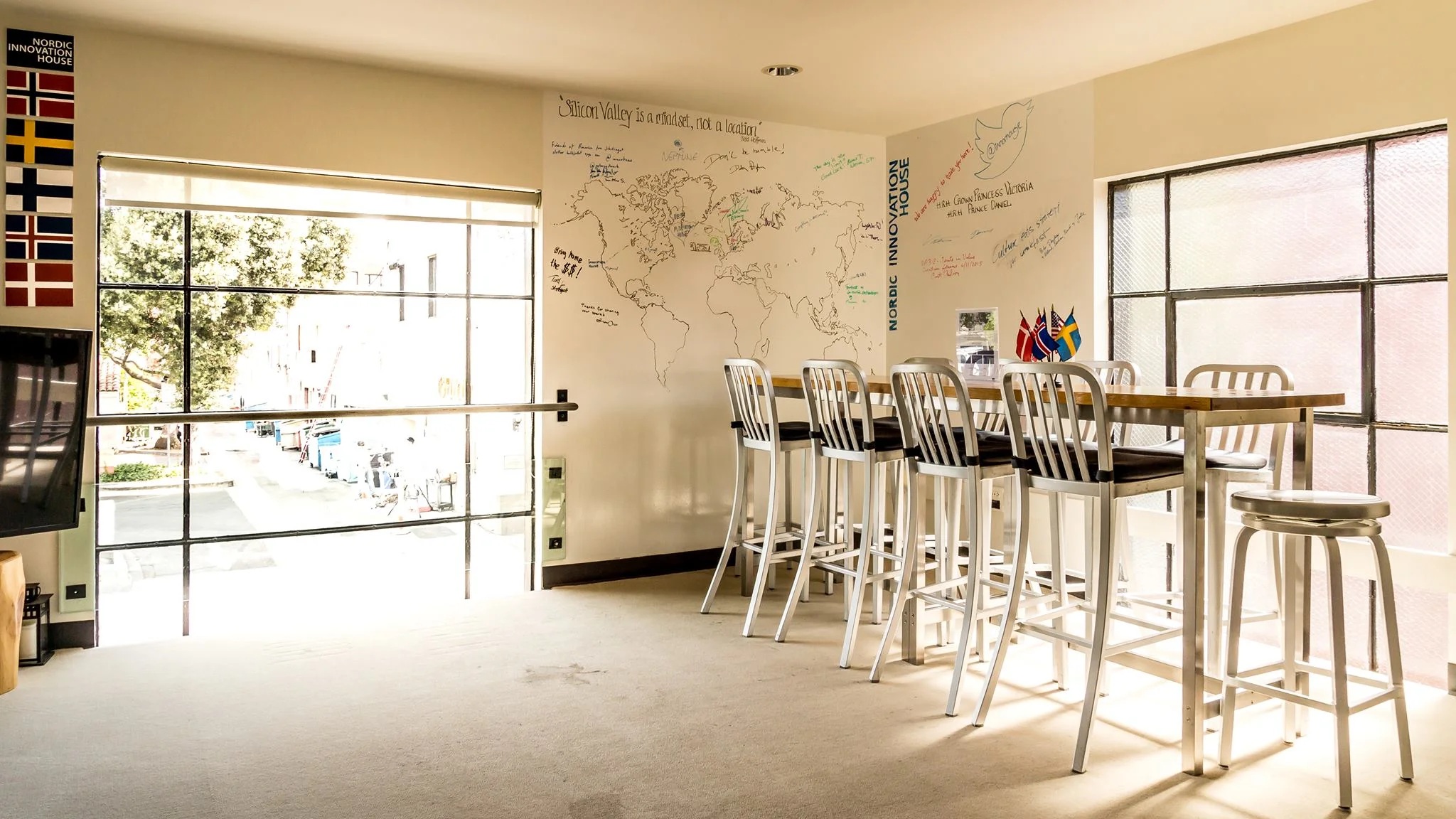
The wall is crowded with company logos. Below it, people sit shoulder to shoulder, facing something outside the photograph. At Nordic Innovation House in Palo Alto, the scene contains a useful distinction: a collection of businesses becomes a community only when people start paying attention to one another. The address gets founders into California. The conversations help them decide what to do there.
- A shared Nordic base for US market entry, with workspace and introductions.
- TINC tests startup market fit; REACH helps research teams find a commercial path.
- Fees buy access and structured work. Founders still have to win the customers.
Norway had a Silicon Valley presence in 2011. In September 2014, it became a wider Nordic undertaking, backed by agencies from Denmark, Finland, Iceland, Norway and Sweden alongside Nordic Innovation. Pooling a foothold gave companies from several small markets a common place to begin. The interesting product was access: to people, local knowledge and the working habits of an unfamiliar market.

An address, with different levels of ambition
The House serves technology startups, scaleups and corporate teams, alongside universities, investors and incubators. Nordic Innovation reported about 140 Silicon Valley members in July 2022, including Controlant, Einride and Kahoot. That historical snapshot captures the range: companies with different products and very different reasons to be in the same room.
Membership makes the practical offer tangible. The published virtual plan costs $1,950 per company annually and allows workspace use for up to five days a month. Daily hot-desk access costs $7,800 per person annually. Mail handling, meeting space and community access turn an overseas visit into something more organized than a succession of coffee appointments.
In market terms, the House sits between a coworking operator, an export-support service and a startup accelerator. Its particular proposition is the combination of a Nordic constituency, public institutional connections and local relationships. A commercial desk rental answers where to work. A specialist founder network such as Silicon Vikings offers another route into relationships. The House bundles several needs together.
The first thing to question is the pitch
TINC, operated by Innovation Norway with Vinnova, Business Finland and KLAK Icelandic Startups, is the more concentrated intervention. Its current page describes a six-week hybrid accelerator and reports 278 Nordic technology companies across 29 programs. Those are participation numbers, useful for understanding experience rather than predicting any particular founder’s outcome.
A 2021 account explains an easily missed obstacle. Founders often arrived talking about technology features. Coaching pushed them toward a concise account of customer need and evidence of traction. Nathan Gold helped teams practice telling that story in under three minutes. Sales work examined repeatable processes; growth sessions asked which metrics actually mattered.
The mentoring design also deserves attention. In 2022, TINC described working repeatedly with a small group of committed core mentors. Continuity lets an adviser understand the company before proposing changes. A founder can return with the results of an experiment, rather than spend the next meeting explaining the business all over again.
An editorial reading of the programs’ customer-discovery approach.
Then the journey itself stopped working
In 2020, the pandemic interrupted the assumption that acceleration required bringing everyone to California. TINC went fully online with nine companies. Organizers worried about losing the relationships that physical proximity made possible. Their retrospective describes a compensating advantage: founders could run their businesses during the day and try workshop ideas as they learned them.
“We have a focus and a way forward with a much better business model than we started with”
Rocsole, in the House’s 2020 TINC retrospective
Participant feedback helped change the organizers’ view of remote preparation. Another virtual cohort followed in spring 2021. By autumn 2026, the published format combines online sessions with a Silicon Valley visit. The lesson is copyable: do the preparation while operating the company, then use the expensive trip for conversations that benefit from being together.
Research needs a different runway
REACH addresses an earlier commercial question: what should a technically validated research project become? Its six-month program combines workshops, mentoring and meetings with potential customers, partners and investors. Teams can join before or after company formation. The 2026–27 edition lists a $16,000 fee for two attendees, excluding travel and accommodation.
This is a budget for learning, with substantial demands on time. TINC expects at least a prototype or MVP, basic financing and the ability to follow through. REACH asks for active, coachable teams. A founder without that capacity risks collecting advice they cannot use. For a company whose buyers sit elsewhere, California may also be the wrong place to concentrate discovery.
The next customer is a real school
An October 2026 member spotlight makes the market-entry problem concrete. House of Math, led by Norwegian founder Vibeke Gwendoline Fængsrud, is preparing an initial LaunchED rollout involving 3,300 students in the 2026–27 school year. The planned work gives the education company an opportunity to document engagement, progress and efficacy in American classrooms.
That is a member’s commercial initiative, not a result to attribute automatically to the House. It illustrates what comes after introductions: a specific partner, an initial deployment and evidence to gather. Bifrost Summit, launched in 2022, supplies a broader meeting ground for entrepreneurs and researchers. The eventual test still happens in someone’s business.
The House has homework too
Nordic Innovation’s 2026–27 business-development project calls for clearer services, improved governance and a sustainable business model for the Silicon Valley platform. It proposes a stronger role enabling shared Nordic initiatives. The House is confronting the same question it puts to founders: what exactly is the offer, who values it, and how does it keep working?
For founders, the practical takeaway is to arrive with a question that another market can answer. Use the desk to get organized. Use the mentors to design a test. Then spend the introduction finding out whether someone will buy.