In xEdu’s meeting room, the world had stopped somewhere in the 1970s. A map from that decade hung on the wall. Antti Korhonen had a reason for keeping it there: people could get stuck with the knowledge and teaching methods of their own schooldays. The old geography was a reminder that the world had moved on.
This was in 2018, at the Fontell villa in Helsinki, an Art Nouveau building tucked among university premises. The setting supplied a pleasing contradiction. Here was a business devoted to education’s future, conducting its affairs in an old house with an older view of the planet. The map was doing useful work. Office decoration rarely earns its keep so efficiently.
Korhonen is the CEO and co-founder of xEdu, the education accelerator established in 2015. His work occupies the space between a promising learning product and the awkward business of getting it used. There are teachers to consult, founders to coach, partners to find and markets to understand. A product can be finished long before its journey is.
A short walk to a different kind of expert
xEdu began next to the University of Helsinki’s Department of Teacher Education, on Siltavuorenpenger. That address was part of the design. Researchers and teachers could help developers decide whether an educational product would actually help someone learn. The distance between a programmer and a classroom had been reduced to a manageable walk.
The launch brought university researchers into the programme from the beginning. More than a hundred applications arrived, covering everything from language apps to learning platforms. The work required testing and designing products with teachers and pupils. A developer’s understanding of a problem would have to survive contact with the people experiencing it.
The arrangement helps explain Korhonen’s particular place in education. He brings a business background that includes Nokia and earlier chief executive roles. His specialties include business development, strategy, networking and competence development. He holds an MQ in Quality Management from Helsinki University of Technology. These are the credentials of someone concerned with how organisations work and improve.
Placed beside teacher education, that experience acquired a different set of questions. Who needs the product? What changes when someone uses it? Can a school adopt it? Can the company support the school afterwards? Each question concerns a different participant. The founder needs a conversation that can move between them without losing the original learning problem.
Three subjects on the timetable
In 2015, programme director Niko Lindholm set out three connected areas for xEdu: business, technology and pedagogy. Commercial mentors would help teams build their companies. Educational experts would help them improve the learning value of their products. Teachers would take part in developing and testing them.
That combination makes an accelerator in education an unusual classroom. The pupils arrive with companies. Their homework may include revising a sales argument, reconsidering a product feature or discovering that a teacher’s priorities differ from their own. An elegant technical solution still has to earn a place in somebody else’s working day.
Korhonen’s personal role becomes clearer through a particular company. 3DBear took part in xEdu’s autumn 2016 programme. In November 2017, the startup announced more than €1 million in seed funding, with investors including New York’s Rethink Education. It had also been developing its products with schools in Finland and the United States.
3DBear CEO Kristo Lehtonen credited Korhonen’s personal effort, alongside xEdu’s help, with enabling the company’s US start and investment round. That is a concrete description of the work behind an accelerator’s broad vocabulary. An introduction, a connection and sustained help can become part of a company’s route into another country. The founder still has to build the business.
A catalyst has its own bills
“We have the catalyst role,” Korhonen said in 2019. He put the final responsibility with entrepreneurs and their teams. He also credited Lindholm with helping bring xEdu into existence and recalled that its programme director had become the first salaried employee before he himself did.
There is a practical modesty in that account. The accelerator can arrange conditions for progress; the companies have to make use of them. It also has to sustain itself. Korhonen described the difficulty of finding partners and services that brought in cash while any returns from startup stakes lay much further away.
That tension gives his job two clocks. One follows the founders’ immediate needs: a product decision, a meeting, the next stage of development. The other follows the organisation that makes those opportunities possible. An accelerator cannot pay today’s expenses with the possibility that someone may eventually build a valuable company. Patience still requires a budget.
“We have the catalyst role.”
Antti Korhonen · 2019
Following the missing money
Korhonen’s career also took him into the funding problem itself. In 2020, he was a partner at Sparkmind, the education investment firm whose fund announced a €40 million first close. He had begun meeting interested investors in 2017, after xEdu companies presented at a conference organised by the Finnish Innovation Fund, Sitra.
The fund’s backers included Tesi and KRR III. Its first investment was in Fuzu, a Helsinki company providing career-focused training for adult learners in East Africa. Tesi’s account later in 2020 listed Korhonen with fellow partners Marko Kyyrönen, Kai Talas and Vesa Laakso. The investor relationships were becoming an organisation with capital to deploy.
The sequence matters to his story. Helping an entrepreneur prepare for investment and helping assemble an investment fund sit on different sides of a table, yet both address a company’s next step. A programme can improve a pitch. Somewhere beyond the programme, an investor still needs the appetite and the means to act on it.
The distance between Helsinki and elsewhere
International work appeared early. In August 2018, xEdu and United Nations Technology Innovation Labs announced a learning accelerator for startups addressing the needs of emerging economies. The plan added tailored modules to the autumn programme, followed by selected country pilots in spring 2019. It connected product development with the circumstances of deployment.
Korhonen named the Finnish education system, Helsinki, Espoo, Samsung and Telia among the contributors to xEdu’s work. The list is revealing in its variety. Public institutions, cities and businesses each supplied something different. Helping a product travel involved more than asking a founder to translate the sales presentation.
In autumn 2019, cooperation with Startup Estonia brought four Estonian startups into xEdu’s programme. The collaboration applied a model in which schools and companies developed innovations together, with an explicit aim of supporting international growth. Here was a neighbouring market becoming a place to exchange methods as well as products.
Another connection concerned the industry’s ability to organise. Entrepreneur Mervi Palander later recalled discussing an association with Korhonen over several years. EdTech Finland began in May 2019. An association gives companies a reason to keep talking when their own programmes and funding rounds have ended. Some useful relationships need a longer timetable than a cohort allows.
Turin gets a classroom of its own
In 2022, NextEdu began in Turin. Supported by Fondazione Sviluppo e Crescita CRT and xEdu, in collaboration with OGR Torino, the programme brought the Finnish accelerator’s work into an Italian innovation hub. Its focus covered product development, validation and readiness for market. The geography was changing while the practical questions stayed recognisable.
For the 2025 edition, the advertised four-month programme combined mentoring, workshops, peer exchange and contact with the wider innovation community. Its themes included artificial intelligence in teaching, experiential learning, microlearning, corporate training and new professional skills. Those are different markets with different buyers. Bringing teams together does not make their problems identical; it gives them people with whom to compare notes.
On 11 February 2026, the programme’s Demo Day agenda placed Korhonen at the opening and closing. Ten companies from Italy, Brazil and Jordan were listed after completing the Turin journey. Between the welcome and the final remarks came startup pitches and a discussion. A CEO’s work can include making sure other people get the microphone.
- 2015HelsinkixEdu established
- 2022TurinNextEdu begins
- 2024VilniusEdu Challenger launches
What the introductions added up to
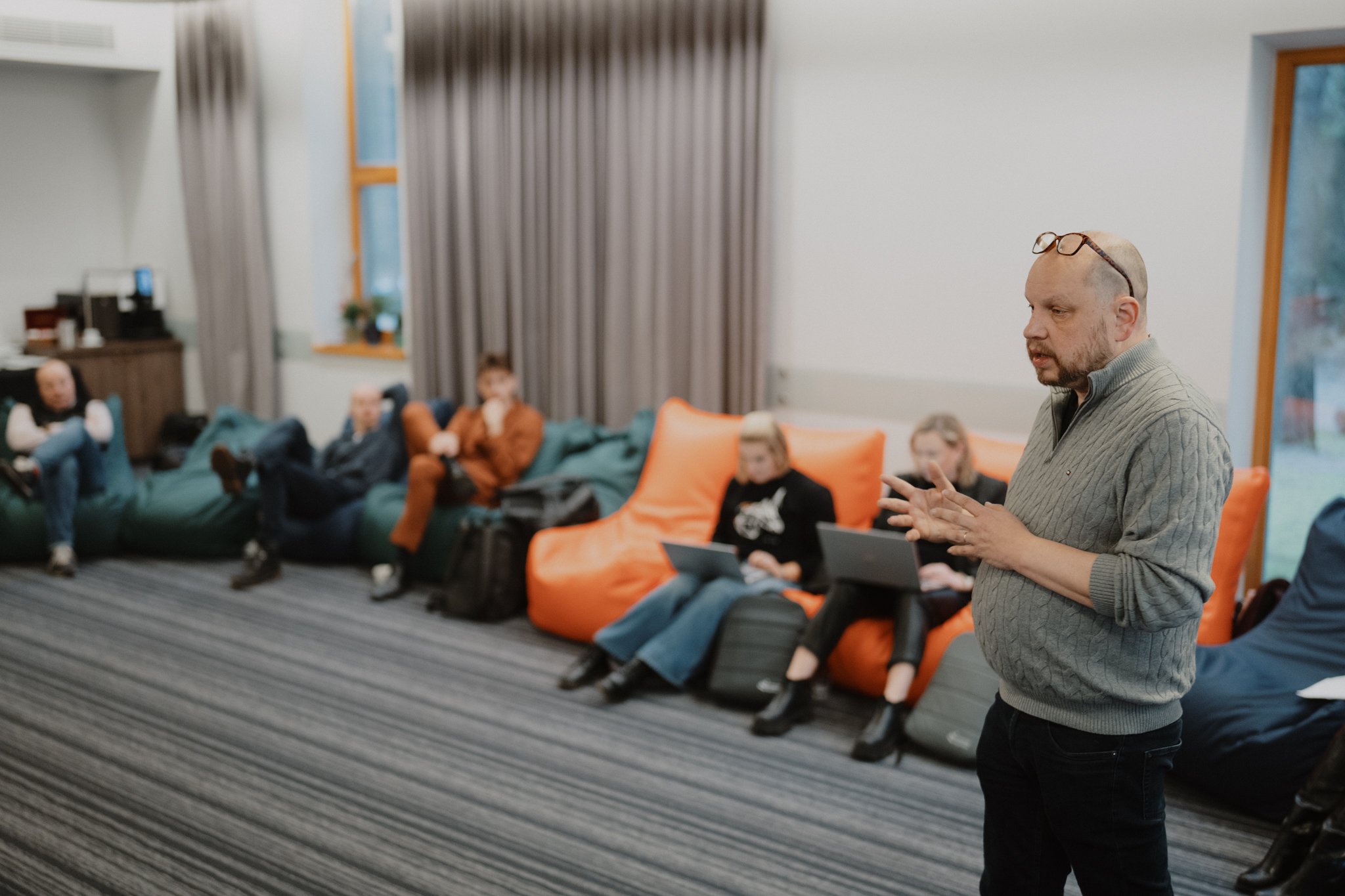
Lithuania supplied another setting. xEdu launched Edu Challenger with Civitta and Lithuanian partners in late 2024. A photograph from the kickoff shows Korhonen talking to participants seated on beanbags, his glasses perched on his head. It is a working scene rather than a formal portrait: a small group, a speaker and room for discussion.
The programme’s published rules described a 12-week experience with online sessions and in-person work in Vilnius. Participation required no equity. Eligible teams could receive grants, subject to the programme’s conditions. The combination joined advice with time, a local presence and money for development. Founders were being asked to participate in a place, rather than simply collect a set of remote introductions.
By May 2026, Startup Lithuania reported results from three cycles delivered during 2024 and 2025. Thirty-four startups had received support from the consortium. Reported outcomes included 28 new employees, 116 new partnerships and expansion into 14 countries. These were collective programme results, reflecting the work of participating businesses and several partner organisations.
The distinction matters when looking at Korhonen’s achievements. His career repeatedly brings him to the point where other people can do more: a teacher helps refine a product, a founder meets an investor, partners establish a programme in another city. The result belongs to many participants. It is still possible to see the contribution of the person who helped them meet.
Keeping the map open
xEdu’s website now reports 110 accelerated startups from more than 20 countries, 11 acceleration programmes in three countries and more than €30 million raised by its startups. Those figures describe the organisation’s accumulated work. They also give a sense of how far a venture founded beside a Helsinki education department has travelled.
Korhonen remains listed as CEO and co-founder. The work continues to involve founders, educators and institutions, with programmes built around product testing and market development. For someone working in that position, a successful introduction is a beginning. The next conversation has to concern what the new relationship makes possible.
The old map offers a useful way to read the career. Knowledge can become dated without announcing its retirement. A familiar method can outlast the circumstances that once made it sensible. Korhonen has spent years helping education companies compare their assumptions with the world beyond their own desks. There is plenty of room on the timetable for that lesson.