When Tom Sayer told his mother he was leaving Google to become an entrepreneur, she offered a piece of due diligence: he used to lose at Monopoly. It is an excellent family contribution to a startup launch. There are pitch decks, there are market forecasts, and then there is someone who remembers what happened the last time you tried to acquire property.
Sayer tells the story with affection. He grew up in Hull, where ambition could meet a brisk reception. He had already travelled a considerable distance from home, through Cambridge and Stanford and into Google for Education. Leaving meant giving up an established way of working on a problem he cared about. His mother’s joke supplied a rather less ceremonial farewell than a corporate announcement.
Today he is co-founder and CEO of Ello, the learning company he built with Elizabeth Adams and Catalin Voss. It began with a child reading aloud and a digital elephant listening. By 2026, its work had expanded into maths. Behind that progression sits a question that has followed Sayer across institutions and continents: how much can change when someone pays attention to one particular child?
A school in Hull, a question that travelled
As a secondary-school student, Sayer volunteered at an elementary school in Bransholme. The memory that stayed with him was of limited expectations. He credits his own parents and education with giving him opportunities, and has described education as a route out of the circumstances he saw around him. His later career would take an indirect route toward that conviction.
He studied mathematics and psychology at Cambridge. The pairing offers two useful ways to think about an education product: what a system does, and what a person experiences. Neither subject, of course, supplies a ready-made answer to a child who has decided that reading practice is over. The distance between an elegant system and a willing learner would become part of his working life.
Before Stanford, his jobs included product management at a London startup and six years as a British Army intelligence officer, with tours in Afghanistan and Libya. At Sandhurst he received the Queen’s Medal in 2008. A year later came top-of-class honours at the Defense School of Intelligence. These are substantial career chapters to encounter on the way to an elephant that helps with books.
Stanford’s 2013 account of Sayer adds a pleasing complication. Alongside joint MBA and education degrees, he was co-president of the Education Club, captain of the graduate rugby team, and a co-founder of Sension. He had also built a mini-golf course in Cambodia. The course belongs on the record simply because very few professional biographies improve so much when someone hands the subject a putter.
“Throughout everything, I’ve always seen education as the way out.”
Tom Sayer, July 2026
He completed his Stanford degrees in 2014. He had initially approached the education degree with the idea of establishing a free school back home, later explaining that Stanford helped him recognize education as the subject to which he wanted to devote his career. A local project had opened into a much larger professional commitment.
The question inside the Google job
At Google for Education, Sayer led impact and adoption programs. His team’s responsibility was to help ensure that the company’s tools were used effectively in classrooms around the world. Adoption is an unglamorous word for a demanding assignment. Buying a device is a discrete event. Making it useful in a school involves habits, priorities and people whose days are already full.
That role gave him a practical test for technology enthusiasm. In conversations with school leaders, he wanted to know what they were trying to achieve by bringing technology into the classroom. The question survives every hardware cycle. A new tool can be easy to describe while the change it is meant to produce remains surprisingly vague.
The job also placed him near a tension that would shape Ello. Improving the operation of a classroom and improving the experience of an individual learner can overlap, but each requires attention. One product may help a teacher organize work. Another may help a child through a difficult word. Success at the first task cannot be assumed to answer the second.
His public education commitments extended beyond his employer. Speaker biographies document his involvement with GO Public Schools and Education Reimagined. The latter’s learner-centered approach offers a useful connection between his institutional career and his startup: begin with the learner’s needs, then work outward. It sounds straightforward until a product has to satisfy everyone else involved in buying, deploying and using it.
Three founders, one child at a time
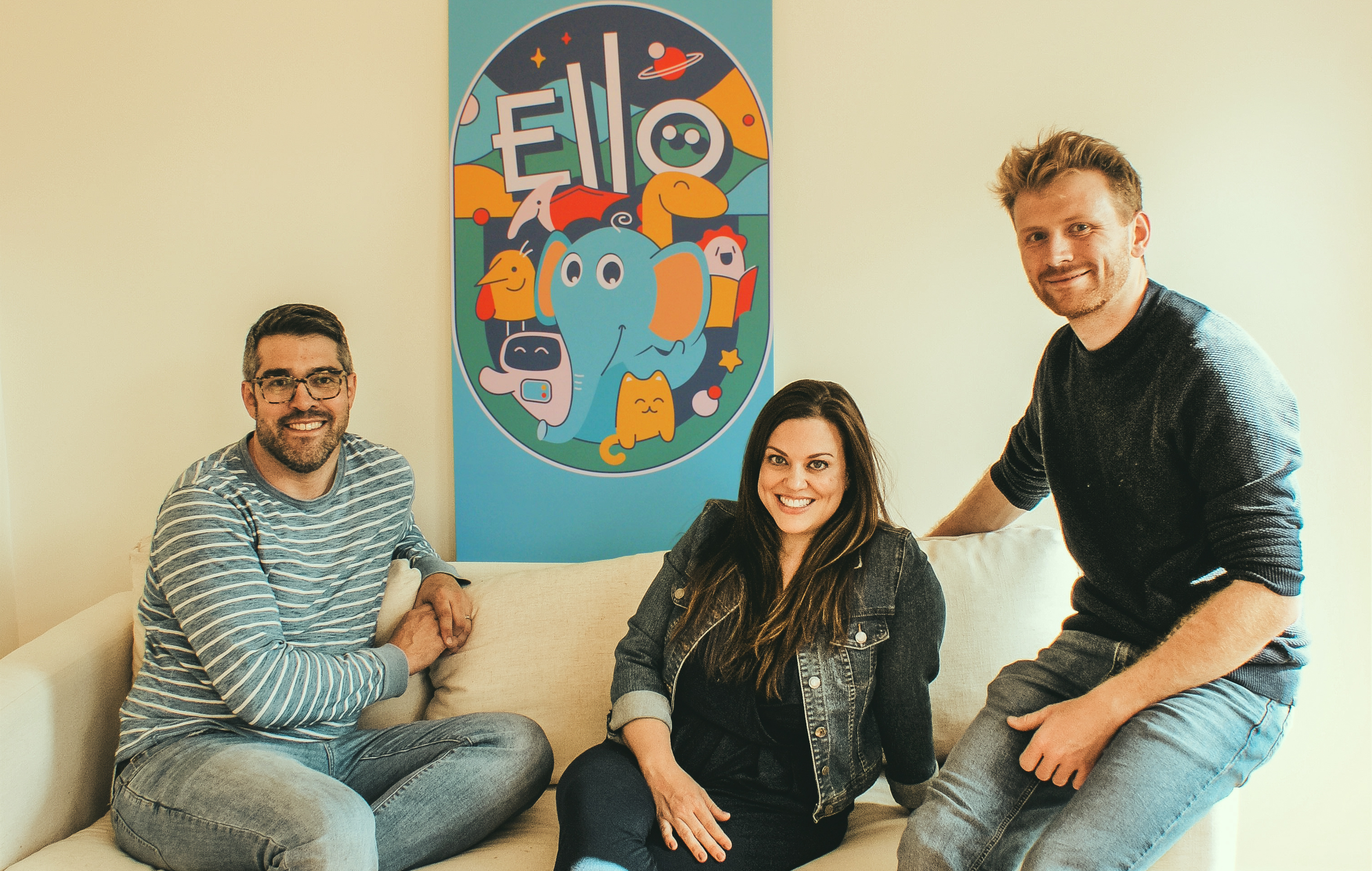
Sayer and Voss had met at Stanford and had already built a company together. Voss’s account of their partnership makes clear that Ello was a reunion as well as a new undertaking. Sayer brought experience with education systems and product adoption; Voss brought engineering. Adams supplied another essential perspective: the experience of children and families.
The reading focus had a close-to-home origin. Adams’s daughter was finding learning to read difficult during the period of school closures. The founders saw a problem that could be approached through individual practice, with support available as the child worked. Rather than treating the book as material to be delivered, they made the act of reading it aloud the center of the experience.
Their roles matter to understanding Sayer. A profile of the CEO can easily turn a company into one person’s invention. Ello’s founding account is explicitly collaborative. The learning problem, the technical possibilities and the work of turning them into something a family could use came from a partnership. Sayer’s job sits where those different forms of expertise have to meet.
September 2023
January 2024 launch
In September 2023, Ello announced a $15 million Series A led by Goodwater Capital. The investor group included Homebrew, Reed Hastings, Common Sense Growth and Ravensburger. Funding gave the founders resources to develop their work; it also placed an educational promise inside the ordinary obligations of a growing company. A child still had to find the next reading session worth doing.
The elephant has a job to do
Ello’s name has a small joke attached. People have assumed it comes from Sayer being English and saying hello without the opening consonant. He says the name actually developed from an elephant used in an earlier concept. The character stayed. Children have sent it letters, a detail he has shared when describing how young readers respond to the companion.
A letter to a digital elephant is a useful reminder of the audience. A parent might evaluate features, price and progress. The child has to live through the session. Instruction needs the learner’s cooperation, and cooperation is difficult to order into existence. The character’s warmth has a practical purpose: helping the child remain willing to practise.
Sayer’s emphasis on motivation gives the technology a specific assignment. The companion listens while a child reads and helps when they get stuck. The activity still asks something of the reader. Its appeal depends on making effort feel possible, rather than allowing the software to perform the entire task on the child’s behalf.
In January 2024, Ello introduced a fully digital reading companion with a library of more than 700 decodable books. These books were designed around particular reading skills, with educators and illustrators using generative tools in their creation. The company paired the library with its child-speech technology, bringing content and guided practice into the same product.
The launch made Sayer’s access argument tangible. The announced digital subscription cost $9.99 a month at the time, with physical books available for an additional fee. Those are historical launch terms, but the design choice is still revealing. Moving the library onto a device changed how the service could reach families and how quickly readers could find another suitable book.
The next lesson is a different problem
By July 2026, Sayer was discussing an Ello that had moved beyond reading into maths and other early learning. The original focus had given the company a specific place to begin. Expansion asked whether the same commitment to individual attention could work across different kinds of lessons. A reading companion’s reputation could open the door; the next subject would require its own work.
His September account of the newer product describes several AI models contributing to teaching decisions. Some respond quickly; others examine the interaction more slowly. He illustrated the idea with his son’s maths practice: after a conceptual mistake, the system revisited the missing skill before returning to the lesson. It is Sayer’s example of the behaviour the team is trying to build, rather than a general verdict on learning outcomes.
- ListenAttend to the child’s response
- RevisitWork on the missing concept
- ReturnContinue the original lesson
His preference for reaching families directly follows the same line of thought. Parents are close to the child, while institutional buyers have other responsibilities to manage. This is a distribution choice with an educational argument behind it. Sayer continues to describe teachers as irreplaceable; his ambition for software concerns what additional individual support can become available.
Access also has a geographical dimension. In July he discussed funding intended to support free provision in Africa, alongside the practical work of getting the product used there. The company has engineering roots in Kenya. A free download and a service that families actually adopt are different stages of the same promise, a distinction familiar from his Google years.
The personal question remains close by. Sayer is a parent making decisions about his own children’s education while building a business around other families’ learning. His public ambition reaches across countries. Its daily unit is smaller: a child, a task, a response, and a reason to try again. Whatever became of those Monopoly games, this is the work he has chosen to keep playing.