An answer can arrive before a student has had time to be puzzled. Photograph the maths problem, wait a moment, copy the result. For a company selling homework help, that sequence offers an attractive demonstration. For Abhay Saboo, it leaves an awkward question sitting on the desk: what, exactly, did the student learn?
That question runs through his work at CoLearn, the education company he co-founded in Indonesia. He has built around the appeal of quick help, then kept returning to the slower business of teaching. A child can open an app for an answer. Persuading that child to return for another lesson takes a different kind of effort.
Saboo’s own relationship with education began well before the company. In middle school, he taught English to Korean children. At university, he tutored athletes. The future chief executive was already doing the small, intimate work of explaining something to someone who needed it explained differently. There was no platform to scale. There was another person to reach.
The long route home
Saboo moved to Indonesia with his family at three. His parents were Indian; his father worked in textiles. He grew up in Semarang and Salatiga in Central Java. Those details matter because his later choice of where to build a company was personal. Indonesia was the place he considered home, even when his education and opportunities carried him elsewhere.
He studied electrical engineering at Georgia Institute of Technology from 2001 to 2005, then earned an MBA at Harvard Business School from 2007 to 2009. Engineering and business make a plausible pair on a founder’s biography. His teaching experience supplies a less tidy, more revealing third subject: people seldom understand something simply because the explanation is available.
His older brother helped draw him toward business and technology. During an internship at GE, Saboo took the direct route to a new opportunity, emailing the chief financial officer and head of human resources. That initiative helped him change departments and work in China. It is an early glimpse of someone willing to ask the person who might actually be able to say yes.
By business school, he was considering an education venture in India. He asked his friend Marc Irawan, who taught STEM to children on weekends, to help develop coding content and a curriculum. Then a visit to family in Jakarta changed the geography of the plan. The market on paper had competition from the country he loved.
“I wanted to build back home,” he later said. There is a practical consequence to that sentence. A founder chooses a market; the choice also becomes a place to spend years, acquire obligations and live with the results. For Saboo, the destination belonged inside the business decision.
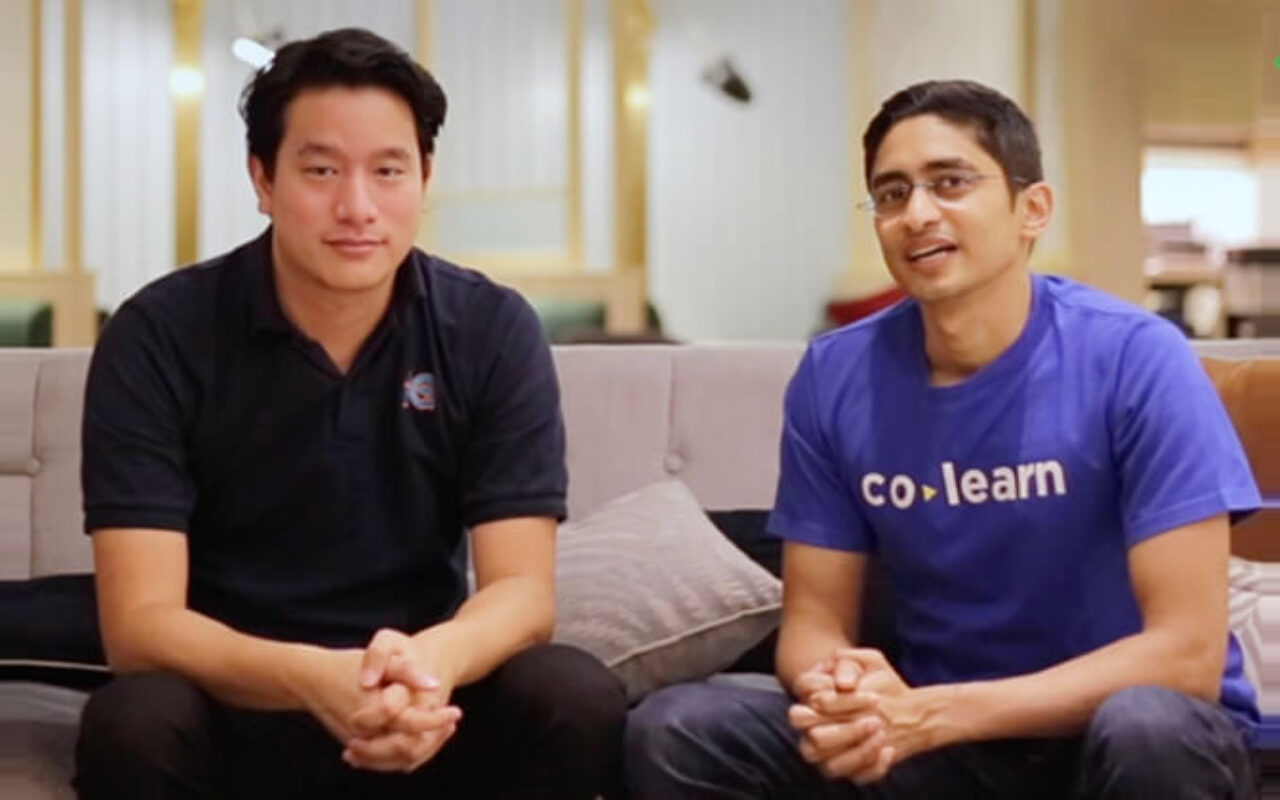
A classroom escapes its walls
The education venture took physical form as IQ Education. Saboo and Irawan’s early work involved learning centres, followed by a hybrid approach connecting offline teaching with online tools. CoLearn’s roots date to 2018; its consumer app launched in August 2020. These are two stages of the same journey, separated by a substantial change in how the teaching reached children.
Sandeep Devaram joined the founding team with product experience from BYJU’s. The combination brought together Saboo’s operating background, Irawan’s teaching and consulting experience, and Devaram’s work on education products. A classroom moving onto a phone needs all three kinds of attention: the lesson, the interface and the business that keeps the lesson available.
The shift online changed what distance cost. A tutoring centre has a catchment area. A student has to get there, and someone has to pay for the trip as well as the class. CoLearn’s proposition was to bring supplementary STEM teaching into the home. The commute could be removed from the timetable without removing the timetable itself.
By early 2022, CoLearn reported more than 4.8 million users and 85 million questions asked since launch. It also announced an additional $17 million in Series A financing, with TNB Aura, KTB Network and BINUS Group among the backers. Those were company milestones. For a teacher, however, a large number of questions is the beginning of the job.
The answer is only the entrance
CoLearn’s homework tool, Tanya, matched questions with explanatory videos. Live classes offered a further step: returning to a teacher and a familiar group of classmates. Saboo’s bet was that the company could use the immediate attraction of homework help to introduce a more sustained relationship with learning.
In his account, motivation and confidence sit near the centre of the problem. A library of recorded lessons can be useful, but its existence cannot make an unmotivated child press play. Fixed groups, teachers and conversations give a student reasons to turn up that a catalogue cannot supply. The classroom carries social machinery along with its curriculum.
“It drives discipline, it drives consistency,” Saboo said of learning in cohorts. The wording is telling. He is describing ordinary habits, the unglamorous things that make education accumulate. The familiar face on a screen, the next scheduled class, the knowledge that someone may notice an absence: none makes much of a product launch. Together, they make a routine.
A 2023 investor case study described CoLearn tracking attendance, participation and assessment results. It also recorded a persistent difficulty: getting students to go deeper than automated question solving. The tension was visible inside the business. Success at attracting a question did not settle the question of what came after it.
That tension makes Saboo’s work more interesting than a story about putting lessons online. Distribution solves a real problem, especially when travel and fees restrict access. Once the lesson arrives, a second problem begins. The student still has to attempt it, misunderstand it, ask again and remain long enough for something to become clear.
“It drives discipline, it drives consistency.”Abhay Saboo, on learning in cohorts
A founder who asks for homework
Saboo applies some of that discipline to his own team. He has described encouraging employees to make new mistakes while learning from old ones. He also asks people proposing ideas to validate them with students. An attractive opinion should have to survive a conversation with the person expected to use the product.
There is a pleasant symmetry here. Students have to show their working; employees have to show what students actually need. The chief executive’s preference gives curiosity a practical job. It is harder to preserve a cherished assumption when a child has just explained why it makes no sense.
His view of leadership also reaches beyond the pitch meeting. He has described it as doing the right thing consistently, including away from public view. That is a demanding standard precisely because it has so little theatre in it. A polished presentation lasts an afternoon. An operating habit has to survive Tuesday.
Investors noticed the team’s detailed understanding of the Indonesian education market. January Capital described a founding group able to explain the sector’s challenges and a structured approach to addressing them. In this account, knowing the country was more than biography. It informed the product decisions and the case for backing the business.
Seven dollars, one month at a time
By March 2024, Saboo was talking about sustainability as well as reach. CoLearn described reducing prices to around $7 a month, allowing monthly payments and offering a money-back guarantee. The terms made the proposition easier for families to try and easier to leave. Affordability had to appear on the bill.
The company’s stated test was whether families returned at full price, month after month, without being pulled back by discounts. That changes the emotional weather of a startup. A fundraising announcement gives everyone a date to celebrate. Renewal asks the same small question repeatedly: was this worth paying for?
For an education founder, that question has two audiences. A parent considers the expense and the result. A student experiences the lesson. A product can satisfy the purchaser’s hopes and still fail to hold the learner’s attention. Saboo’s focus on motivation acknowledges that the person paying and the person doing the work bring different demands to the same classroom.
The pencil comes back into the picture
CoLearn’s more recent AI work returns to the problem at the start of this story. Its tutor asks students to submit their own written attempts before receiving help. In a June 2026 account, the team compared deployments with different levels of teacher, parent and peer involvement. It reported much more sustained handwritten effort when the tool was built into a supported class routine.
The comparison was observational. It did not establish that the surrounding adults and classmates caused the difference, or that handwritten submissions proved greater understanding. Even with those limits, the experiment puts Saboo’s longstanding interest in motivation into concrete form: look at what students actually do after the technology arrives.
In October 2026, CoLearn Lab opened a $6,000 Kaggle challenge focused on identifying misconceptions in handwritten maths. The task asks a model to inspect a student’s working and identify the idea or procedure that led it astray. Correct work matters too; a system that invents errors would make a tiresome tutor.
The line connecting these projects to Saboo’s early tutoring is easy to follow. A useful teacher pays attention to the attempt. The wrong answer contains information. So does the hesitation before it. Technology offers a way to examine more of those attempts; the educational purpose still depends on what happens next.
Saboo’s ambition has long included helping Indonesian students compete more confidently beyond their own country. The route he has chosen keeps bringing him back to a smaller unit of progress: one student willing to try another problem. Even after millions of questions, the pencil still has a job.
Continue the conversation ↗
- Abhay Saboo on LinkedInPersonal profile
- CoLearnClasses and learning tools
- CoLearn LabExperiments and writing on learning
- Watch: Building an EdTech in IndonesiaStart-ups Simplified / YouTube / 2024
- Listen: One More Scoop with Abhay SabooAmanda Cua / 14 January 2024
- CoLearn’s early classroom storyKrASIA / 9 June 2020
- The handwritten-maths challengeCoLearn Lab / 5 October 2026