The order came from Ketapang, in West Kalimantan, and was worth roughly Rp200 million. For Joseph Aditya, its significance went beyond the invoice. A company far from Jakarta had found industrial goods through Ralali because those goods were difficult to find nearby. A website had shortened a search that geography had made awkward.
He later recalled that purchase as the moment his confidence in online B2B commerce began to settle. The customer’s explanation was wonderfully practical: Ralali made finding the supplies easier. There was no need to dress the answer for an investor meeting. Someone needed something. Someone else could supply it. Aditya had found a useful place between them.
An education in selling
Before he could connect buyers and sellers, Aditya had been a seller himself. He studied commerce at Deakin University in Australia, concentrating on marketing and international business. Returning to Indonesia in 2006, he entered a business dealing in test equipment and measuring devices. His route into entrepreneurship passed through the ordinary obligations of a sales job.
At PT Tridinamika Jaya Instrument, he worked his way toward management and eventually became managing director and a major shareholder. The progression took more than seven years. He also helped rescue the company from the threat of bankruptcy before leaving in June 2014. His experience of running a business included the possibility of losing one.
The pay at the beginning was modest. In a later account of his early working life, he described earning Rp2.5 million a month after returning from Australia. He spoke about work as an opportunity to acquire experience. The overseas degree had not exempted him from starting near the bottom.
During his student years, part-time work had also provided a place to meet people and learn how business functioned. That detail fits the career that followed: formal study, then an extended apprenticeship in the daily business of selling. His knowledge of procurement accumulated through the work itself, with its negotiations, disappointments and consequences.
A price tag, and a missing letter
One frustration stayed with him. In industrial procurement, a competitively priced offer could still lose to a more expensive one. Aditya wanted a more transparent route between suppliers and business customers. The problem was personal enough to notice at work, and common enough to build a company around.
The first website dates to August 2013; incorporation followed in July 2014. That distinction explains the two years attached to Ralali’s beginnings. The business started with maintenance, repair and operations supplies, usually shortened to MRO. These are purchases made to keep other work moving. They are unlikely to inspire a queue outside a shop at midnight.
Aditya’s choice of name brought a little warmth to the industrial catalogue. Ralali draws on ora lali, the Javanese expression for not forgetting. He has linked the choice to his Semarang background. An early account also connected it to a favourite nasi kucing stall there. Remove the opening letter, keep the memory.
That was sensible branding for a business asking people to adopt an unfamiliar purchasing habit. The early proposition was to gather suppliers in one place. Industrial customers had varied needs, and a single seller could struggle to cover them. A marketplace could make the combined selection easier to discover. The name was brief; the catalogue had room to grow.
suppliers
marketplace
buyers
A shorter search. A more visible offer.
The setting matters here. A procurement platform becomes useful when it can accommodate how businesses actually purchase. Discovering an item is one step; arranging its supply is another. Aditya’s early career had placed him close to both sides of that process. He brought the habits of an industrial merchant into an online business.
The month the database broke
A growing catalogue did not protect Ralali from a much less picturesque problem. A database issue once caused the company to lose almost 90 percent of its business in a month. The episode, described in a 2020 investor account, is a sharp interruption to any smooth version of the company’s progress.
The team resolved the problem within the following month. The account does not turn the repair into a technical thriller. Its emphasis is on the founder’s persistence and the investor’s willingness to give him room to work. Aditya’s clarity of purpose and determination had made an impression before the crisis arrived.
Almost 90% of the business lost in one month.A database disruption recalled in 2020; the team resolved the problem within the following month.
For a company built to make other businesses’ work easier, that sort of interruption goes to the heart of the promise. Reliability becomes part of the product. The incident belongs beside the early order in Aditya’s story: one tested whether customers wanted the service, the other tested whether the company could keep providing it.
It also gives some weight to the otherwise well-worn word persistence. A founder can state an ambition in a sentence. Keeping a service operating requires people to return to the problem, make decisions and finish the repair. In this episode, the recovery supplies the evidence.
The people between the transactions
By September 2018, when Aditya appeared at a Startup Grind gathering in Jakarta, the event description put Ralali at 8,000 merchants and around 200,000 listed products. Those figures describe that stage of the company. They also suggest the variety his original idea had to accommodate: different suppliers, different inventories and different reasons for a business to visit.
Aditya was there to discuss a journey from traditional wholesaling into online commerce. It was a natural subject for someone whose career had crossed that boundary himself. The customers’ purchasing needs linked the two worlds, even as the tools for meeting them changed.
By 2019, Aditya was describing the obstacles facing small businesses in three parts: sourcing, scaling and sustaining. Finding inventory was only the beginning. A company also needed ways to reach customers, pay for purchases and manage the demands of expansion. Ralali’s scope widened around those adjacent needs.
BIG Agent, launched that year, added people to the equation. It connected freelancers with businesses needing services and allowed workers to choose tasks according to their skills and preferences. Flexible work could provide occasional extra income or become a more regular activity. The marketplace’s relationships now extended beyond an item and its buyer.
A less formal glimpse of those relationships survives from the company’s December 2014 gathering in Jelambar. Employees met to review the year and discuss targets for 2015. They also wrote hopes on a “Wall of Wish”. Aditya took his turn. Afterwards came games, food and a barbecue.
There is something pleasingly ordinary about that early company scene. Annual targets require a meeting; eventually, somebody has to arrange dinner. The photographs and account preserve a business still close enough for its head-office and branch teams to gather around the same occasion. The founder appears among the people doing the remembering and planning.
He later took his ideas about shared progress onto public stages. At the MRTJ Incubator Product Showcase in April 2022, he argued that cooperation between startups and corporations required aligned aims. His phrase was “We All Win”. He included the smaller businesses among the stakeholders who should benefit.
From industrial supplies to the dinner table
In a 2024 video conversation around the Inclusion Conference on the Bund in Shanghai, Aditya described a company moving into a further phase. Its first decade had involved building platforms across commerce, finance and logistics. In its eleventh year, he said, it was moving further into the real sectors, including food.
“We want to solve a bigger problem,” he said. He spoke of access to markets, finance and human resources, and of reaching people as well as businesses. The vocabulary was consistent with his earlier work. The categories of goods and services were widening around it.
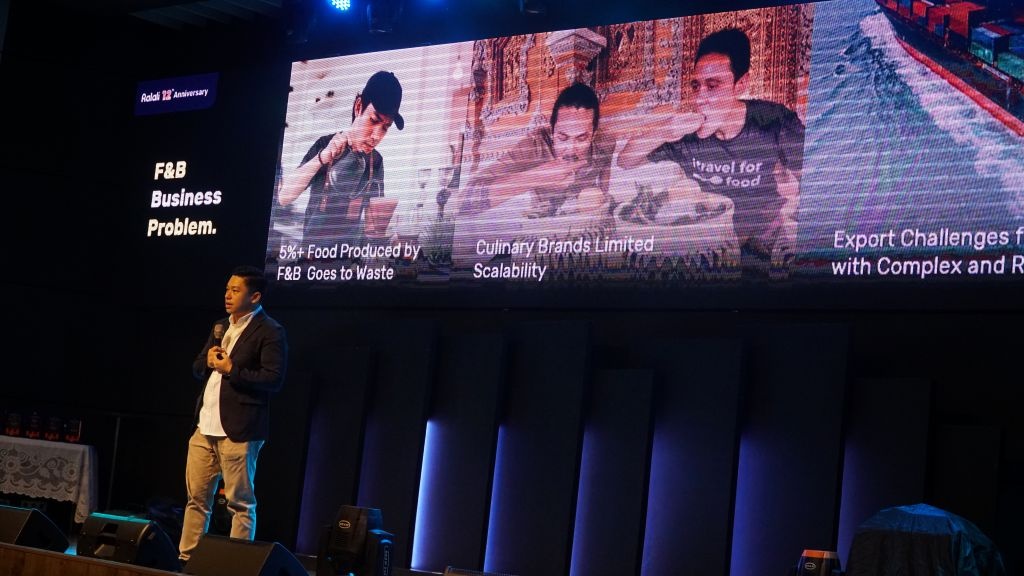
At the 1+1 Summit in July 2025, that direction had specific partners attached. Ralali announced cooperation involving Pagi Sore, JNE and Wani Boemboe. Ready-to-eat Indonesian food products were planned for distribution through more than 3,000 Alfamart branches. JNE’s part was logistics. These were announced distribution plans, with the operational work still built into the promise.
The same presentation brought together Ralali Plus, focused on financing access, and Limbah.id, working on waste management and waste-to-energy solutions. Aditya was now speaking for a group with several kinds of business under its roof. Food, purchasing power and distribution occupied the same conversation.
A website for business purchasing.
BIG Agent adds flexible services.
Food, financing and distribution share the stage.
The work behind the promise
Ralali Group’s current leadership page identifies Aditya as founder and president director, alongside co-founder and director Irwan Suryady. It presents a collection of businesses including Ralali.com, Kalibrasi.com, Kokikit.com, RBiz.com and Limbah.id. The company that began with industrial procurement now describes its work across a broader set of business needs.
There is a risk that the word ecosystem makes all of this sound comfortably automatic. The details of Aditya’s career resist that impression. Someone had to learn the products, make the sale, notice the purchasing problem and persuade a customer to try a different route. Later, someone had to repair the database.
The Ketapang order remains an unusually clear way into the story. The customer was trying to get something done and could not easily find what it needed. Aditya’s ambition has grown considerably since then. Its practical test is still recognizable: whether the next business can get past the obstacle in front of it.