Aruna Put a Marketplace Between the Boat and the World
Indonesia has millions of small-scale fishermen and one of the world's longest coastlines. Aruna built the digital plumbing to link them - and the middlemen were the first thing to go.
The trawler comes back before dawn. For most of the last century, whatever it carried - grouper, snapper, blue swimming crab - was sold on the beach to the first buyer who showed up, then sold again, and again, through a chain of six or seven hands before it reached a restaurant or an export crate. Each hand took a cut. The fisherman, who did the dangerous part, kept the least. Aruna's founders looked at that chain and decided the problem was not the fish. It was the arithmetic.
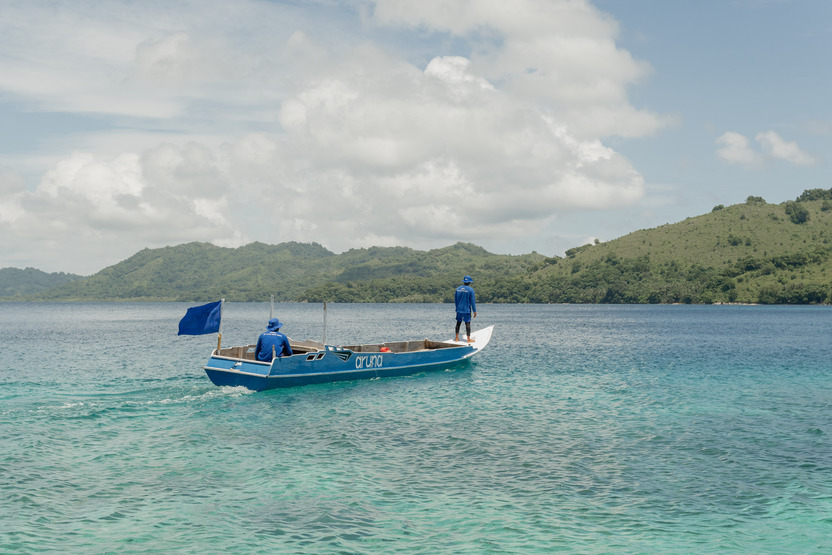
Aruna is an integrated fisheries commerce platform based in Jakarta. In plain terms, it buys seafood directly from small-scale coastal fishermen and sells it onward - to Indonesian retailers and wholesalers, and to importers in dozens of countries. Between those two ends it runs the parts nobody sees: onboarding, cold storage, logistics, quality grading, and a data trail that tells a buyer where a specific fish came from. The company calls the model "sea to table." What makes it work is that Aruna organized the messy middle into software and hubs.
01Three students and a hackathon
Farid Naufal Aslam, Indraka Fadhlillah, and Utari Octavianty met as IT students at Telkom University in Bandung. In 2016 they entered Hackathon Merdeka, a national coding competition, and won. The idea they pitched was not a food-delivery app or a payments wrapper. It was a way to connect fishermen to markets. Octavianty came from a fishing family, which is the sort of detail that turns a good demo into a company - the founders had seen the problem before they had the vocabulary for it.
That proximity became the strategy. Rather than parachute an app into villages where many fishermen had never used a smartphone, Aruna hired what it calls "local heroes" - young, tech-literate residents who help fishers photograph a catch, list it, and get paid. The human layer is the product's on-ramp. It is also the part a competitor sitting in an office in Singapore finds hardest to copy.
"Make the sea a better livelihood for all."
Aruna's stated mission02Counting the middlemen, then removing them
Most startups say they "cut out the middleman." Aruna actually counted them. In the traditional route, a catch could pass through six or seven layers - collector, sub-collector, agent, wholesaler, distributor - before a buyer ever saw it. Each layer added a margin and subtracted transparency. Aruna's platform compresses that. Buyers place purchase orders; Aruna aggregates them and routes them to fishing communities that specialize in a given commodity. The fisherman gets a more predictable market. The buyer gets a shorter, traceable supply line.
The old chain
With Aruna
The payoff shows up in fisher income. Across interviews and company reports the reported gains vary - anywhere from a few times to many times prior earnings depending on the year, the commodity, and who is counting. The direction is consistent even where the exact multiple is not: fishers who join tend to earn meaningfully more per kilogram, because fewer hands are dividing the same fish.
03Two sides, one ledger
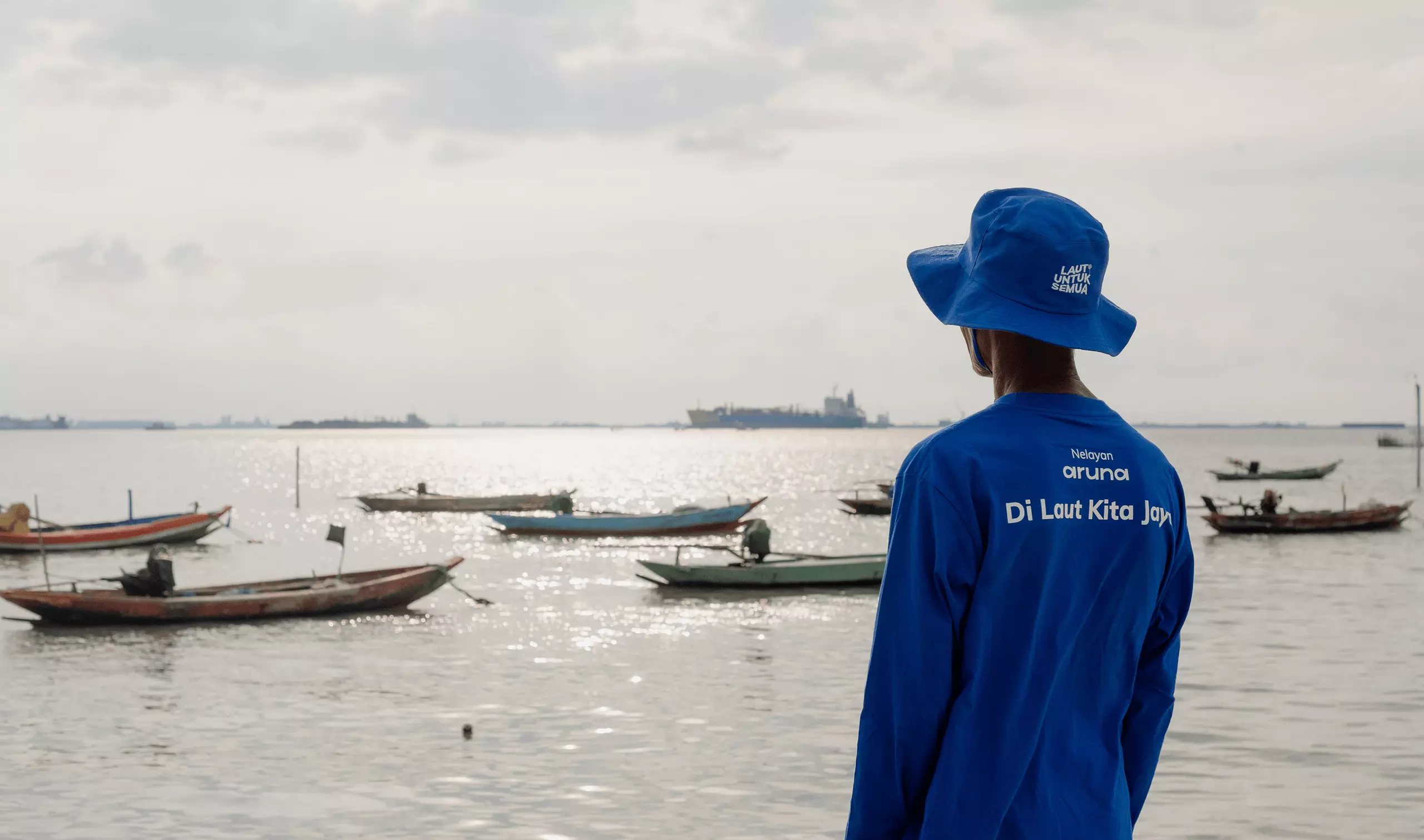
On the supply side are the fishermen - reported at roughly 40,000 partners in 2022 and around 55,000 by 2025 - plus thousands of coastal women who handle sorting and inspection at the hubs. That last group matters more than it sounds. Fish quality is decided in the first hour after landing, and the sorting work created steady, paid roles in places where formal jobs are scarce. Aruna has said its supply chain supports on the order of 7,000 jobs in coastal areas.
On the demand side are domestic retailers and wholesalers plus international buyers across 30-plus countries, sourcing commodities like tuna, blue swimming crab, and lobster. For those buyers the pitch is not just price. It is consistency and provenance - a documented answer to "where did this come from," which regulators and premium retailers increasingly require.
People, Profit, and Planet.
Company motto04Upstream, midstream, downstream
Aruna splits its tools by where they sit in the chain. Upstream, the Fishers App and the local-hero network handle onboarding, catch listing, performance profiles, and incentives. Midstream, an ERP dashboard manages transactions and commodity flows across the hub network - the unglamorous logistics brain. Downstream, Seafood by Aruna, launched in 2020, is the e-commerce and wholesale channel that sells fresh and value-added products to retail and B2B buyers, with export services attached.
Around that core sit the sustainability programs, which are less a marketing wrapper than an operating constraint. Aruna has used GPS tracking to steer fishers away from overfished and protected zones, run fishery-improvement work, and experimented with a zero-waste angle - turning blue swimming crab shells into fish feed. The logic is commercial as much as ethical: a depleted fishery has nothing to sell next year.
05How Aruna gets paid - and funded
The business model is straightforward: Aruna captures the margin it used to hand to intermediaries, and layers paid logistics, cold chain, and financial-inclusion services on top. Buy from the community, sell to the market, keep the spread that the old chain scattered across six players. Investors bought the story. Aruna raised a $35M Series A in 2021 led by Prosus and the East Ventures Growth Fund, then added $30M in a 2022 follow-on led by Vertex, bringing the Series A to $65M.
Then the market turned. In mid-2024 Aruna took a down round - a raise at a lower valuation - alongside conventional debt, and in October 2024 closed a smaller Series B of about $3.2M led by East Ventures. Early in 2025 it restructured; reports of a 40% staff cut circulated, and the company countered that the reduction was closer to 18%, saying its expansion plans still stood. It is a more honest arc than the usual up-and-to-the-right, and worth noticing: how a company narrates a hard year is its own kind of data.
The field06Where it sits in the market
Indonesia's aquatech scene is crowded, but Aruna occupies a specific corner of it. Companies like eFishery, Delos, and Jala lean toward aquaculture - farmed fish and shrimp, feeding and water data. Aruna's center of gravity is wild-catch commerce: moving what the ocean already produced from remote landings to distant buyers. Its nearer neighbors are supply-chain players like FishLog, PasarMIKRO, and Jaring Pangan, and, at the global sourcing end, marketplaces such as Tridge.
The differentiator is the combination. Plenty of firms can build a marketplace. Fewer are willing to own the physical, low-margin, weather-dependent middle - the hubs, the ice, the sorting tables, the boats that come in late. Aruna's expertise is exactly there, in operations that don't demo well but decide whether the fish arrives fresh and documented. That is also its expertise in a literal sense: cloud infrastructure via Google Cloud, GPS and traceability systems, and a decade of learning how to run docks across 31 provinces.
"IP is one of the very important assets of any company."
Aruna's founders, on trademarks and traceability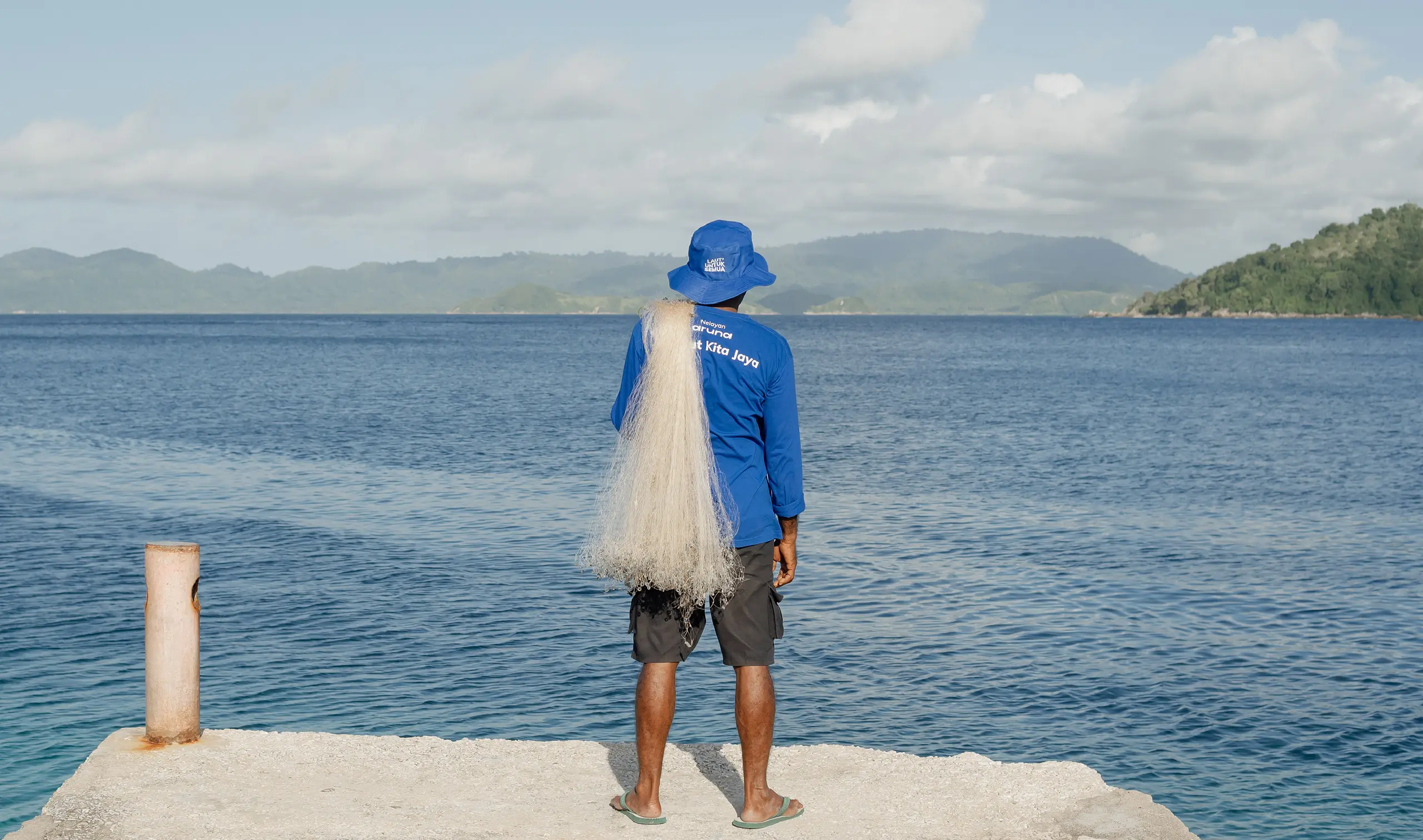
07Receipts
The recognition arrived early. All three founders made the Forbes 30 Under 30 Asia list in 2020. Aruna took gold at the 2018 ASEAN ICT Awards, was named the most social-impact startup in ASEAN in 2019, and landed on Fast Company's list of the most innovative Asia-Pacific companies in 2022. President Joko Widodo pointed to the company at the 2019 ASEAN Summit. On the sustainability side, Aruna joined WWF-Indonesia's Seafood Savers program in 2023 and won a Sustainable Seafood Product award the same year, while pursuing Marine Stewardship Council certification.
What that record adds up to is not a finished story. Aruna is nine years into a hard, capital-intensive attempt to industrialize the fairness of a supply chain that resisted it for a century. The down round is real; so is the coastline coverage. Both can be true. The interesting question is no longer whether the model works - fishers are getting paid more - but whether it can hold its margins while the ocean, the weather, and the funding market all keep their votes.