Sabda PS has described an opening assignment that would be awkward to mark with a red pen: ask students for the twenty biggest questions of their lives. Then examine the assumptions inside the questions. Before anyone gets to a formula, the question itself has become homework. A teacher expecting neat answers might find this inconvenient. Sabda appears to regard the inconvenience as useful.
It is a revealing introduction to the co-founder of Zenius. Students may arrive looking for help with mathematics, physics, English or economics, the subjects listed in his tutor biography. His ambitions follow them beyond the examination room. He wants them to acquire the habit of asking why an answer makes sense, and the confidence to keep learning when nobody has assigned the next chapter.
That ambition has travelled in several containers: a tutoring classroom, CDs and DVDs, a website, a phone application. It has also survived changes in his own job, from chief executive to business development, education leadership and back to chief executive. The recurring subject is the thinking student. The recurring difficulty is how to build a business around the patient work of producing one.
A programmer encounters a different kind of test
Sabda Putra Subekti studied informatics at Institut Teknologi Bandung. His account of the impulse behind Zenius begins with the Graduate Record Examination. He was struck by the difficulty Indonesian students had with a test that placed weight on reasoning. The experience sent him towards a larger question about what an education should leave behind.
A syllabus can supply information. Reasoning requires students to do something with it. The gap between those two achievements became central to his work. A person may recognise every ingredient in a problem and still struggle to combine them. Anyone who has confidently opened an examination paper, then reconsidered the meaning of confidence, will recognise the distinction.
His interest in technology preceded the company. As a schoolboy he learned through multimedia software supplied by his parents. He also met Medy Suharta through tutoring. The relationship eventually became a founding partnership. Here was a route from something he had enjoyed as a learner to something he could help other learners use.
There was an influential conversation with former education minister Fuad Hassan, too. Sabda recalled being encouraged to use technology rather than seek a ministerial career. It was advice with a long horizon: work on education beyond the lifespan of an appointment. The computer could carry an explanation farther than a single classroom, and keep carrying it after its teacher had gone home.
The classroom paid for the recording
The Zenius project began in 2004. The incorporated company followed in 2007. Those dates describe different steps in a business whose first machinery was fairly ordinary: teach students, collect fees, pay for the next piece of work. Sabda has recalled financing the early operation with borrowing and credit cards.
The classroom supplied cash to hire more teachers and record lessons when they were free. This is a pleasingly practical origin for an enterprise concerned with fundamentals. Before the platform could teach millions, somebody had to fund the recording. A disc had the considerable advantage of working without asking the household internet connection for permission.
- 2004Tutoring becomes the starting point.
- 2007The company is established.
- 2010Zenius.net takes the lessons online.
- 2023Sabda returns to the CEO role.
- 2024An operational pause, followed by a return.
By 2008 the company was selling its CDs through a website. The learning website zenius.net launched in 2010. Distribution was changing, but the recordings retained a useful property: an explanation could be replayed. A student could stop at the difficult part, retreat a little, and listen again. Repetition no longer required persuading an entire class to revisit the same sentence.
Sabda's brother Wisnu Subekti became another central figure in the company. Wisnu has remembered enjoying Sabda's stories about school when they were young. Later, they shared an interest in making science less forbidding. Their partnership gives the enterprise a family connection as well as a professional one: curiosity was circulating between them before there was a business to organise it.
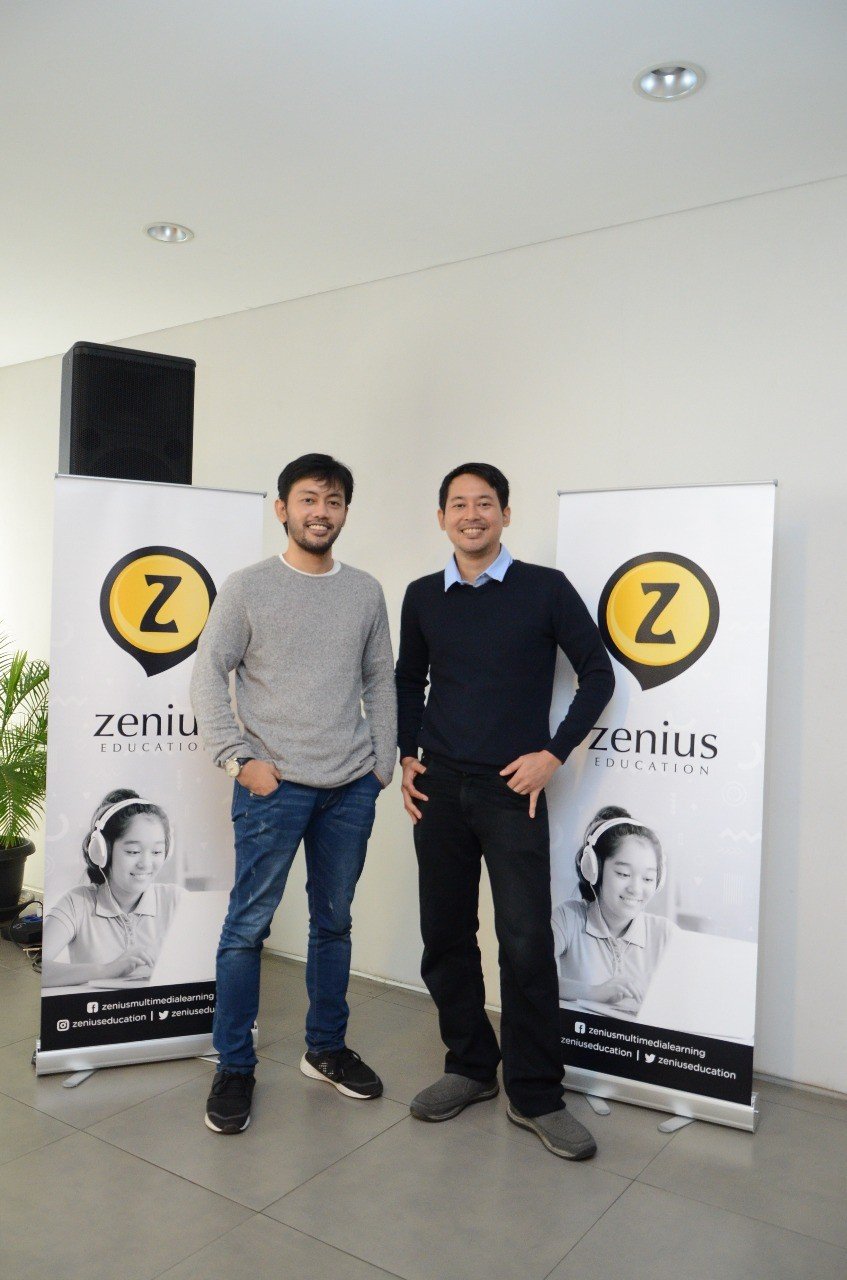
When the students came to the company's aid
Recorded lessons could be copied as well as replayed. In 2010 and 2011, piracy put Zenius under enough pressure that the company cut salaries and let employees go. Sabda described those decisions as the hardest he had made.
The response he remembers is unusually personal. The team published an open letter explaining that piracy threatened its ability to make more videos. Students helped find and report unauthorised copies. In his telling, the people buying the lessons understood that someone had to keep making them.
It is a small episode with a larger implication. A recording is easy to treat as an object that has somehow appeared on the internet. The letter made the labour behind it visible. There were teachers, production costs and people whose next month's pay depended on enough customers choosing the legitimate version.
Sabda called the episode both painful and a source of pride. Affection did not remove the economics of distributing educational material. It did reveal a relationship stronger than a transaction at a checkout. Some students had become invested in the continuation of the classroom they carried around with them.
“Our mission is to spark the love of learning for everyone, everywhere, and to question everything.”
Sabda PS, 2019
Three words, and a demanding definition of success
Sabda gives his educational ambition an Indonesian shorthand: cerdas, cerah, asik. He has explained cerdas through basic mathematics, literacy and logical thought; cerah through the ability to connect knowledge and apply it; and asik through empathy and social skills. Taken together, they make a rather broader job description than helping someone remember what will be on Tuesday's test.
He also links these fundamentals to navigating false information. Someone who can examine a claim has a tool that travels beyond any particular subject. An examination has a scheduled finish. The supply of dubious assertions does not. His argument asks education to prepare students for both.
The habits show up in how Zenius presents mathematics. Its writing about Euclid points readers towards the postulates Sabda teaches, and the construction of an argument from basic starting points. There is pleasure here in seeing how a result is assembled. The formula becomes more interesting once its workings are exposed.
Students' accounts offer a different view of that effort. In a published 2018 testimonial, a learner who gained admission to physics at IPB recalled Sabda's distinctive voice and his explanations of mathematics and physics from their foundations. Such recollections are personal experiences, rather than a measurement of everyone's results. They show, however, what a student might carry away: a way of understanding, attached to a recognisable human voice.
A screen still leaves work for a teacher
Sabda's public case for educational technology includes a substantial role for teachers. In 2019, he described an initiative called We the Teachers, which supported educators and schools in underserved areas. Its work included helping with administrative tasks and providing school servers so learning material could remain accessible where internet service was unreliable.
There is a practical consistency between that approach and the old discs. Access depends on the conditions in which somebody actually studies. A video available on a distant server does little for a classroom that cannot reliably reach it. Delivery becomes part of teaching, however unglamorous the equipment may look.
By 2020, he was describing schools as places for discussion, debate and brainstorming, while explanations could be obtained from different places. The arrangement gives recorded material and the classroom different jobs. A recording can patiently repeat itself; a group can surprise one another. Both properties have their uses.
His argument also extends into working life. At Telkom Digiland in 2023, Sabda discussed gaps between workers' skills and employers' needs alongside KoinWorks co-founder Benedicto Haryono and Blue Bird executive Sigit Djokosoetono. Earlier that year, he represented Kadin in a parliamentary discussion of higher education. The tutor's concern with foundations had followed students into questions about employment and institutions.
The business has to learn, too
Sabda returned to the CEO role in March 2023, according to his professional profile. In January 2024, Zenius announced a temporary operational shutdown, citing operational challenges. A long history and committed students had not exempted it from the need to sustain its operations.
The announcement complicates any comfortable account in which an educational mission automatically produces a durable company. It leaves two questions to be answered separately: whether people value the teaching, and whether the organisation can keep delivering it. The earlier piracy episode had exposed the same tension on a smaller scale.
The pause was followed by a return in July 2024. By December 2025, Sabda was appearing on Malaka Books' podcast, whose introduction described him as a collaborator in building the project. His public conversations had continued beyond the original tutoring business.
Zenius's current offering again includes school material and university entrance preparation, with basic skills given their own place. Its message now places understanding in the context of AI: readily available answers make the ability to think for oneself consequential. The technology in the conversation has changed considerably since the CD years. The teaching problem remains familiar.
That is where Sabda's twenty questions belong. They make room for a student to bring something unfinished into class. They also give the teacher a difficult assignment: help a person examine an idea without taking away the desire to have another one. For a business built around explanations, leaving someone with a better question would be a respectable result.