A startup can arrive at Gerakan Nasional 1000 Startup Digital’s Bootcamp without a finished app. A working manual system will do. It is a revealing admission rule for a movement with “digital” in its name: a team needs something it can test with customers, even if the software is still catching up. Before the interface comes the awkward question of whether anybody wants what is being offered.
That practical streak runs through an initiative born with a much bigger ambition. Launched in 2016, Indonesia’s national startup movement helps prospective founders turn local problems into businesses. Its machinery is familiar enough - seminars, workshops, prototypes, mentors - but its public mission and regional reach give it a different place in the startup economy. The intended participant may be learning how to form a company for the first time.
The program occupies the stretch between having an idea and having a credible business to develop. For someone outside an established technology network, that stretch can include finding colleagues, learning the vocabulary and meeting a person willing to examine the business model. A national ambition becomes useful only when it supplies those smaller encounters.
A thousand companies, one enormous promise
KIBAR and Indonesia’s communications ministry launched the movement in Jakarta on June 17, 2016. Yansen Kamto, then KIBAR’s chief executive, was its initiator. The original ambition was to create 1,000 companies with a combined business valuation of US$10 billion by 2020. That figure was a target for the companies the movement hoped to produce; it was never the movement’s own valuation or a cheque available to participants.
The early geographical plan mattered. In August 2016, Universitas Gadjah Mada’s Innovative Academy supported the Yogyakarta Ignition event, bringing a university entrepreneurship initiative into the effort. The proposition was to connect people already working on parts of the problem: campuses with students, practitioners with experience and government with a national remit.
By March 2017, the initial ten-city circuit had reached Medan. Approximately 450 participants attended Ignition at Universitas Sumatera Utara. The ministry’s account described Medan as the last of the first ten cities. That sequence gave the project a physical shape beyond a launch ceremony in the capital.
Today, the website’s location list runs from Medan and Toba to Ambon and Jayapura, with cities across Java, Kalimantan and eastern Indonesia in between. The argument behind that spread is straightforward: residents understand the problems around them. A founder’s familiarity with a place can become useful business knowledge, provided it survives testing with other people.
Listed on the official program page. A network of locations is a measure of reach, not a count of successful companies.
The price is zero. The assignments are real.
The movement charges participants no fees at any stage, according to its FAQ. A ministry program brochure also states that participation costs are borne by the ministry. Its operating proposition is public support for entrepreneurship, delivered through a network of institutions and people. The immediate users are aspiring founders and young teams; the wider intended beneficiaries are the communities their businesses serve.
Free admission removes a price barrier. It does not do the founder’s work. People must still make time to collaborate, investigate a market and act on criticism. Later stages involve selection. For a participant, the sensible calculation includes the hours needed to take an idea outside the classroom and find out what happens.
The published sequence begins with Ignition, an introduction to startup thinking through practitioners and industry regulators. Workshop supplies technical and nontechnical foundations. Hacksprint moves into prototype-making through a design sprint. Bootcamp concentrates on market validation. Hatch adds intensive incubation, product development and mentoring. The sequence gives beginners a next step after the introductory excitement wears off.
- 01IgnitionUnderstand the opportunity
- 02WorkshopLearn the building blocks
- 03HacksprintMake a prototype
- 04BootcampTest the market
- 05HatchDevelop the business
The registration dashboard introduces another bit of program philosophy: choose Hacker, Hipster or Hustler. In this vocabulary, those are coding, design and business roles. The labels have the cheerfulness of a startup meetup, but the organizational point is sound. Someone must build the thing, someone must make it usable and someone must work out who will buy it.
Let the first customer interrupt
Bootcamp’s requirements make the next step concrete: a team, a working MVP or manual system, and some initial knowledge of the market. Its published activities include testing sales to early adopters and deciding whether the product, strategy or business model needs to change. The mentor helps interpret the evidence; the customer supplies it.
This is also where the movement’s educational writing gets more useful than its slogans. A November 2024 article about startup failure warns against building before validating demand, misunderstanding competitors and trying to serve too many markets. It also discusses founder friction, mismatched time commitments and poor cash management. Those are everyday business problems, without much glamour attached.
The lesson a reader can copy is a sequence of decisions. Describe a narrow problem. Identify who experiences it. Offer a small, testable solution. Observe whether people use it or pay for it. Decide what the result justifies building next. This is an interpretation of the program’s method, and it asks more of a founder than collecting enthusiastic reactions from friends.
The conditions matter. A team that cannot reach prospective users will struggle to validate anything. Founders who treat feedback as a threat will get little from mentoring. A venture needing expensive equipment or specialist approvals must solve those requirements alongside customer discovery. Training can help sharpen the proposition; the practical work of operating the business remains with its owners.
In Bali, the national plan fits around a table
Hatch’s partnerships show how the broad movement can become more specific. In April 2024, the British Embassy Jakarta’s UK-Indonesia Tech Hub, the communications ministry and Instellar launched a Digital Hub collaboration. Its incubation component, Hatch x PEDE, focused on helping digital ventures become sustainable businesses, alongside a separate talent-development initiative.
The cohorts brought the idea down to a manageable scale. Ten green innovators attended onboarding in Surabaya on July 9-10, 2024. They included climate ventures Ecowood and BumiBaik and agriculture businesses such as Crustea and Calty Farm. Their opening work included setting priorities and writing action plans with responsibilities, resources and timelines. The three-month format gave the assignments somewhere to go.
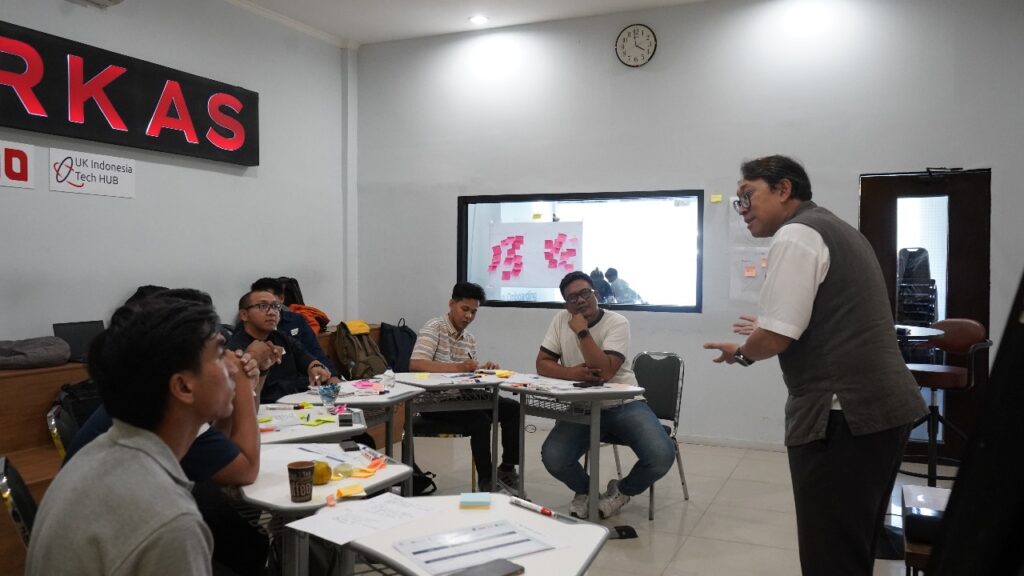
Bali followed on August 15-16 with five businesses: Daurulang.id, Umah Pupa, Electric Wheel, Biojel and Patala. Their onboarding included business diagnostics and a session on access to funding. The emphasis was practical planning for a green business, with mentors and workshops supporting the next three months. Here, “ecosystem” meant people in a room comparing problems and identifying the help they needed.
By the second cohort, the partner account described a stronger emphasis on market access through partnerships and intensive mentoring. On July 30, 2025, a Jakarta showcase presented 12 Hatch x PEDE ventures alongside three teams from PEDE Innovation Lab. It was a documented adjustment in emphasis toward commercial connections, with pitching and business matchmaking on the agenda.
“We were able to collaborate with many other stakeholders and broaden our perspectives on building startups.”
Nova Aryanto, CEO of Olat Maras, on Hatch x PEDE
The classroom has an app and a podcast
Between formal stages, the movement offers several ways to keep learning. Its Android app listing describes a calendar, webinars, private messages and group conversations. Those are modest features with a clear purpose: helping people follow activities and communicate across a distributed program. The listing shows more than 10,000 downloads, a distribution milestone rather than a measure of active founders.
Sekolah Beta’s online classes divide practical learning across the same business, design and engineering roles. The homepage highlights topics as specific as product requirements documents and animation for user interfaces. Rintisan, the pocket-book series, extends the reading into digital talent, startup ideas and innovation. Participants can encounter the material without waiting for a single annual event.
Cakap Startup adds people to the curriculum. Its founder conversations have included Binar Academy’s Alamanda Shantika, Hacktiv8 co-founder Riza Fahmi and Jojonomic co-founder Abdul Qifli Sangadji, known as Aly. The description of Aly’s episode starts in Nabire, Papua, where he grew up. For a movement asking people across Indonesia to imagine a technology career, the geography of a guest’s childhood belongs in the story.
There are tangible examples of ventures identifying with the program, too. Diceritain, which describes its service as peer counseling for Indonesian university students, lists Hatch among its milestones. That is evidence of a connection, rather than a reason to attribute everything the business subsequently does to an incubator. Founders can learn through several institutions along the way.
A starting point in a longer journey
The movement’s distinct position is early, accessible and geographically distributed. University incubators, private accelerators and independent learning offer other routes. Within government’s own support system, a 2024 ministry report places 1000 Startup Digital at the introductory end, Startup Studio further along toward market fit, and HUB.id in business connections. The programs address different moments in a company’s development.
Its published scale needs to be read with the same care. The program page reports more than 85,000 prospective founders, 400 mentors and 1,260 startups initiated. Those categories describe participation and formation. They do not tell a reader how many firms have repeat customers or durable margins. The distinction matters when a project’s name contains a numerical promise.
For a prospective participant, the useful question is closer to home: what must the team learn next? The movement offers a place to find collaborators, a progression of assignments and access to experienced people. Its most convincing invitation is the modest one embedded in that Bootcamp rule. Bring something that works well enough to test. Then let somebody outside the team decide whether it deserves another version.