A car door can make a rather forceful argument about interface design. Mo Maghsoudnia was riding his bicycle when a driver opened one into his path. He later described a different kind of exit control: a surface that could combine an approaching-cyclist warning with light, sound, and a tactile signal. The thought is characteristic of the problem he has chosen for his company. A button occupies very little space. The consequences of pressing it can occupy considerably more.
Maghsoudnia is the founder and CEO of UltraSense Systems. His business concerns the encounter between a finger and an object, and all the engineering required to make that encounter useful. A piece of metal might look inert. With sensing beneath it, the surface can become a control. Then comes the difficult part: deciding which touch deserves a response.
Before the fingertip, the factory
His route to that question began well before smart surfaces acquired a name. He studied microelectronic engineering at Rochester Institute of Technology and earned a master’s degree in electrical engineering at Santa Clara University. His professional background then accumulated around the less visible side of electronics: making the devices, managing the processes, and getting production to work.
At Analog Devices, where he spent fifteen years, his responsibilities included wafer fabrication and technology management. He subsequently became vice president of worldwide manufacturing at NetLogic Microsystems. There, his remit extended across process technology, packaging, quality, and supply chains as the business developed a broader product portfolio.
Consider what that list asks of a person. A design needs a suitable process. A finished chip needs packaging. Customers expect consistent quality. Materials and production capacity have to arrive in the right places. It is a career spent among dependencies, where a promising answer in one department can become an awkward question in another.
In June 2012, he joined InvenSense, replacing its retiring operations executive. He went on to serve as vice president of technology and worldwide manufacturing. The move put him inside a sensor business, close to the work of translating physical events into information electronic products could use. The connection to his later startup is easy to see: sensing must coexist with production discipline.
A second act, under the surface
When TDK acquired InvenSense in 2017, Maghsoudnia pursued another opportunity rather than transferring into the new owner’s employment. By 2018, he was building UltraSense. The company’s founding team brought experience with sensors into a new question: how could ultrasound change the way people operated everyday objects?
He has described the founding discussions taking place in a Santa Clara coffee shop, with ultrasound fingerprint sensing providing an early inspiration. It is an appropriately ordinary setting for a company concerned with everyday interactions. The leap was to consider how a sensing technique associated with one task might serve a wider collection of objects and materials.
The current leadership includes co-founder and chief technology officer Hao-Yen Tang and co-founder and chief sensor architect Sina Akhbari. This is collaborative engineering with unusually small physical ingredients. Maghsoudnia, Tang, and Akhbari also appear together as inventors on a patent application concerning piezoelectric components with force-measuring, touch-sensing, and haptic functions.
The patent application puts those collaborators beside one another on a concrete piece of technical work. Its combination of touch, force, and haptic functions also captures the scope of the interface problem. An input has to be measured, interpreted, and answered. For a person using the finished product, those operations belong to one moment. For the engineers, they require several kinds of expertise to arrive at the same result. Maghsoudnia’s role sits at that meeting point between a technical proposal and an organization capable of delivering it.
At the heart of the proposition was a useful relocation. Put the sensing beneath a product’s outer surface, and the outside could remain continuous while responding to touch. Metal, glass, wood, and plastic became candidates for interaction. A designer could contemplate a control without automatically cutting a hole for a mechanical button.
In February 2020, UltraSense announced a $20 million Series B, taking its disclosed funding at that point to $24 million. Artiman Ventures and Robert Bosch Venture Capital led the round. Abies Ventures, Asahi Kasei, Hui Capital, and Sony Innovation Fund participated. The stated task was to accelerate deployment and support customers in the United States and greater Asia.
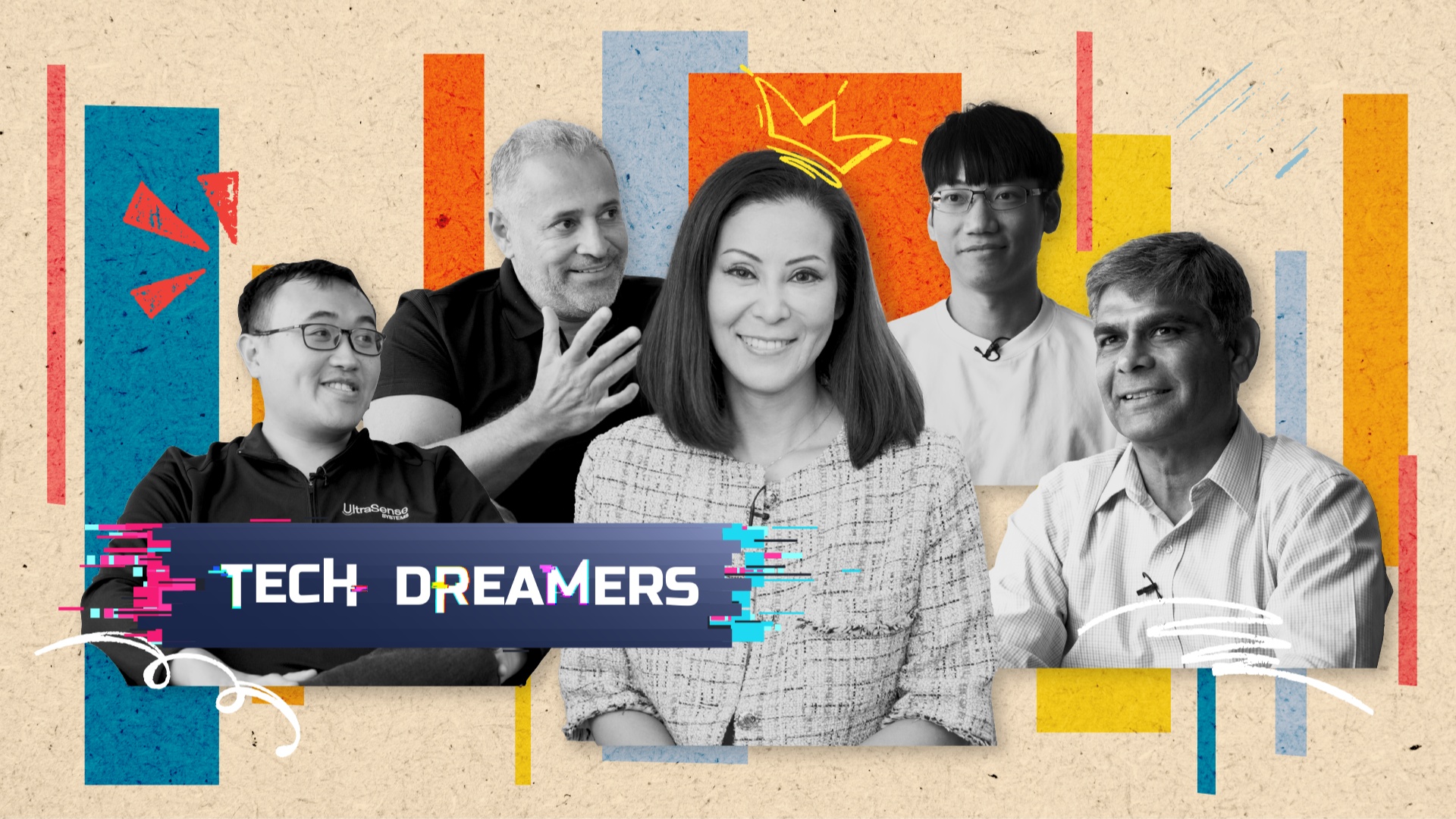
Money bought an opportunity to execute. It did not remove the uncertainties of a young hardware business. In a later televised conversation, Maghsoudnia and Tang discussed a startup journey that included a promising smartphone-company deal and early difficulties threatening the company’s survival. The eventual story would include automotive applications, alongside the original interest in mobile devices.
A raindrop should not open the door
The work becomes easier to appreciate at a car door. UltraSense’s published glass-pillar switch design uses phone authentication, then illumination to indicate where a person should press. Its specified accepted action is a press and release within the icon. Wiping, rain, contamination, and a power wash belong among the inputs it is designed to reject.
That is a good deal of social discrimination for a small patch of glass. The hand cleaning the car and the hand opening it may pass over the same territory. The desired outcomes differ. The product specification makes the distinction concrete: touch location and force become evidence about intention, rather than an invitation to treat every disturbance as a command.
Maghsoudnia’s controller family approaches these problems with different combinations of sensing. TouchPoint C combines capacitive and force sensing. TouchPoint Q provides piezoelectric force sensing that can supplement an existing capacitive system. TouchPoint Z combines ultrasound and force sensing for applications including touch through metal. There is no need to make every material behave like a phone screen.
A slider adds another layer. UltraSense’s metal-slider module senses a finger’s position along a line and supplies haptic feedback. A sensor, controller, and haptic motor are packaged into a module. The little tick people associate with moving a control has to be deliberately provided when the old mechanism no longer supplies it.
For Maghsoudnia, this introduces an obligation along with the design freedom. Removing a familiar mechanism also removes some familiar information. The user still needs confirmation. A smooth surface has to communicate clearly enough that people can understand the result without conducting a small investigation every time they adjust something.
“technology can be overwhelming”
Mo Maghsoudnia, 2022
He has used his children as a sounding board for technology ideas, including replacing steering-wheel stalks. It is a useful domestic setting for an ambitious proposal. The people expected to use an invention bring their own expectations, and a car full of opinions offers a fairly direct form of feedback.
The arithmetic of getting it made
In January 2026, UltraSense reported shipping more than three million automotive HMI controllers. By its April announcement, the company put automotive units shipped above four million. These are component counts, rather than a count of cars. Even with that distinction, they place the story in production rather than solely in the demonstration room.
UltraSense describes a platform spanning MEMS transducers, custom chips, firmware, algorithms, and modules. Owning those layers lets its engineers adjust them together. The manufacturing background in Maghsoudnia’s biography matters here: the object reaching a customer is the accumulated result of decisions across the system.
September brought two announcements that show the next stages of that work. With Antolin, UltraSense described a collaborative development project for a future vehicle platform. UltraSense would provide electronics, sensing architecture, firmware, and algorithms. Antolin would handle integration, engineering, and industrialization of the complete interface.
The division of responsibilities is revealing. Supplying the underlying technology and fitting it into a vehicle interior are connected jobs, each substantial in its own right. The project was announced as development for a future platform. Its promise has to travel through the practical work of turning complementary expertise into a finished product.
Later that month, UltraSense and South Korea’s Partron signed a memorandum of understanding concerning AI wearables and smartphones. The proposed collaboration combines sensing with product integration and manufacturing. It establishes a framework for work, rather than a list of completed deployments. For Maghsoudnia, it is another route toward the place his earlier career taught him to take seriously: production.
The next pair of hands
Wearables bring a particularly unforgiving version of the interface problem. In discussing AR glasses in 2026, Maghsoudnia emphasized everyday appearance and intuitive use. A device sits on somebody’s face. Its controls must live within the constraints of weight, shape, and the ordinary business of wearing glasses.
UltraSense’s April 2026 tactile-platform announcement moves the sensing question into robotics. Here the intended user of touch information is a machine. The company proposes putting the active sensing layer beneath the interaction surface, using ultrasound returns to detect contact and infer force while protecting the sensing element from direct wear.
A robotic hand has to meet things repeatedly. Contact produces friction, pressure, and changes in the surface. The announced architecture aims to preserve useful sensing through those encounters. Maghsoudnia’s argument places durability alongside sensitivity: a useful response needs to remain useful after repeated use.
From a door control to a wearable frame to a robotic gripper, the materials and circumstances change. His chosen problem keeps returning to contact and its meaning. The small component has to serve the larger action. Someone presses, something responds, and the engineering earns its keep in that brief exchange. A button can be a surprisingly demanding employer.
Follow the touch
Conversations, company news, and further reading.