The most fashionable button in a modern car is the one you cannot see. It sits beneath a sheet of trim, perhaps black plastic or brushed metal, and waits for a finger. When the cabin wakes, a small symbol appears. When the finger presses, a pulse confirms the choice. The designer gets an uninterrupted surface. The driver, ideally, gets the certainty of a switch. Making both people happy is the business of UltraSense Systems.
The San Jose company designs semiconductor controllers and interface modules for what engineers call human-machine interfaces. In plainer terms, it helps a solid surface understand a tap, a press, or a swipe. Its touch technology can work beneath materials that are awkward for a conventional capacitive pad, especially metal. UltraSense sells to the people who build products, chiefly automakers and their suppliers, rather than to the person sitting behind the wheel.
- UltraSense combines ultrasound, force, and capacitive sensing to make hidden controls more deliberate.
- Its TouchPoint Q controller has appeared in Genesis and FAW vehicle programs through supplier partners.
- By April 2026, the company reported more than four million automotive units shipped.
- It is extending the same sensing stack to smart rings, AR glasses, and robotic touch.
A beautiful surface has a difficult job
A mechanical switch announces itself by moving. A capacitive pad, like the one on a phone, can sense proximity and touch but may also react to an accidental brush. Put a control beneath metal or a thick decorative layer and the design problem gets harder. UltraSense's answer is to ask more than one question of the finger. Did something touch the surface? Where? Was there force behind it? Only then does the system treat the gesture as an instruction.
The company calls this multi-mode sensing. Its controller can combine ultrasound with force sensing and, where useful, capacitive input. Lighting and haptics can then tell the user what happened. This is less glamorous than the promise of a seamless cockpit, and more useful. A button that looks elegant but changes the music when a sleeve brushes past has confused decoration with control.
Its InPlane Sensing architecture places touch sensing, lighting, and haptic control on one printed circuit board. UltraSense says a representative design can cut plastic by 80 percent, volume by 70 percent, weight by 65 percent, and part count by 60 percent against a traditional mechanical assembly. Those are company comparisons, not universal measurements. Still, the appeal is easy to see: less depth behind a dashboard can give an interior designer room to work, and fewer parts can simplify assembly.
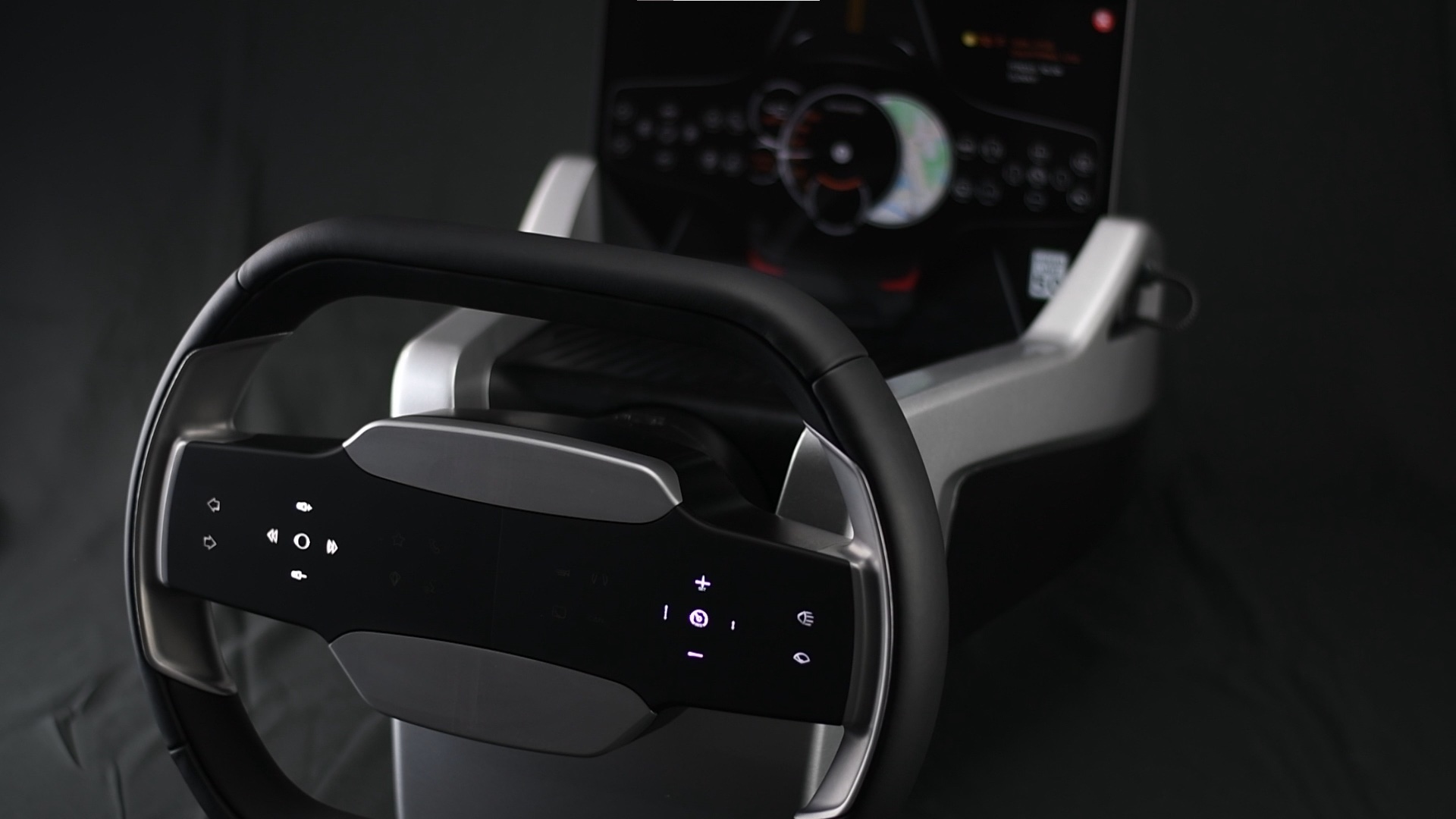
The proof is in the production run
UltraSense was founded in 2018 by Mo Maghsoudnia, Hao-Yen Tang, and Sina Akhbari, engineers with backgrounds in sensors. In February 2020 it announced a $20 million Series B led by Artiman Ventures and Robert Bosch Venture Capital, bringing stated cumulative fundraising to about $24 million. That money backed an ultrasound touch platform pitched broadly at phones, appliances, cars, and other devices. The consumer promise was obvious: a product shell without holes for mechanical buttons.
The more revealing chapter arrived in the car. UltraSense introduced InPlane Sensing in 2022, and a 2023 agreement with Korean supplier Mobase put its TouchPoint Q force controller into solid-surface infotainment bars. In 2024, UltraSense identified TouchPoint Q in Genesis GV80, GV70, and G80 programs through Mobase, and in FAW vehicle steering-wheel controls through BCS Automotive Interface Solutions. These are the partnerships through which a sensor becomes a part in a vehicle rather than a demonstration on a trade-show table.
UltraSense reported more than three million AEC-Q100-qualified automotive HMI controllers shipped in January 2026. Its April robotics announcement put the automotive total above four million. Shipment counts are the company's figures, but they give the story a useful scale. A prototype can be coaxed into behaving for a camera. Millions of controllers must survive a much duller and tougher audience: factory processes, temperature changes, years of use, and people who never read the manual.
“The challenge is maintaining stable, useful tactile data over time in a contact-intensive environment.”Mo Maghsoudnia, founder and CEO, on the robotics platform
Who actually buys an invisible button?
UltraSense is a fabless chip designer and a Tier-2 automotive supplier. It offers TouchPoint HMI controllers, InPlane sensing designs, and solid-state interface modules. A Tier-1 supplier can build those parts into a finished console, door control, or steering-wheel assembly; an automaker then specifies the interaction and puts the assembly in a vehicle. The company also supplies firmware and algorithms, because a sensing chip alone cannot decide what a purposeful press feels like on every surface.
Mobase is the clearest production example. Its infotainment bar combines UltraSense force sensing with capacitive touch and haptics so a driver can press to confirm. Mankiewicz, a coatings company, provides another piece of the puzzle: decorative surfaces whose symbols appear only when lit. In September 2026, UltraSense and Antolin announced a development initiative for a future global vehicle platform. UltraSense will supply electronics and sensing software; Antolin will handle integration and industrialization. It is a division of labor that explains why this market is full of partnerships. The dashboard is not made by one company.
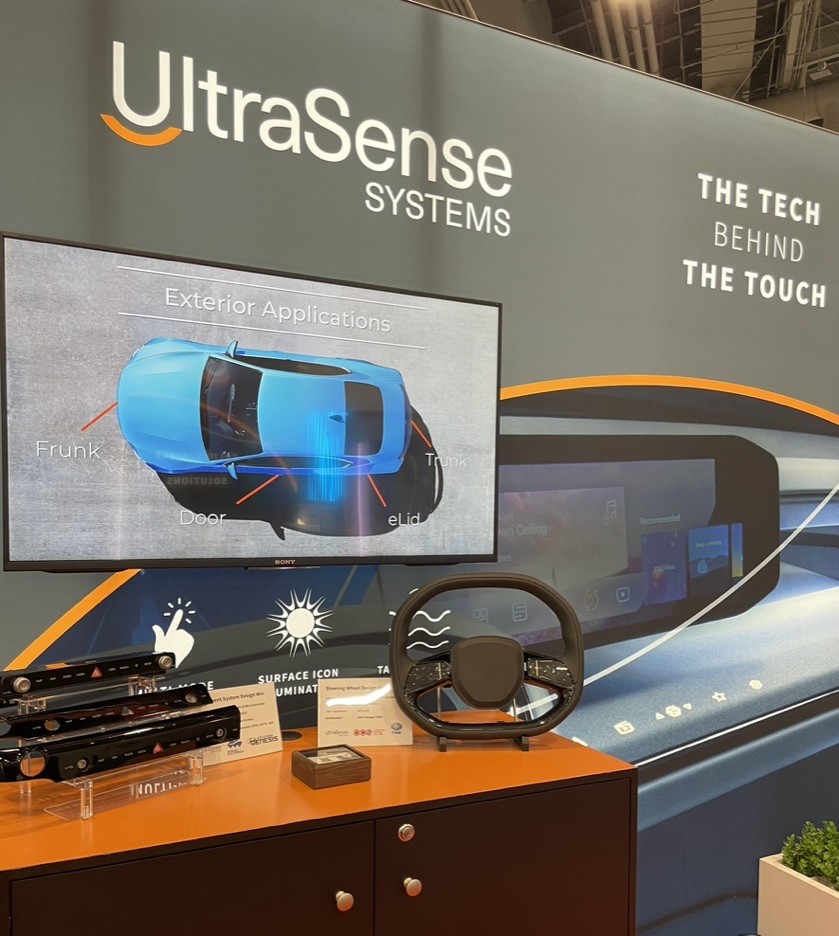
The business model follows the same logic. UltraSense sells controllers, modules, and integration work to OEMs and suppliers; public unit prices and program economics are unavailable. A buyer can ask for a controller to complement an existing capacitive design, or a more integrated module to reduce the number of separate parts. The alternatives remain familiar: a mechanical switch, a capacitive-only pad, or another force-sensing design. UltraSense's specific wager is that ultrasound plus a tuned force threshold can open up more materials while limiting stray activations.
The surface keeps changing
The chronology is telling. The 2020 fundraising announcement emphasized smartphone buttons as much as cars. The later production milestones centered on automotive interiors. In 2025, UltraSense introduced touch technology for AR glasses, where a narrow frame must handle calls, media, and camera functions without becoming a puzzle of gestures. Its UltraTouch AR2 controller combines ultrasound, force, and capacitive sensing for metal or plastic frames. In February 2026 it announced UltraTouch RG1 for metal and ceramic smart rings. These are product platforms aimed at device makers, not consumer gadgets sold under the UltraSense name.
Then came robotics. UltraSense's April 2026 tactile platform moves the sensing layer below the surface of a robotic hand or gripper. The aim is to detect contact and infer force while keeping the active sensor away from abrasion. Evaluation kits were announced for June. A robot that can sense contact reliably has a different job from a driver finding a climate control, but both problems reward a sensor that works through the material people or objects actually touch. The company's September memorandum with Korean manufacturer Partron extends the same idea back toward wearables and smartphones.
There is a practical lesson here for anyone designing an interface. Begin with the accidental interaction: the wet finger, the sleeve brushing a control, the driver reaching without looking. Decide what should count as intent, then choose the sensing and feedback that make that intent legible. UltraSense's best work appears to start where the handsome rendering ends. A smooth surface may win the first glance. A control earns its place by working on the thousandth press.