Six thousand euros bought a peculiar privilege. When BMW announced Personal Pilot L3 for the German market in November 2023, the option would let eligible 7 Series drivers temporarily turn their attention away from the road in defined motorway conditions, at speeds up to 60 kilometres an hour. They could read a message. They could watch a video. A traffic jam, that most democratic of indignities, had acquired a premium escape clause.
Among the technologies supporting that permission was InnovizOne, a laser sensor from Innoviz. The customer saw a button and a promise. Behind them sat years of optics, software, manufacturing preparation and validation. Innoviz’s story begins with that difference in perspective: an apparently simple benefit can demand a very complicated supplier.
- Innoviz sells LiDAR sensors, perception software and engineering services to businesses.
- BMW supplied a production reference; Volkswagen/Mobileye and Daimler Truck/Torc widened the opportunity.
- Customer-funded engineering remains a substantial part of the business.
- Security and defense offer new buyers for expertise developed around cars.
The €6,000 permission slip
LiDAR sends out laser light and measures its return, building a three-dimensional account of the surroundings. Perception software turns measurements into useful distinctions: an object, its position, its category and its movement. A vehicle needs those distinctions to decide what to do next.
There is a temptation to make the sensor the protagonist of every autonomous-driving story. BMW’s launch illustrates the limits of that habit. Personal Pilot L3 combined LiDAR with cameras, radar, other sensing and positioning technology. The driver still had to be ready to take control when prompted. The permission had conditions, including the right road and the right speed. Its €6,000 launch price covered the option package, including VAT, rather than the price of an Innoviz sensor.
For Innoviz, reaching a production vehicle mattered because it placed the company inside the practical world of automotive supply. A demonstration asks whether something can work. A vehicle program asks whether it can work repeatedly, fit the car, survive its environment and satisfy the manufacturer’s safety requirements. The paperwork has a purpose, even when it has no charm.
A sensor with an apprenticeship
Innoviz was founded in Israel in 2016 by Omer Keilaf, Oren Rosenzweig, Oren Buskila and Amit Steinberg. Its early team brought experience from technological units of the Israeli military, including electro-optics, computer vision, MEMS design and signal processing. Those disciplines explain the product more usefully than a grand promise about changing transportation.
MEMS are miniature electromechanical structures. Innoviz’s scanning technology uses them to steer light. The company’s solid-state description should therefore be read with some care: tiny scanning structures can move even though the device does not resemble the conspicuous spinning rooftop sensors familiar from early autonomous-car photographs.
The expertise spans several layers. Optical engineering determines what light reaches the detector. Electronics and custom chips turn those signals into measurements. Software interprets the resulting point cloud. Quality and reliability work tries to keep the whole arrangement dependable outside the laboratory. Innoviz’s management and engineering roster makes that division of labour visible, with teams devoted to photonics, scanning, hardware, software and testing.
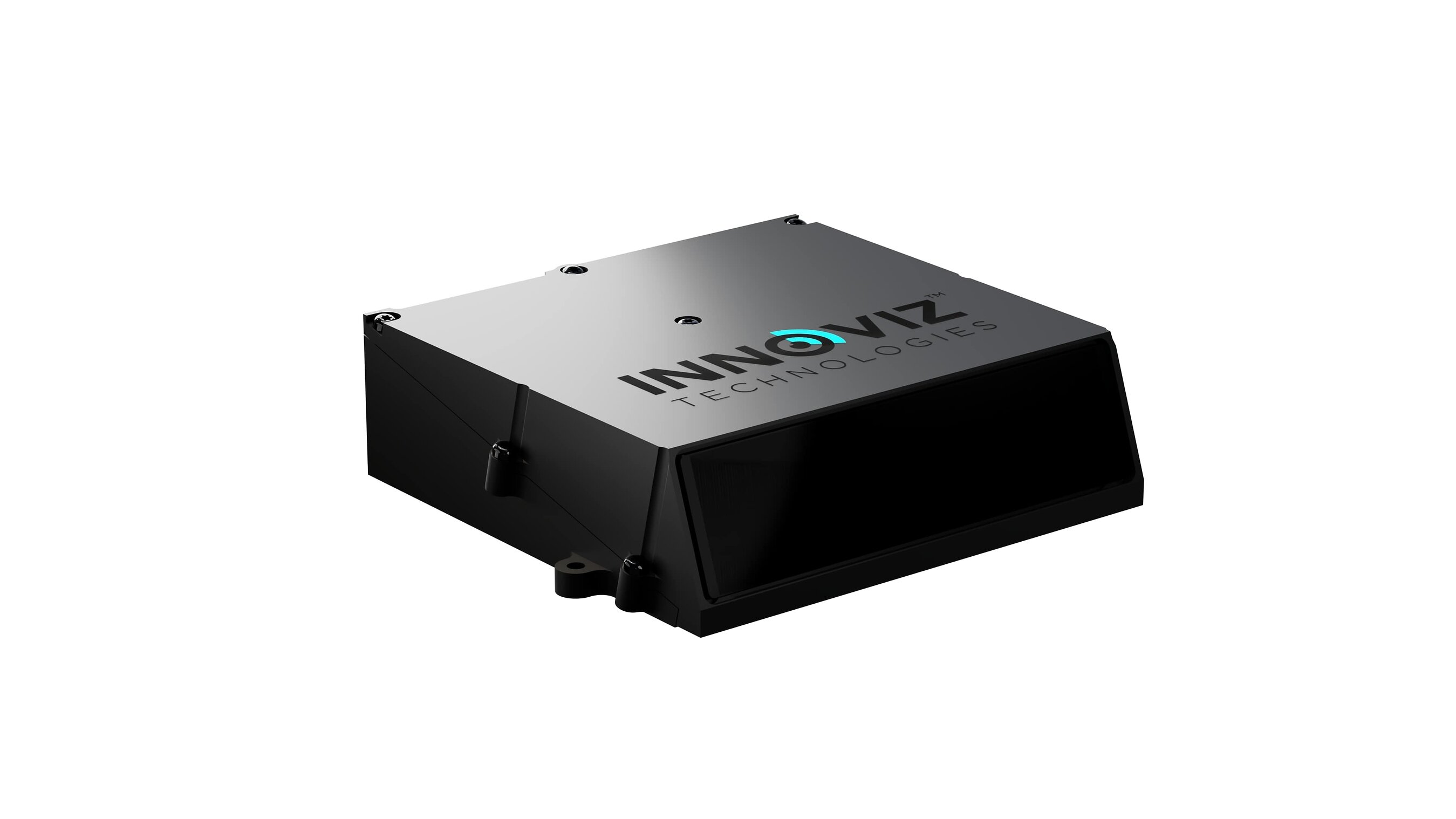
InnovizOne served as an apprenticeship in that world. Its current product page says it is no longer for sale. The next designs carry the lessons forward. InnovizThree, launched in December 2025, was announced at 600 grams with a 13-watt low-power mode. In January 2026, Innoviz announced an integrated camera and sensor-fusion capabilities for the platform. Packaging has become part of the proposition: a sensor that fits the designer’s car is easier to consider than one that asks the designer to start again.
Nine eyes, different jobs
A Volkswagen ID. Buzz AD offers a rather different problem from a premium saloon in a motorway queue. A shuttle needs to perceive the street around it, including nearby obstacles as well as objects farther ahead. Its Innoviz configuration combines three long-range sensors with six short- to mid-range units, working within Mobileye’s autonomous-driving platform.
3 long-range + 6 short- to mid-range
Counts shown schematically; not sensor mounting positions.
The point is coverage suited to the job. Innoviz’s long-range product page publishes a detection range up to 300 metres. Its short- to mid-range offering emphasises a broad vertical field of view. Those specifications describe different priorities. Looking far down a road and noticing something close to a tall vehicle are related tasks, but neither automatically solves the other.
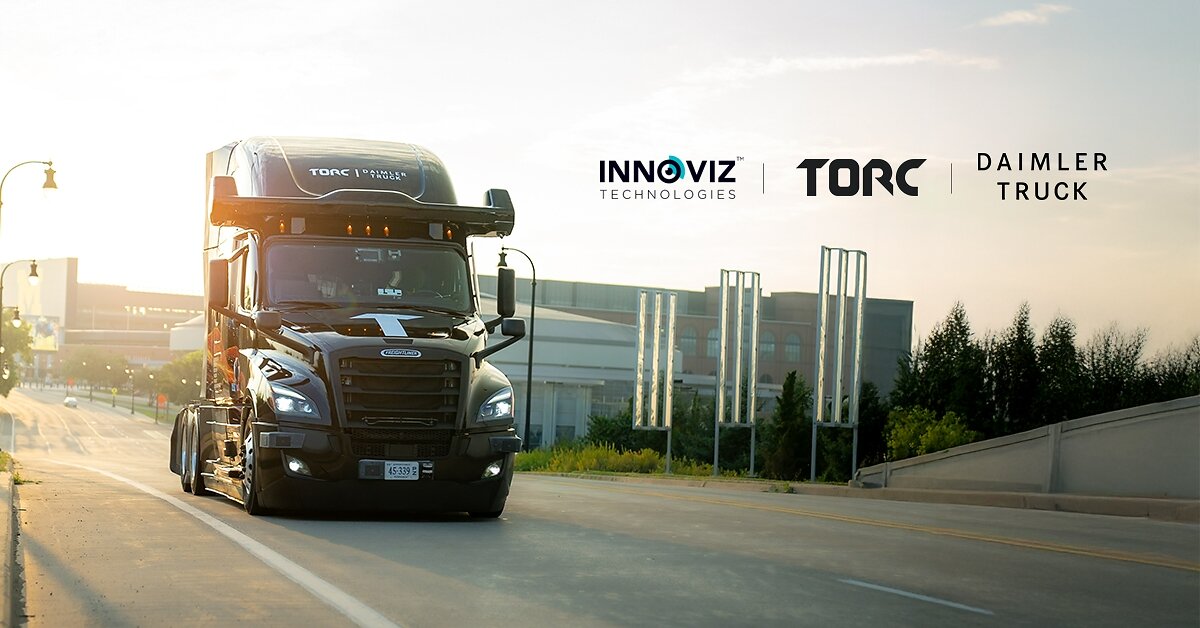
That distinction also appears in trucking. In December 2025, Daimler Truck and its subsidiary Torc Robotics named Innoviz as their short-range LiDAR supplier for future series-production Level 4 Class 8 trucks. The planned integration is part of an autonomous Freightliner Cascadia, alongside Torc’s virtual driver and other components. A selection is a meaningful commercial step; the production and deployment work still follows.
“Selecting the right LiDAR partner is fundamental to our autonomous trucking strategy.”Rakesh Aneja, Daimler Truck North America · December 2025
The revenue before the revenue
Here the financial statements interrupt the showroom tour. Innoviz reported $55.1 million in revenue for 2025, up from $24.3 million in 2024. About $37.2 million came from non-recurring engineering, or NRE. Another $8.4 million came from selling machinery to a customer. Its operating loss was $67.7 million.
$37.2m Engineering
$8.4m Machinery
~$9.5m Remaining revenue
NRE means a customer pays for development work attached to its requirements. For a supplier facing long vehicle-development cycles, that can bring money in while the eventual production program is still being prepared. It also reveals how much labour sits between selecting a component and selling cars that contain it.
My reading is that the practical lesson for hardware founders lies here. Negotiate payment for identifiable engineering work. Keep the economics of that work visible alongside the hoped-for economics of volume production. An automotive nomination can be valuable, but it cannot pay every bill merely by existing.
Innoviz occupies a demanding part of the market. Hesai offers automotive LiDAR alternatives, while Valeo has its own series-production LiDAR history. Buyers have reasons to compare price, integration, qualification and software as well as range. Innoviz’s pitch combines its sensor platform with perception expertise and experience inside named customer programs. That combination gives a purchasing team something concrete to evaluate; it does not settle every procurement contest.
The expensive art of choosing
The financial patience required was apparent early. Innoviz’s Series B ultimately reached $73 million in 2017, with automotive and electronics backers among the investors. Its Series C closed at $170 million in 2019. In April 2021, its combination with the SPAC Collective Growth brought approximately $371 million in gross proceeds and a Nasdaq listing.
Money bought development time. It also enabled parallel commitments. By January 2024, Innoviz said it had been funding both InnovizOne and InnovizTwo production-path programs since 2021. Once InnovizOne reached series production, it moved new quoting and bidding activity to InnovizTwo and reduced duplicative development spending.
The same realignment reduced investment in a minimum-risk-manoeuvre software initiative and the InnovizCore AI compute module. Innoviz announced an approximately 13 percent headcount reduction and expected annualised cash savings of $22 million to $24 million. These were announced plans and targets, rather than proof that every saving materialised.
The documented constraint was the cost and time involved in pursuing several futures at once. Innoviz’s explanation was explicit: some initiatives demanded meaningful cash upfront and a lengthy wait for commercialisation. A founder reading this can copy the decision rule. Ask which customer need is funded, which product can serve it, and how long the company must carry the work before receiving payment.
A second use for automotive homework
During 2026, Innoviz gave that accumulated expertise more places to earn its keep. InnovizSMART serves industrial and infrastructure sensing. InnovizSMARTer pairs LiDAR with NVIDIA Jetson Orin Nano processing, addressing the inconvenience of moving large amounts of raw sensor data through constrained networks. A useful installation has to communicate as well as detect.
In July, Innoviz launched Perciz, its defense and homeland security brand, using existing LiDAR technology for applications including perimeter protection and counter-drone systems. It announced initial defense orders of about $3.5 million. In September, the company reported that Israel’s defense research directorate, MAFAT, recognised its LiDAR as suitable for defense applications. Recognition and orders are separate milestones.
The automotive business continued alongside this expansion. Innoviz reported second-quarter 2026 revenue of $18.1 million. It also closed a roughly $30 million registered direct offering in July. More buyers create opportunities, but capital remains part of the operating story.
The approach depends on customers proceeding with their programs, paying for development and buying hardware at workable economics. Published maximum ranges do not establish performance for every target, weather condition or installation. Nor can a capable sensor, by itself, validate an entire autonomous vehicle. Those limits belong in the purchasing decision.
Innoviz makes an unusually useful case study because the benefits are real and the waiting is visible. The driver wants a few minutes back in a traffic jam. The automaker wants a system it can put in a car. The supplier must make a device, an interpretation of the world and a business that can survive the time between the two.
See the sensors at work
Explore Innoviz’s website, its ID. Buzz product story and company news.