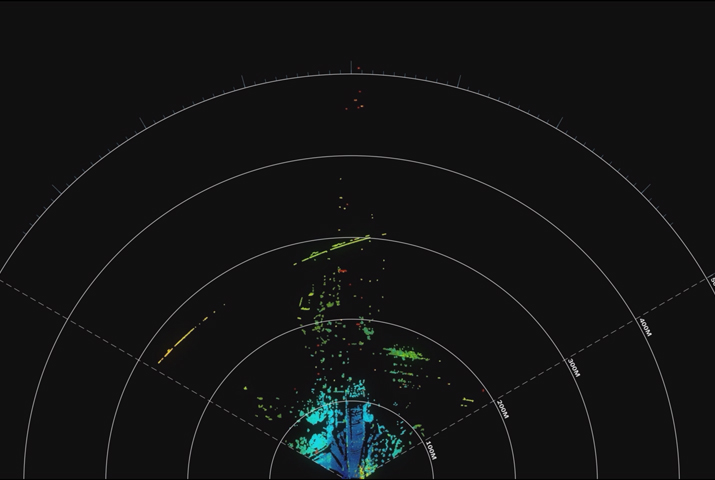
At a test track outside Sunnyvale, a black sedan rolls down an unlit lane at 60 miles an hour. The cameras on its roof are, for all intents and purposes, blind. The Seyond Falcon mounted behind the windshield is not. It sees a tire lying flat on the asphalt 250 meters out, plots it, classifies it, and decides what the car should do about it - all before the driver's eyes have finished adjusting to the dark.
Who Seyond is right now
Seyond is, depending on the day, three things at once. It is a hardware company whose sensors sit behind the windshields of NIO's most popular electric cars. It is a software company whose perception stack turns clouds of laser dots into useful objects. And it is a Silicon Valley startup with manufacturing lines in Ningbo and Suzhou that has shipped more than 250,000 of its flagship LiDAR units - a figure most of its public-market rivals would politely decline to discuss.
The headcount sits around 140. The website is bilingual without making a fuss about it. The CEO, Junwei Bao, is still answering his own email. None of this is the usual founder mythology, and that may be the point.
The problem they saw
Back in 2016, the question facing anyone building autonomous vehicles was the same one that had been around for a decade - can a car see well enough, in enough conditions, to be trusted with a human life? The fashionable answer was that cameras and a sufficiently clever neural network would get there eventually. The unfashionable answer was that physics had not been repealed: cameras struggle at night, in fog, in rain, in low contrast. They struggle most of all with the thing autonomous driving fails on - the unexpected dark object in the road.
LiDAR did not struggle with any of that. It also cost roughly as much as the car. It was the size of a coffee can. It rotated noisily on the roof. It looked, in short, like a science project that had no business being on a production vehicle.
The founders' bet was that the science project did not have to stay one.
The founders' bet
Junwei Bao and Yimin Li met at the intersection of optics and applied physics. Bao had spent a career thinking about how light moves through complicated environments. Li had spent his thinking about how to build instruments that survive being shaken, baked, and frozen in real-world products. Their combined hypothesis was modest in shape but ambitious in scale: a LiDAR that detected things the way a human eye does - with enough resolution to recognize a tire as a tire and not just as an obstacle - could be built small enough, cheap enough, and tough enough to ride inside a passenger car for ten years and 250,000 kilometers.
They called this "image-grade LiDAR." The phrase has since been borrowed liberally. At Seyond, it remains less a marketing line than a specification: enough points per second, enough angular resolution, enough range, to produce a picture you could actually do computer vision on rather than a smear of dots that needed heroic interpretation.
The product, in plain terms
The Seyond catalogue is short enough to read on a napkin, which is unusual for a sensor company.
Falcon
The flagship. Long-range, image-grade, automotive certified. Sees 500m. Sees dark objects at 250m. Lives on NIO's premium EVs.
Robin W
Wide field of view (120 x 70 degrees) for robotics, warehouse vehicles and infrastructure. The peripheral vision unit.
Robin E1X
Image-grade front-view for ADAS. 200m range, 120 x 20 degree FoV, dense enough to do real perception on.
Hummingbird D1
Fully solid-state. No moving parts. The version that lets LiDAR finally become as boring as a brake light - and as reliable.
OmniVidi
Perception software. Turns the firehose of points into objects, tracks, and decisions.
The point of the lineup is not breadth for its own sake. It is that the same optical recipe scales up to a 500-meter highway sensor and down to a stamp-sized solid-state unit. A platform, not a product.
The Seyond timeline
- 2016Founded as Innovusion by Junwei Bao and Yimin Li in Silicon Valley, with R&D quietly expanding into China.
- 2018First Falcon prototypes demonstrated. Industry mostly yawns.
- 2020NIO selects Falcon for its next generation of electric vehicles.
- 2021Series B and B+ close totaling roughly $130M, led by Temasek with Shunwei, NIO Capital, F-Prime and others.
- 2022Falcon ships as standard equipment on NIO ET7, ET5 and ES7. The catalog stops being theoretical.
- 2023Innovusion renames itself Seyond. The brand finally fits in a tweet.
- 2024Falcon K cumulative shipments cross 250,000. Industrial and infrastructure customers multiply.
- 2025Exclusive supply agreement signed with a major Chinese auto group. Solid-state Hummingbird enters production planning.
- 2026CES debut of the full end-to-end portfolio, mass-production-ready solid-state included.
The proof
The most persuasive thing about Seyond is that the proof is not a press release. It is a part number on a bill of materials. Open a NIO ET7, look behind the rearview mirror, and there it is - a Falcon, doing its job at highway speed for owners who in many cases have no idea who built it. That is the goal, in fact. Sensors that are visible to engineers and invisible to drivers.
What the numbers say
Read horizontally, the bars are about light, distance, capital and people. Read together, they describe a company that is leaner than its output suggests - which is, more or less, the whole pitch.
Beyond the automotive line, the customer list reads like a tour of industries that have spent the last decade trying to bolt sensing onto things that move. Avikus, the autonomy unit of HD Hyundai, uses Falcon to keep boats from running into harbor walls. Hexagon plugs the sensors into geospatial workflows. Cratus handles US distribution. Mining operators in Australia, port operators in Asia, highway operators across Europe - all customers of the same small Sunnyvale company.
The mission, stated without flourish
Seyond's stated mission is to help machines see smarter. In practice this means two things. First, that LiDAR has to stop being exotic. It has to be ordinary - cheap enough to be standard, durable enough to be ignored, small enough to disappear behind a windshield. Second, that the data the LiDAR produces has to be useful out of the box. A point cloud is not a perception system; OmniVidi is what closes that gap.
None of this is a particularly romantic story. There is no Steve Jobs at the keynote. There is no consumer device. There is, instead, a stubborn idea that the hardware needs to be good enough to disappear, and a company that keeps building toward it.
Why it matters tomorrow
The conventional wisdom about autonomous driving has cycled, roughly, between "this is happening next year" and "this will never happen" for fifteen years. The truth is more boring and more interesting. Autonomy is happening, gradually, in lanes: highway pilot first, urban second, full Level 4 robotaxis third. Each of those lanes needs a sensor stack that can see at night, in rain, at distance, and survive a decade of vibration. Seyond is one of a handful of companies whose hardware is already inside production vehicles meeting those tests.
The next chapter is solid-state. The Hummingbird D1 - small, fan-less, electronically steered, no moving parts - is the version of LiDAR that finally looks more like a chip than an instrument. If it ships at the price points being discussed, LiDAR stops being a category and becomes a component, the way GPS quietly became one inside every phone two decades ago. That is the bet now.
Back at that Sunnyvale test track, the black sedan rolls past the tire and slows neatly without drama. The driver, who has been chatting through the demonstration, does not notice. Which is, in the end, the whole achievement.