A Company That Sells Speed You Cannot See
Here is a fact that sounds boring and is not: a modern car is a small, mobile data center that mostly loses money whenever its data does not arrive on time. Cameras, radar, lidar and a dozen compute boxes all need to talk to each other, constantly, and the moment that conversation stutters, the car's brain is making decisions on stale information. Ethernovia, a roughly 96-person semiconductor company in San Jose, sells the plumbing that keeps the conversation from stuttering. This is a less exciting sentence than "we build AI," and it is arguably a more important one.
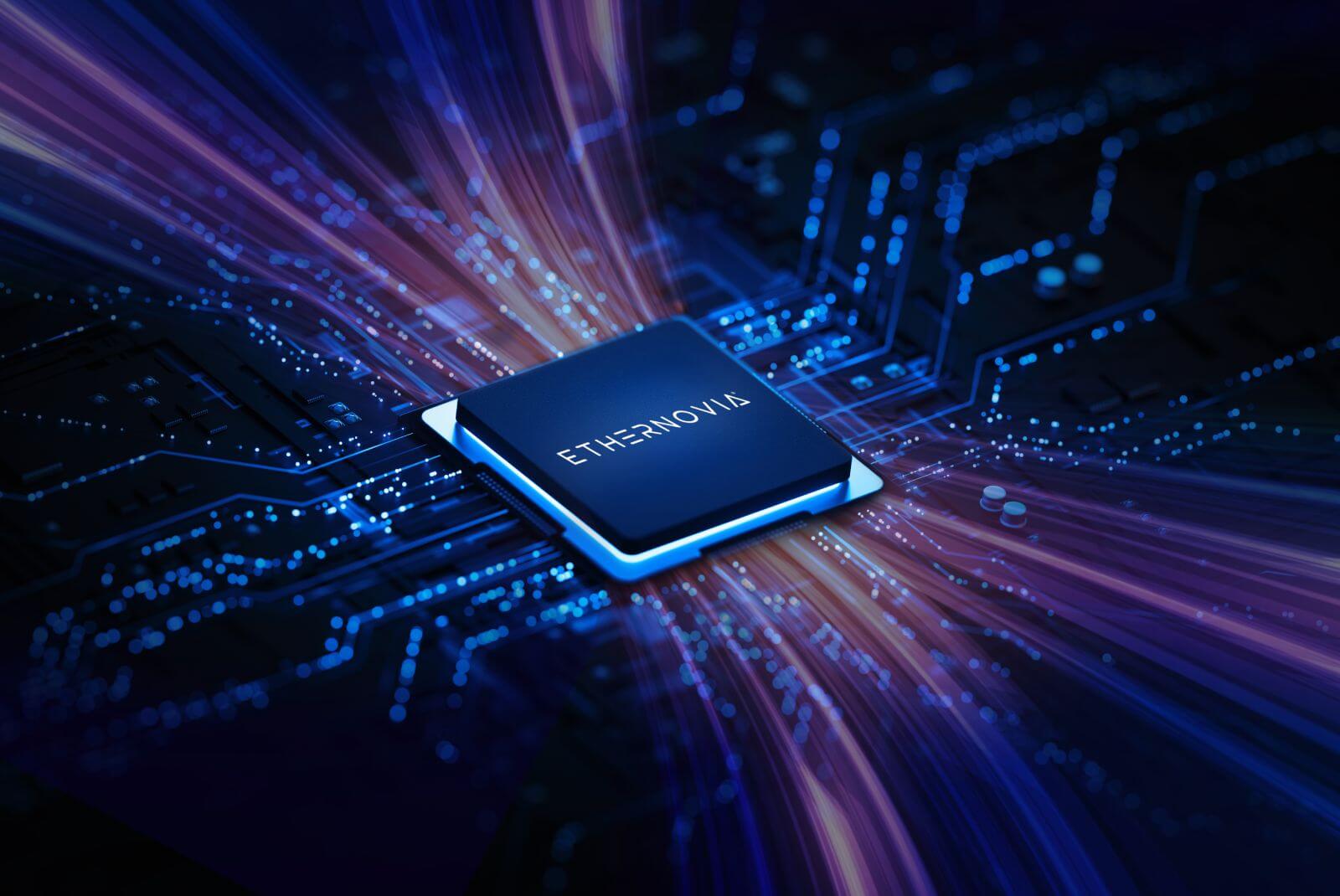
The pitch goes like this. Cars used to be networks of small, dumb wires - one bus for the windows, another for the brakes, a tangle of copper that got heavier and more expensive with every feature. That worked when cars did a few things. It does not work when a car wants to drive itself, update its software over the air, and run advanced driver-assistance systems that eat bandwidth the way a teenager eats a data plan. The industry's answer is to move to Ethernet, the same networking standard that runs the internet, and to consolidate all those little computers into a few big ones. Ethernovia makes the chips that make that shift possible: the Ethernet PHY transceivers that push bits down the wire, the switches that route them, and the packet processors that decide what goes where.
The word Ethernovia keeps using is deterministic, and it is doing a lot of work. Regular networks are fast on average, which is fine for streaming a movie and disqualifying for stopping a two-ton vehicle. A deterministic network guarantees not just speed but timing - your data arrives inside a known window, every time, so the car never has to guess. When Ethernovia describes its chips as the "nervous system" and the "reflexes" of a machine, that is the actual claim: not that the network is quick, but that it is predictable enough to trust with a decision.
The engineering flex
In March 2024, Ethernovia unveiled what it called the world's first single and quad-port automotive Ethernet PHY that scales from 10 Gbps all the way down to 1 Gbps in a single device - the ENT11100 and ENT11025 - built on TSMC's 7nm process. Two things are notable here. First, 7nm is a leading-edge node normally reserved for smartphones and data-center chips, not the automotive world, which tends to run a few generations behind for cost and reliability reasons. Bringing it to a car PHY is a way of buying power efficiency and thermal headroom that competitors on older nodes cannot easily match. Second, one chip covering four speeds means an automaker can design its network architecture once instead of picking a different part for every link. In a business where design cycles run for years, "design once" is a genuine selling point, not a slogan.
He Already Did This Once
Ethernovia was founded in 2018 by Ramin Shirani and a group of fellow Ethernet-silicon veterans, and Shirani's résumé is the kind that makes strategic investors return phone calls. He co-founded Aquantia, an Ethernet chip company that went public on the NYSE in 2017. Before that he co-founded Enable Semiconductor, acquired by Lucent in 1999. He holds more than 60 patents and is credited as the inventor of Ethernet auto-negotiation - the handshake that lets two Ethernet devices agree on a speed - which is now used across the entire industry. When the person building the car's Ethernet stack is the person who invented a piece of how all Ethernet negotiates, that is a reasonable thing to put on the pitch deck.
The founding team reads like a reunion tour: chief technology officer Hossein Sederat, engineering SVP Roy Myers, and silicon VP Darren Engelkemier all bring deep IC-development backgrounds. This matters more than usual in semiconductors, where the gap between "we have a great architecture" and "we have working silicon that survives a decade under a car hood" is wide, expensive, and littered with startups that never crossed it.
Who Is Buying, and Why It's Telling
In May 2023, Ethernovia closed a $64 million Series A. In January 2026, it closed a Series B of more than $90 million, led by Maverick Silicon, with Socratic Partners, Conduit Capital and CDIB-TEN Capital joining alongside returning backers. That pushes total funding past $150 million. The amounts are respectable for a fabless chip company, but the more interesting line is the investor list: Porsche SE, Qualcomm Ventures and AMD Ventures have all put money in.
Strategic investors like those do not chase narrative; they buy supply chains and option value. Porsche wants to know its future network silicon exists. Qualcomm and AMD sit next door to this problem in compute and connectivity. When a carmaker's holding company, a mobile-chip giant and a data-center-chip giant all show up on the same tiny cap table, the signal is less "this is hot" and more "several people who would know consider this part of the road ahead." The company says it will use the money to accelerate its packet-processor family, expand software and systems work, and support customers across automotive, robotics and industrial markets.
And there is the Continental partnership, announced in 2023, to co-develop a 7nm automotive switch. Tier-one suppliers are cautious institutions; when one agrees to build silicon with a startup, it is a vote that the incumbent way of wiring a car is genuinely up for grabs. That is the whole bet, really: that the automotive network is being rebuilt, that Ethernet wins, and that a focused specialist can out-execute the big general-purpose networking vendors on the part of the problem that touches the car most directly.
The Uses, Minus the Jargon
It is worth being concrete about what Ethernovia's silicon actually enables, because "networking chips" is the kind of phrase that lets your eyes slide off it. Start with ECU consolidation. A modern car can carry dozens of electronic control units - little computers, each bolted to its own function, each with its own wiring. Consolidating them onto a handful of powerful compute boxes connected by fast Ethernet cuts weight, cost and complexity. Ethernovia's PHYs and switches are the links that make consolidation practical, because you cannot collapse forty computers into four unless the four can talk to everything at once, reliably.
Then there is the software-defined vehicle itself - the idea that a car's features should be updated over the air, the way your phone gets new tricks overnight, rather than frozen the day it left the factory. Over-the-air updates and continuously improving driver-assistance features both assume a network with the bandwidth to carry new software and the determinism to run safety functions on top of it. That is the environment Ethernovia designed for: high bandwidth, low latency, low power, and predictable timing, all in a part rated to survive the heat and vibration of an automobile for years.
The company is also pointing the same technology outside the car. Robotics, industrial automation and edge-AI systems have the identical shape of problem - many sensors, central compute, a hard deadline for turning perception into action. Ethernovia's Ethernet Sensor Bridge for NVIDIA Holoscan is a tell here: it takes high-bandwidth sensor data and feeds it into an edge-AI compute platform. If the car was the first customer, "any intelligent machine that has to react to the physical world" is the market the Series B is really buying.
Small Fish, Crowded Pond
Ethernovia is not alone in noticing that cars are becoming Ethernet networks. Marvell, Broadcom, NXP and Microchip all sell into automotive networking, and they are far larger, with existing customer relationships and the kind of balance sheets that let them wait out a slow design cycle. That is the standard hard truth of a chip startup: the incumbents are not asleep, and automakers are conservative buyers who do not switch suppliers on a whim.
Ethernovia's counter is focus and process leadership. The big vendors serve many markets; Ethernovia does one thing and is trying to do it on a more advanced node than the incumbents brought to automotive. Its argument to a carmaker is that a single scalable PHY family, in 7nm, with integrated switching and deterministic behavior, is a better foundation for a network you will ship for a decade than a patchwork of older parts. That argument only wins if the silicon works and the design-ins land - which is why the money is going toward production, software and customer engagement rather than, say, marketing.
An Engineer's Company
There is not a lot of theatrical mission-statement energy around Ethernovia, and that appears to be by design. It is a semiconductor company staffed by people who have built Ethernet ICs before, many of them together, at Aquantia and elsewhere. The through-line is craft: patents, standards participation, and the unglamorous discipline of turning an architecture into automotive-grade silicon that does not fail in the field. For a certain kind of engineer, "we are the people who invented auto-negotiation, and now we are doing the car" is a more compelling recruiting pitch than any perk.
Whether the bet pays is a question for the design wins of the next few years - the part of a chip company's story that happens quietly, in engineering labs, long before anyone gets to write the headline. But the shape of the wager is clear, and it is a sensible one: the automotive network is being rebuilt from scratch, the winning standard looks like Ethernet, and there is real value in being the specialist who owns the fastest, most predictable path between a machine's senses and its brain. Ethernovia has the founder, the money and the process node to take the swing. The rest is execution, which in semiconductors is another word for everything.