AXONNE, San Jose - the chipmaker that wants the car to think faster than it drives.
Company / Semiconductors
AXONNE.
Wiring the AI-defined vehicle, one twisted pair at a time.
Wiring the AI-defined vehicle, one twisted pair at a time.
On a bench in a San Jose office park, a coil of copper no thicker than a shoelace is carrying ten gigabits a second. No fiber. No shielding worth bragging about. Just a single twisted pair, and a chip at each end doing arithmetic fast enough to make the noise disappear. That chip is AXONNE's. The car of the near future is, underneath the leather and the touchscreens, a rolling data center - and somebody has to build its nervous system.
AXONNE builds that nervous system. The name is a near-pun on axon, the fiber that carries signals between neurons, which is either a coincidence or the most honest brand decision in semiconductors. The company is fabless - it designs silicon and lets others fabricate it - and it has pointed all of its attention at one unglamorous, enormous problem: getting data around a car quickly, safely, and without burying the vehicle in wiring harness.
The old way was a tangle. Each camera, each radar, each domain controller had its own link, its own pace, its own dialect. AXONNE's bet is the zonal architecture - fewer, fatter pipes, all speaking Ethernet, all scalable from one gigabit to ten and beyond. Less harness, more bandwidth. It is the difference between a switchboard and a network.
It helps that the people doing the betting have done this before. The founding team first brought Automotive 1000BASE-T1 Ethernet to market in a prior life. Now they are aiming an order of magnitude higher.
"The car becomes a computer. We build the wires that let it think in microseconds, not milliseconds."
- The AXONNE thesis, in plain English
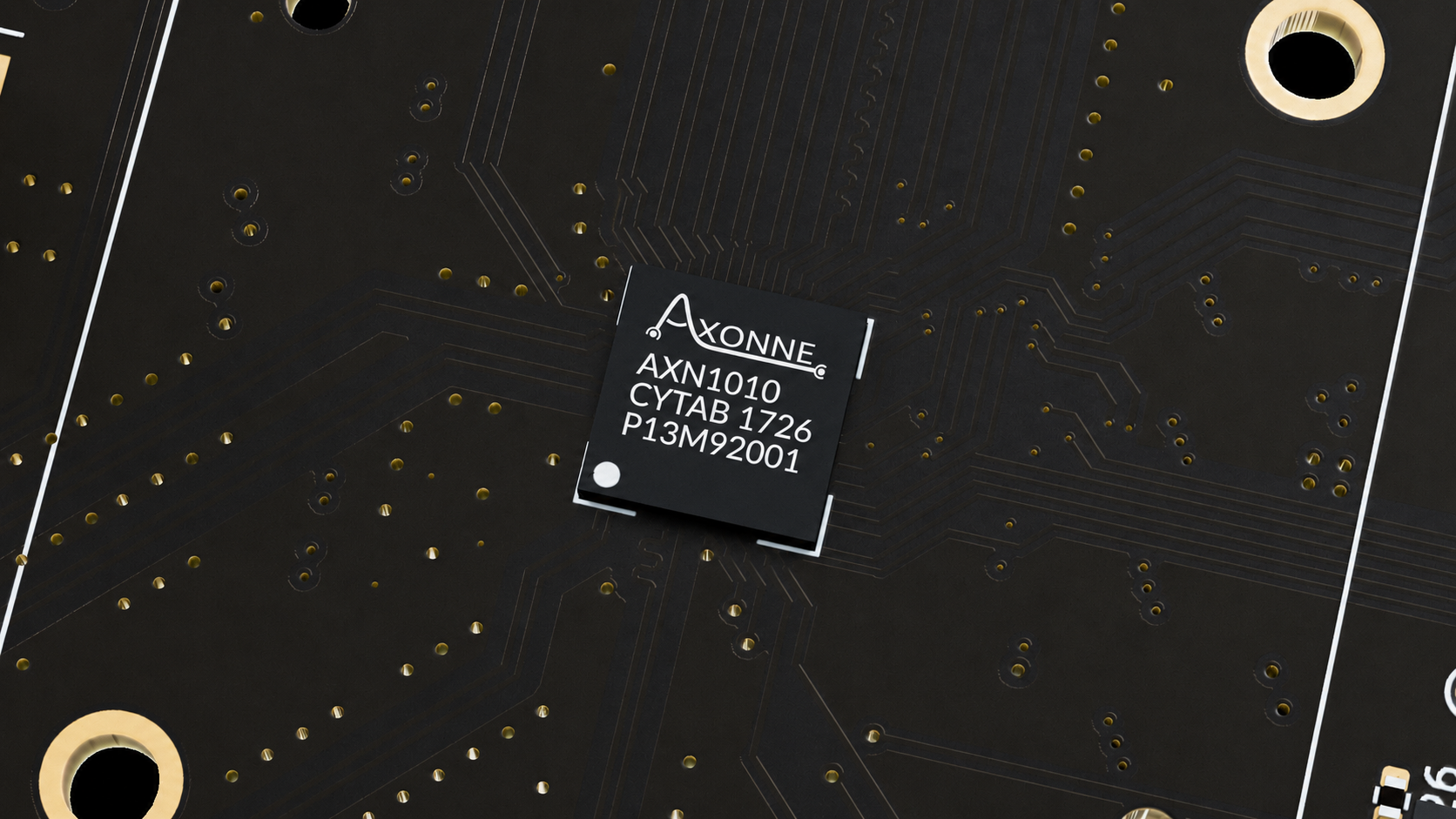
An Automotive Ethernet transceiver compliant with IEEE 802.3ch - 1Gbps to 10Gbps over a single unshielded twisted pair or coax, covering 1000BASE-T1 through 10GBASE-T1.
Maps MIPI CSI-2 sensor data straight onto multi-gigabit Ethernet using IEEE 1722, with PTP timing - so cameras, radar and lidar drop onto the network without translation tax.
A reference platform built with Leopard Imaging and Amphenol, shown as the world's first multi-gigabit Automotive Ethernet camera module - powered by the Cyton PHY.
One PHY family, the full ladder. Pick the rung the zone needs.
BS, MS and PhD in EECS from UC Berkeley. Spent nearly 15 years as VP of Engineering at Marvell before walking away from a large-cap chair to build automotive silicon from scratch.
Co-founded AXONNE on the conviction that the in-vehicle network needed to be rebuilt from the silicon up - part of the team that first brought Automotive 1000BASE-T1 Ethernet to market.
AXONNE founded in Silicon Valley by Gani Jusuf and William Lo.
Named among Intel Capital's cohort of 11 startups sharing a $132M investment round.
Shows the world's first multi-gigabit Automotive Ethernet camera module with Leopard Imaging and Amphenol at DesignCon.
Joins the AutoSens Europe press conference, framing its work around AI-defined mobility.
Presents at the Automotive Ethernet Congress in Munich.
San Jose corporate HQ, with European design centers in Karlsruhe and Hamburg, Germany, and Bucharest, Romania. Fabless by design - chips engineered here, fabricated elsewhere.
Video links open YouTube search - AXONNE's appearances cluster around DesignCon, AutoSens and the Automotive Ethernet Congress.
Back to that bench in San Jose, and the shoelace of copper still humming with ten gigabits. A few years ago, moving that much data in a car meant fiber, or a thicker harness, or simply not moving it at all. Now it rides a single pair, and the chip at each end - quiet, fabless, unglamorous - makes the impossible look like nothing happened.
That is AXONNE's whole trick. Not a logo on the hood. Not a name a driver will ever read. Just the wire under everything, fast enough that the car's eyes and its brain finally agree on what they are seeing - in microseconds, before the road has time to change.