A finger slides across a laptop touchpad. A cursor moves. The transaction is so ordinary that the engineering has become invisible. Yet somebody must distinguish an intentional gesture from a stray palm, translate movement into instructions, and do it without making the user think. Synaptics built a business in that small gap between what a person means and what a machine understands.
- Inside the device: touch, displays, wireless connections, and embedded AI.
- The customer: the manufacturer building the finished product.
- The bet: more intelligence running locally, under tight power limits.
Today the gap is widening. A security camera has images to interpret. A voice interface must make sense of sound. A robot hand needs information about contact. Synaptics wants to supply more of the electronics between those signals and a useful response. The touchpad is a good place to begin understanding the ambition. It is a poor place to stop.
The research found a finger
Federico Faggin and Carver Mead founded Synaptics in 1986. Its early subject was neural-network circuitry. A 1988 Dataquest profile described a five-person company researching intelligent sensors and pattern recognition, without products expected for some time. The original problem was ambitious: build circuits that could recognize something about the world.
The commercial answer became wonderfully physical. Synaptics’ history dates its notebook touchpad launch to 1995. Capacitive sensing also reached the Apple iPod’s click wheel in 2004. Here was computing that rewarded a finger rather than demanding a lesson. The pattern suggests a useful discipline for inventors: an abstract capability earns its keep when somebody can use it to do one ordinary thing more easily.
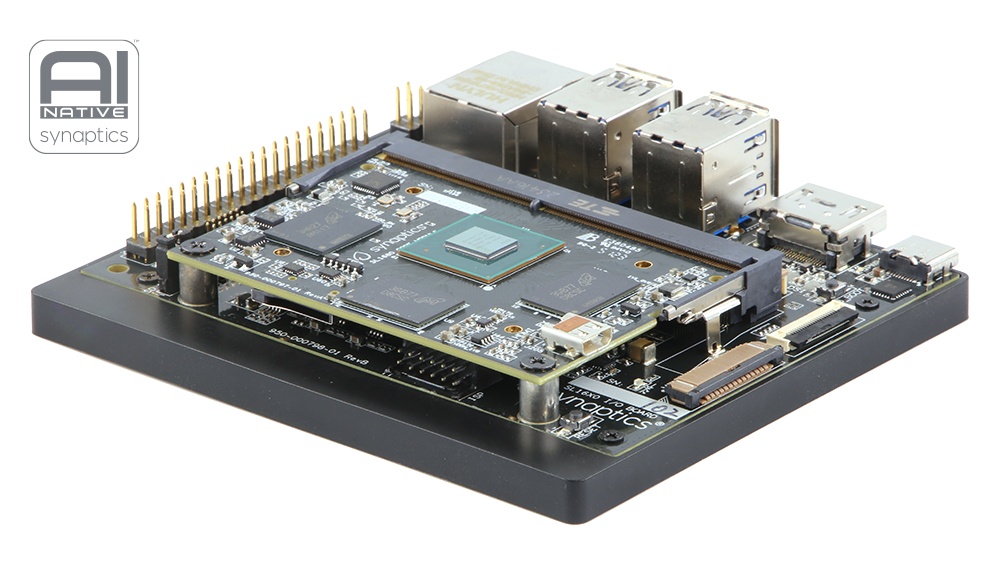
The Synaptics Coralboard is a starting line the whole ecosystem can share.
Olivier Lacombe · Google DeepMind · October 2026
Buying the missing pieces
A touch interface, however successful, does not give a supplier everything needed for an intelligent connected product. Synaptics expanded through acquisitions. Conexant and Marvell’s multimedia business added audio and video capabilities in 2017. Broadcom wireless IoT assets and DisplayLink followed in 2020. DSP Group brought further voice and low-power processing expertise in 2021.
The bills make the strategy tangible. The 2020 Broadcom transaction cost $250 million. DisplayLink was announced at $305 million; later filings recorded $444 million in aggregate purchase consideration, including acquired cash and investments. Those figures describe different measures of the same deal. DisplayLink’s practical contribution is easier to recognize: software and chips that help a computer drive additional displays through a docking connection.
The resulting company sells components and engineering possibilities to manufacturers, rather than a single finished gadget. Its technology can appear inside laptops, phones, audio equipment, automotive interfaces, and connected appliances. Manufacturing partners fabricate and package its designs. Synaptics’ job is to win a place in somebody else’s product, then keep delivering when that product ships.
A model needs a whole device
Astra, launched in April 2024, pulls the newer ambition into view. It combines embedded processors with software and development hardware for running AI close to the sensor. A manufacturer can use local processing to avoid sending every input away for interpretation. That can shorten response times and reduce the movement of sensitive data, though the application determines the actual benefit.
One interaction. Several engineering problems.
Google Research supplies an important partnership through Coral NPU technology and co-developed Coralboard hardware. On October 20, 2026, Synaptics announced general availability of Coralboard SL through DigiKey. It also introduced the SR200 processor family for constrained devices combining vision, voice, and other inputs. The accompanying Torq compiler uses open-source foundations, giving developers a way to inspect and extend parts of the software path.
The customer examples make this less abstract. In the SR200 announcement, Sonos discussed scalable compute, audio, and power; Verisure described running its own vision, voice, and audio models locally for security applications. These are manufacturer requirements, with an application attached. They explain why Synaptics pitches a collection of capabilities rather than simply a faster processor.
That collection is its competitive argument. STMicroelectronics’ STM32N6 offers another route to embedded AI; Infineon’s AIROC family competes for wireless connections. Buyers can also assemble processors, radios, and sensors from separate suppliers. Synaptics is asking whether fewer integration problems are worth choosing its platform. The sensible way to evaluate that proposition is to run the intended model on development hardware and measure memory, latency, and energy. A demonstration cannot substitute for the workload. If the model exceeds the device’s memory or power budget, keeping it local can become the wrong design choice.
The warehouse gets a vote
There is an inconvenient business underneath the technology. Fiscal 2023 revenue fell 22.1%, followed by another 29.2% decline in fiscal 2024. The company identified demand and inventory corrections. Customers were consuming parts already bought and delaying orders. An improved chip does little to empty a customer’s warehouse.
Fiscal years · US$ millions · bars start at zero
Fiscal 2026 brought recovery: revenue reached $1.1972 billion, up 11%, with Core IoT growing 43%. The accounts still recorded a $490.8 million GAAP net loss, including a $425.3 million non-cash deferred-tax valuation allowance expense. Research and development cost $381.8 million. Building this portfolio is expensive, and growth alone does not settle the profitability question.
The next owner wants the whole stack
Onsemi agreed to acquire Synaptics in June 2026. An October amendment, following an unsolicited competing proposal, changed the transaction to $123 per share in cash, approximately $5.7 billion. Closing remains expected by mid-2027, subject to approvals. The proposed combination would join Synaptics’ connected computing with onsemi’s power and sensing businesses.
Meanwhile, the old touch problem has acquired a new customer: the robot. September’s announcement brought Synaptics tactile sensing into NVIDIA Isaac Sim support, with Astra processing linked to Holoscan. The connection is almost mischievous. A company that helped fingers tell computers what to do now wants to help machines understand what their own fingers are touching.