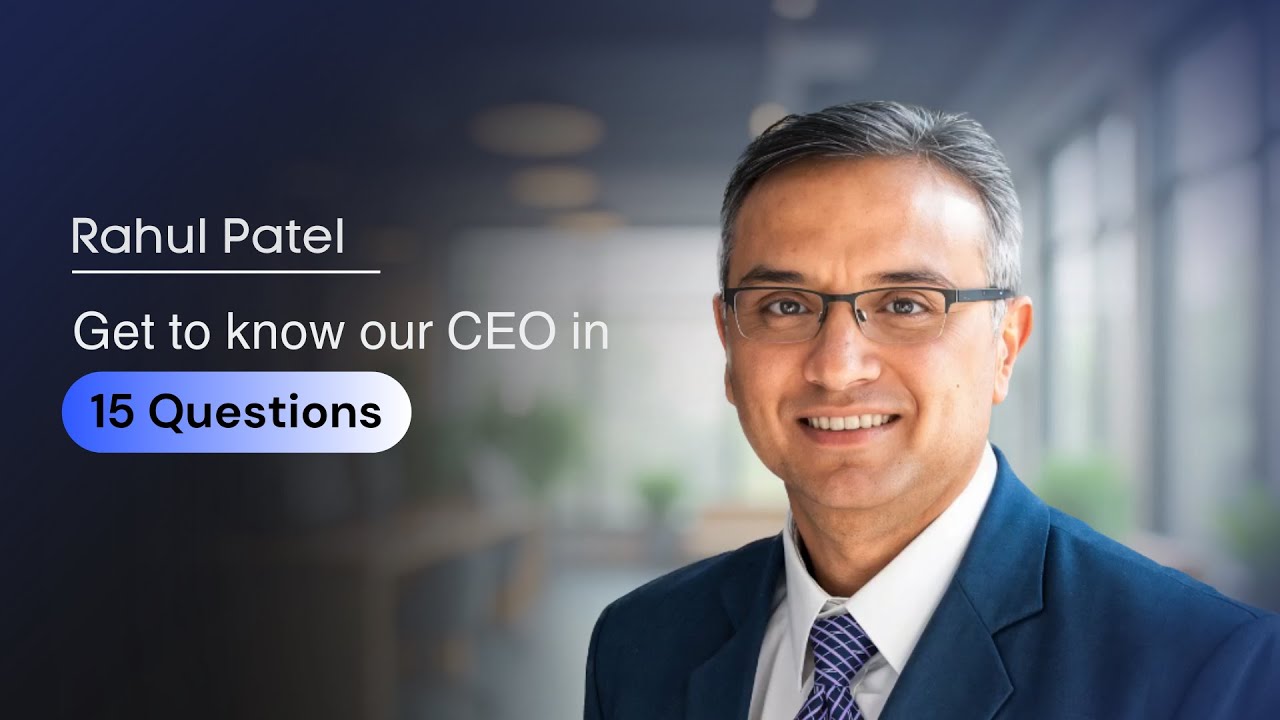
Rahul Patel saw a problem that a better circuit would not fix. Engineers were putting pride into their work, yet the work could struggle to get a fair hearing. He had begun on their side of the table, designing chips. He wanted to cross the room and help explain what they had made. An MBA and a move into product marketing followed. The circuit designer had found another kind of connection to improve.
That decision is a useful place to begin with the president and chief executive of Synaptics. His résumé contains the expected weighty nouns: Broadcom, Qualcomm, wireless connectivity, multi-billion-dollar portfolio. But the more revealing thread is his movement between people who build technology and people who must decide what to do with it. A functioning chip is an achievement. Getting it into a product brings a different set of arguments.
Patel joined Synaptics in June 2025, taking a seat on its board as well. The company already had a direction in Edge AI. His assignment brought together a familiar technical subject, connectivity, and a broader management question: how to make several capable groups useful to one another. Even semiconductor companies, it turns out, can have connection problems inside the building.
The engineer who wanted the work understood
His education spans three institutions and two kinds of training. At the National Institute of Technology in Warangal, India, he studied electronics and communications engineering. He went to Arizona State University for a master’s in computer science and engineering. Santa Clara University supplied the MBA, in marketing and finance. The sequence stretches from designing something that works to understanding what makes it worth buying.
His early jobs reflect that widening interest. From 1993 to 1996, he held integrated circuit design engineering and marketing roles at EPSON/S-MOS Systems. Marketing positions followed at Tritech Microelectronics and Samsung Semiconductor. At HiFn, a security processor company, he became a business line manager. Before the better-known corporate chapters, there was this apprenticeship across design, marketing and the responsibility for a business.
It matters that his move toward management began with a concern about the engineering. In his account, he wanted the people making the technology to have their work properly represented. That is a particular motivation for entering marketing, a profession sometimes accused of putting a nicer jacket on an ordinary idea. Patel’s explanation begins with the idea already being good, and the explanation failing it.
A career carried by invisible connections
Broadcom occupied 13 years of his career, from 2002 to 2015. He eventually led its Wireless Connectivity Group, working across Wi-Fi, Bluetooth and GPS. His remit included the product roadmap, research and development, marketing, business development and applications engineering. Those responsibilities follow a product from the initial technical choices through to the practical business of helping somebody use it.
Qualcomm followed in 2015. Over the next decade, his responsibilities included wireless infrastructure, mobile connectivity, computing, wearables, voice and music. Most recently, he was senior vice president and group general manager of Connectivity, Broadband & Networking. The portfolio he oversaw ran to multiple billions of dollars. These are products whose success often takes the form of being taken for granted: the connection works, and everyone gets on with something else.
By October 2024, he was presenting Qualcomm’s Networking Pro A7 Elite platform at Network X, bringing AI into the conversation about Wi-Fi 7 networking devices. The later move to Synaptics therefore carried a recognizable continuity. Intelligence at the edge was already part of his work before it became the organizing subject of his new company’s pitch. The route to AI could run through a network gateway.
Eleven players, one company
There is another version of Patel’s life in which electronics receives less attention and cricket receives considerably more. He has spoken about wanting to play the sport before his career took its eventual turn. His interests still include a cricket autograph collection. Cooking, hiking and music also make appearances in his public introductions, along with spicy Indian masala chai. The executive biography has a kitchen and a soundtrack.
The cricket connection is tempting when he talks about leadership, although no sporting metaphor is needed to understand his point. He repeatedly gives the team priority over the individual. At Synaptics, he calls the approach One Synaptics. His stated task is to supply clarity and focus so that people across the company can choose the right opportunities and execute together.
It is an approach that makes particular sense for a company selling several kinds of expertise. A customer’s device may need touch input, audio, processing and a wireless link. Internal boundaries become a customer problem if the pieces arrive without enough help joining them. In that setting, a shared direction has a technical consequence. The organization has to cooperate before the product can.
“Be passionate, chase your dreams, don’t compromise.”Rahul Patel, on his advice to his younger self
A shorter trip for intelligence
The phrase Edge AI can sound like an address supplied by an estate agent with an unusually abstract map. The underlying question is quite concrete: where should a device do its thinking? Patel’s argument is that some of it belongs close to the person or machine using it. Power, response time, privacy and the cost of cloud computing all enter that decision.
Synaptics has relevant pieces in its portfolio: sensing to gather information, processors to interpret it, and connectivity to communicate. Patel’s ambition is to bring those capabilities into fuller solutions. That puts considerable weight on the work surrounding the chip. Software, development tools and integration support influence how readily a customer can turn an available component into a useful product.
“In semiconductors today, silicon is only half the answer.”Rahul Patel
In a November 2025 conversation, he described reducing the engineering expense customers face when building end products. Reference designs and open-source tools formed part of his answer. The design engineer’s earlier concern about representation has a practical echo here: excellent technical work needs a route into use. This time, part of the explanation comes as software a developer can actually work with.
When the jellyfish joined the band
At Google I/O in May 2026, that direction acquired an unusually agreeable demonstration. Synaptics and Google Research showed an experience called Jellectronica. A model running on a Coralboard tracked jellyfish movement from a Monterey Bay Aquarium livestream. The motion became control information for a generative music performance powered by Google DeepMind’s Lyria Realtime model. The jellyfish had acquired an indirect career in electronic music.
The demonstration was playful, but the division of work was instructive. A small board handled object detection at the edge; its output participated in a larger experience. Coralboard combined Synaptics Astra processing with technology from Google Research. Developers could start from a platform with camera, display and audio interfaces rather than assemble every part of a demonstration from scratch.
By October 20, Synaptics had moved Coralboard SL into general availability through DigiKey and introduced Coralboard SR. The expanded family used a shared Torq compiler and runtime to support development across versions. For Patel’s strategy, those details are consequential. An ecosystem becomes easier to take seriously when an engineer can order the board and begin working, without a trade-show invitation or an aquarium.
A sense of touch, a change of terms
Another collaboration put the company’s touch background into robotics. In September 2026, Synaptics announced support for its capacitive tactile sensing module in NVIDIA Isaac Sim, alongside Astra processing and NVIDIA Holoscan. The module is designed to detect contact and pressure distribution in robotic hands and grippers. Simulation offers developers a way to work on those interactions before deploying physical hardware.
For Patel, the appeal lies in bringing sensor information and processing together while reducing integration hurdles. A robotic grip makes the problem easy to picture. Knowing that an object is present and understanding the contact with it are related tasks with different demands. Synaptics’ older expertise in human interfaces supplies material for a newer application, with the company seeking a role in Physical AI.
Meanwhile, the corporate setting has been changing. In June 2026, onsemi announced an agreement to acquire Synaptics in an all-stock transaction valued at approximately $7 billion. On October 1, following an unsolicited competing proposal, the companies revised the terms to $123 per share in cash, with an aggregate value of approximately $5.7 billion. Patel emphasized certainty of value for Synaptics shareholders.
Proposed acquisition by onsemi. Closing expected by mid-2027, subject to shareholder approval, remaining regulatory approvals and other customary conditions.
The deal remained a proposed transaction, while product development continued. October also brought the Astra SR200 series, a family intended to put multimodal AI capabilities into devices with tight power and memory constraints. That is the present tense of Patel’s job: decisions about ownership on one side, engineering and customers on the other, and a company that must keep working through both.
His career began with a wish to give engineering a better hearing. It has since expanded to portfolios, partnerships and the responsibilities of a public-company CEO. The scale has changed; the work still requires people with different specialties to understand each other. Somewhere between the circuit, the explanation and the customer’s finished product, Patel has built a career making the introductions.