A phone has a remarkably accommodating owner. Someone carries it toward a better signal, plugs it in at night and forgives it the occasional sulk. A water meter gets no such service. Neither does a camera at the gate. Michael De Nil had spent years helping wireless chips do their work inside smartphones when he began building a company for devices with rather less obliging circumstances.
De Nil and his co-founder, Andrew Terry, came from Broadcom. They knew the machinery of Wi-Fi from the inside. In 2016, they started Morse Micro to work on a different set of requirements: longer range, lower power and connections suited to machines that might spend their working lives beyond the convenient reach of a household router.
The distinction sounds modest until you follow it outside. Devices tend to be installed where something needs measuring, watching or controlling. The job determines the location. A network that works beautifully around a desk can become an awkward proposition at a distant gate. De Nil’s career has come to revolve around that awkwardness.
Before the chips, a fairground
His first route into electronics was hardly inevitable. At De Nayer in Belgium, where he began studying in 2002, De Nil had intended to pursue computing. Patrick Pelgrims, his future mentor, persuaded him to choose Electronics-ICT. During an Erasmus exchange in The Hague, De Nil and fellow students built an audio sampler for fairground installations. Press a button; an announcement came out. Part of the software became open source.
It was a practical introduction to making hardware and software cooperate. A fairground operator needed a box that did a job. After his bachelor’s, De Nil completed a master’s at Eindhoven University of Technology, then worked as a researcher at imec. In 2010 he moved to Australia, where six years at Broadcom preceded the decision to start Morse Micro.
By the time he appeared at Tech23 in 2018, his professional biography described a principal IC design engineer who had worked on Wi-Fi chips used in modern smartphones. This was experience in a technology already woven into ordinary life. Starting another chip company meant taking that accumulated knowledge and asking where its assumptions no longer fitted.
Two savings accounts and a long wait
De Nil’s explanation of the founding opportunity was disarmingly concrete. Large semiconductor companies were busy. Connected devices needed engineering attention that phone chips could not simply supply by being repurposed. He and Terry saw room to build a low-power design from the beginning.
“We both invested $25,000 in savings to get Morse Micro off the ground.”
Michael De Nil, 2022
The amount belongs near the start of the story because later fundraising figures can obscure what a beginning feels like. Two people put their own savings behind a technical judgment. Years of development lay between that judgment and a customer being able to buy something useful. By 2021, the company had announced Wi-Fi CERTIFIED HaLow technology; the work had acquired a product, a team and a much larger set of obligations.
The early team also had a useful division of labor. Terry brought radio-frequency and analogue expertise. De Nil’s territory was digital design and software. Dave Goodall contributed standards and media-access-control experience. Those specialties matter because a wireless chip has to solve several problems at once. The radio must communicate; the digital machinery and software must make the communication useful.
Funding brought another kind of education. Blackbird became an early backer. De Nil has described learning from its partners about raising capital and growing into a multinational company. His criterion for investors was revealing: he wanted partners with ambition to match the founders’. Money had to arrive with an appetite for the scale of the undertaking.
Startmate, meanwhile, describes Morse Micro as its first hardware investment in 2016. In the accelerator’s account, De Nil also appears in the continuing circle of founders and mentors. A semiconductor business can look solitary from a distance: a specialist team, a difficult design, a guarded technical advantage. Its development also depends on introductions, advice and people prepared to take the project seriously before there is much to show.
The recruitment pitch had a fridge
One of De Nil’s more memorable appeals to prospective recruits involved Belgian beer. Speaking to Belgian readers in 2020, he listed the beers already stocked in the company fridge. The glasses for Chimay were ready; the beer itself was missing. Applicants who sent a crate, he joked, would have an advantage. Semiconductor recruitment had acquired a refreshment policy.
The rest of the pitch was substantial: demanding engineering work, shares in the company, help with an Australian visa and the attractions of Sydney. De Nil understood the relocation decision from experience. He had moved from Belgium with his wife and young daughter. He talked about hard work alongside time with family and evenings at the beach.
That combination gives the founder a more recognizable shape than a sequence of financing announcements does. He was asking specialists to cross borders for a company whose prospects still depended on work ahead. The offer needed to make sense as a life, as well as a job.
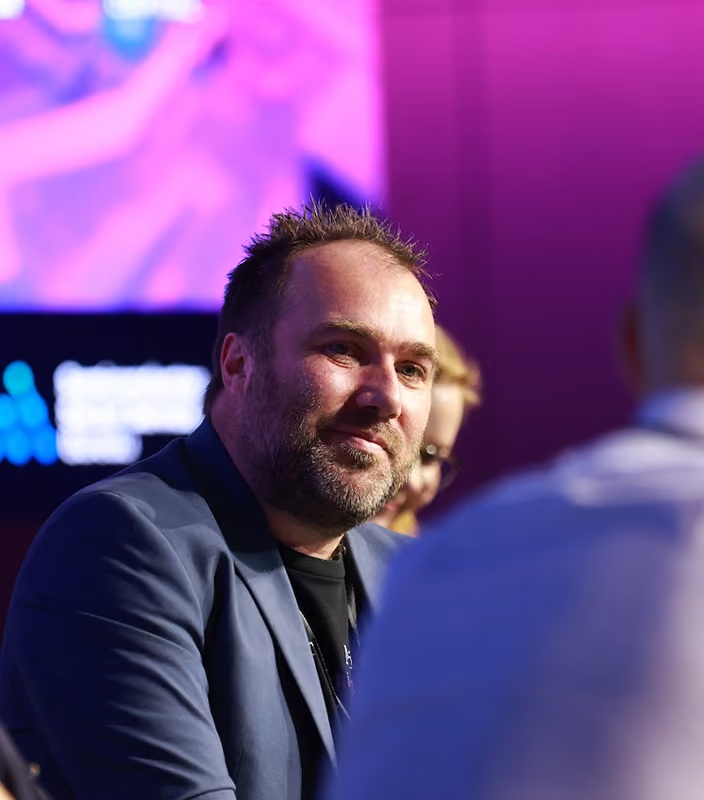
Morse Micro’s engineering connections extended into earlier chapters of wireless history. Neil Weste, who co-founded Radiata, and Wi-Fi co-inventor John O’Sullivan were among the experienced figures associated with the company. Their presence gave a younger business access to people who had already wrestled with turning wireless research into working technology. De Nil’s own Broadcom experience sat within that wider accumulation of knowledge.
The distance from a chip to a customer
Wi-Fi HaLow uses the IEEE 802.11ah standard and sub-gigahertz spectrum. Its appeal to De Nil follows from the requirements that started the company: reach, power consumption and the ability to serve devices beyond the usual indoor network footprint. He has argued for it in factories, commercial buildings and other places where equipment is distributed across a site.
At CES in January 2025, Morse Micro introduced its second-generation MM8108 system-on-chip. De Nil explained the range argument in terms of coverage. Extending a signal’s reach changes how much ground a network can serve. The company describes HaLow as offering ten times the range and one hundred times the area of conventional Wi-Fi. Those are company comparisons, rather than a promise that every installation will reproduce the same result.
100 × area
Illustrative circles, based on Morse Micro’s range comparison. Buildings, interference and installation conditions affect actual coverage.
The coverage argument is ultimately about installation work. More access points mean more things to position, connect and maintain. A device that can communicate from its intended location gives a designer more freedom. The attraction is easy to understand even without a fondness for radio standards: the camera can stay where it has a useful view.
September 2025 brought A$88 million in Series C funding, led by MegaChips. Morse Micro put its total funding above A$290 million and said the new capital would support international expansion and production. The round included existing venture investors, institutional investors and Australia’s National Reconstruction Fund Corporation. It was a large commitment to the next stage of the business.
Series C announced, led by MegaChips.
Company-reported total funding: more than A$290m.
De Nil has spoken publicly about an eventual stock-market listing, with products and revenue preceding it. That order is worth keeping in view. Capital can finance engineering, production and expansion. Customers still have to choose the technology, integrate it and sell devices of their own. The chip company’s commercial progress depends partly on what happens at other companies’ desks.
Intelligence needs an address
In March 2026, Morse Micro launched a design partner program at Embedded World. The initiative linked the company with design houses, system integrators and developer groups. It addressed the work around the silicon: turning reference platforms and components into products that could reach the market. De Nil framed the next phase of connected devices around deployment at scale.
On October 8, Zilogic Systems became the program’s first partner based in India. The Chennai company brought embedded engineering, firmware, validation and test automation. The detail is telling. Once a design works, customers need help with the untidy succession of tasks between a component and a dependable finished product. De Nil’s company was organizing more of that help around its chips.
A day later, his public writing returned to the physical world. Discussing edge AI, he argued that intelligent devices need reliable connections in the places where they operate: property perimeters, utility spaces, garages and industrial sites. Computing capability does not remove the need to communicate through walls or across distance.
It is a consistent preoccupation for someone who once helped make the chips inside phones. The user can move a phone. Installed equipment has a job to stay and do. A decade after founding Morse Micro, De Nil is still working on what follows from that difference: the engineering, the people, the customer’s product and, finally, a connection that reaches the place it is needed.
Continue the conversation
Morse Micro: company and leadership
Michael De Nil on LinkedIn
De Nil’s essays on connectivity
The founding story, in his words
Watch: the Dynamic Business interview
Watch: AWS Community Chats with Aley Hammer
Morse Micro on YouTube
October 2026: the India design partnership
Read: The Connectivity Problem Holding Back Edge AI