The modern wireless complaint is usually microscopic. A mouse hesitates. A headset compresses. A sensor wakes too often and eats its battery. Each irritation is small enough to tolerate, right up until a product designer adds them together and discovers that the supposedly invisible connection has become the main character. Fares Mubarak has built his latest chapter around those accumulated fractions of a second and milliwatts of power. As chief executive of SPARK Microsystems, he is trying to make a short-range radio behave less like a compromise and more like a piece of dependable infrastructure.
Mubarak arrived at this problem by the scenic route through Silicon Valley. His public résumé begins in product engineering at Samsung Semiconductor, includes management and engineering work at AMD, and then settles into an 18-year stretch at Actel. The FPGA maker gave him unusually wide room: engineering, marketing, and executive leadership all appear in the record. Later came the presidency of TeleResults, then responsibility for the semiconductor business unit at engineering-simulation company ANSYS, followed by semiconductor industry sales and business development there. By the time he joined SPARK as CEO in 2017, he had spent more than three decades seeing how a chip moves from technical object to commercial promise.
That breadth is useful because semiconductor companies punish narrow thinking. A circuit can perform beautifully and still fail to become a product. Manufacturing has to cooperate. Software must make the hardware approachable. Customers need support before they become references. Distributors need reasons to stock the part. Investors must accept a calendar measured in design cycles rather than weekly releases. Mubarak's job is translation: between the people who speak in microseconds, the people who speak in product roadmaps, and the people who speak in purchase orders.
01 / The overlooked layerThe conversation beneath the computation
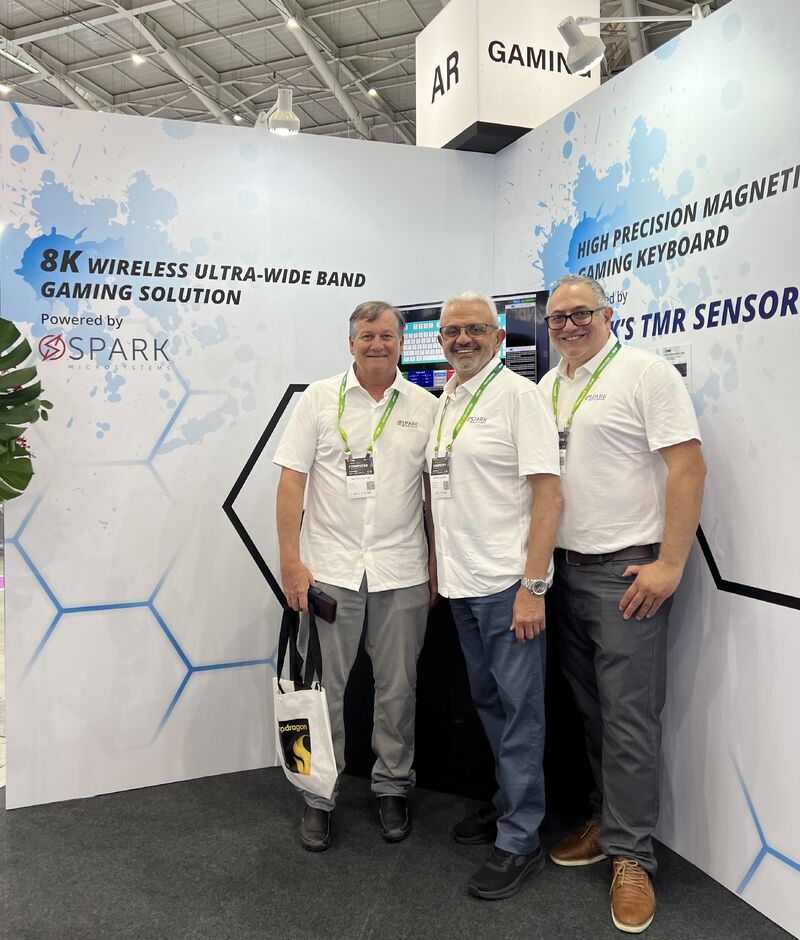
In May 2026, while attending Computex in Taipei, Mubarak offered a crisp version of the thesis: “Every major shift in computing eventually runs into the same constraint: not how fast its parts think, but how well they talk to each other.” He connected that constraint to Physical AI, the broad field of intelligent machines and devices acting in real time. A robot may calculate quickly. A wearable may infer locally. But if data arrives late, unreliably, or at an extravagant energy cost, the entire system inherits the weakness of the link.
Wireless designers are usually asked to pick their pain.
The technology behind the pitch is low-energy ultra-wideband, which SPARK brands LE-UWB. Ultra-wideband is already familiar for precise ranging and positioning. SPARK's argument is that the spectrum can do more: carry substantial data with very low latency and a low power profile. That makes the technology relevant to things people can feel immediately, such as a gaming mouse or uncompressed wireless audio, and things they may never notice, such as a connected sensor waiting years between battery changes.
Mubarak's way of explaining the opportunity is revealing. He does not isolate one heroic specification. The point is the bundle. Fast but hungry is a problem. Frugal but sluggish is another. A high data rate that collapses in a busy radio environment is merely an impressive laboratory anecdote. The product must hold several virtues at once. This is engineering as diplomacy, except the parties are latency, bandwidth, power, and reliability, and none has agreed to be reasonable.
02 / The long clockA startup made of patience
SPARK began in Montreal in 2016, founded by wireless scientists. It entered the Silicon Catalyst incubator around the turn of 2017, and Mubarak took the CEO role that year. The division of labor is important. The founding team brought deep RF, mixed-signal, and systems expertise. Mubarak brought the accumulated commercial scar tissue of the semiconductor business. The arrangement is less founder mythology than complementary architecture: technical invention on one side, operating translation on the other.
The company's public milestones read like a lesson in how slowly “suddenly” happens. There were early grants and incubators, an SR1000 product announcement in 2020, financing for commercialization in 2021, software tools and distributor expansion, reference designs for gaming, partnerships in audio and industrial sensing, and another wave of silicon in the SR1120. Each step reduced a different kind of uncertainty. Could the radio work? Could a developer use it? Could a customer build around it? Could the company support production? A semiconductor startup does not cross one chasm. It crosses a chain of smaller ravines while carrying expensive luggage.
Mubarak becomes CEO
A veteran operator joins the Montreal wireless startup.
SR1000 series arrives
SPARK publicly introduces its first UWB transceiver family.
Commercialization capital
A CAD $17.5 million round backs hiring and volume-production work.
The next scale-up
A CAD $48 million financing supports product and customer expansion.
Follow-on and recognition
CAD $17 million more arrives as the SR1120 earns industry recognition.
Mubarak sounds most personal when addressing that long clock. In a 2025 open letter to semiconductor pioneers, he named four qualities: “Resilience, adaptability, steady direction and fiscal discipline.” It is advice with its tie loosened. No disruption incantation, no overnight triumph, no insistence that the old world has already vanished. A chip startup has to survive long enough for customers to trust it, and trust often arrives one evaluation board, one design win, and one production conversation at a time.
03 / The operator's educationLearning every dialect of the chip business
Mubarak's academic pairing says something about the work: a master's degree in electrical engineering from Case Western Reserve University and an MBA from Golden Gate University. One teaches the constraints inside the device. The other teaches the constraints around it. His career kept braiding the two. At Actel, he reached senior leadership across marketing and engineering. At ANSYS, he first ran a semiconductor business unit and then led industry sales and business development. The pattern is not a departure from engineering but an expansion of its field of view.
It also helps explain the customer's prominence in his language. In the same open letter, Mubarak wrote that customer success is the best measure of a company's own success. That is a sober standard for a component supplier. The radio is not the final product and the consumer may never know its name. Victory happens when someone else's headset sounds cleaner, someone else's mouse responds faster, or someone else's sensor becomes less needy. There is an agreeable modesty in building the part that succeeds by disappearing.
Those are SPARK's comparisons for the SR1120, and the commercial world will decide where the claims translate into durable advantage. The more meaningful evidence is beginning to appear in products and collaborations: gaming peripherals, premium active speakers, connected monitoring systems, development kits, and customer reference designs. The spread matters because it tests whether one radio architecture can travel beyond a single showcase use case.
Funding, meanwhile, supplies time rather than certainty. SPARK announced CAD $17.5 million in 2021, CAD $48 million in 2023, and a CAD $17 million Series B follow-on in March 2026. The latest round was co-led by Idealist Capital and Real Ventures, with Cycle Capital, ND Capital, and Export Development Canada participating. The money was assigned to commercial expansion, customer programs, channel work, and product development. Those nouns sound ordinary. In hardware, ordinary execution is the entire sport.
04 / What comes nextMaking the radio boring
The aspiration eventually points toward devices that depend less on wires and, in selected cases, less on conventional batteries. Mubarak has described connected buildings and sensors powered by harvested energy. That future is not a promise attached to every current product. It is a direction made plausible when the energy cost of communication falls far enough. The irony is pleasing: an ambitious wireless future rests on persuading a radio to become exquisitely stingy.
For Mubarak, the immediate work is more concrete. SPARK has been adding senior commercial and product leadership, joining industry alliances, expanding distribution, and placing its technology in customer demonstrations and products. Its SR1120 was named a CES 2026 Innovation Awards Honoree and later received a product innovation award associated with Canada's Semiconductor Council. Awards make pleasant shelf furniture. Design wins and reliable production make a company. His public comments keep returning to scaling the organization around the market opportunity.
This is where a long career becomes an operating asset rather than a biographical ornament. Mubarak has seen component companies from the engineering bench, the marketing room, the sales call, the business-unit budget, and the CEO chair. He knows that the future arrives disguised as a support ticket. The grand vision of intelligent devices talking in real time eventually becomes a customer asking whether the evaluation kit works with Tuesday's firmware.
There is no guarantee that LE-UWB becomes the default language of the intelligent edge. Wireless standards are crowded, incumbents are entrenched, and product makers dislike adding risk to a bill of materials. But the constraint Mubarak identifies is real: smarter devices need better conversations. His wager is that SPARK can improve those conversations enough for designers to reconsider old compromises. His role is to keep the company technically credible, commercially useful, and financially present while that reconsideration unfolds.
The quiet ambition
Make the link quick enough that nobody feels the delay, lean enough that nobody resents the battery, and reliable enough that nobody thinks about the radio at all. In infrastructure, invisibility is often the nicest compliment.