Phil Brace tried retirement. It lasted eighteen months. Then he announced that he had too much appetite for work to stay away, and went back to learning about software, large corporate customers and private equity. Plenty of executives announce their next appointment with the language of destiny. Brace offered something more recognisable: he had stopped working and discovered he wanted to work.
“I simply had too much desire to keep working,” he wrote. The admission supplies a useful starting point for a career that otherwise threatens to disappear beneath a pile of job titles. Intel. LSI. Seagate. Veritas. Sierra Wireless. Inseego. Skyworks. Read quickly, the list looks restless. Read in order, it follows the machinery that processes, stores, protects and moves information.
By October 2026, the returning retiree was running Skyworks after its combination with Qorvo. The transaction had closed on October 5. Brace remained chief executive officer and president. A career spent moving among different parts of the technology business had arrived at a job requiring several of those parts to work together. Retirement had become a rather distant scheduling suggestion.
Eighteen months away. Then another chapter in the business of moving information.
An education in the parts nobody sees
Brace’s formal training was in engineering: a bachelor’s degree in computer engineering from the University of Waterloo, followed by a master’s in electrical engineering at California State University, Sacramento. His public professional profile places his Waterloo years between 1988 and 1993. The combination of computer and electrical engineering is a useful introduction to his later work, which kept crossing the boundary between what a machine does and how its components make that possible.
He spent twelve years at Intel, eventually becoming general manager of server product marketing. Nine years at LSI followed, including responsibility for its Storage Solutions Group as executive vice president. Those roles brought together engineering, products and the commercial question that waits at the end of every development programme: who will buy this, and why?
At Seagate, his remit included storage systems and solid-state drives. These are businesses whose achievements mostly happen behind a screen, below a desk or inside a data centre. The user remembers the photograph that loaded or the file that survived. The components doing the work seldom receive an introduction.
That background helps explain the particular breadth of his later appointments. Brace had worked on the hardware underneath computing and on the businesses selling it. When Veritas appointed him executive vice president in July 2019, his assignment covered appliances and software-defined storage. Greg Hughes, then its CEO, brought him in to strengthen those offerings. The work gave the former chip and storage executive another view of enterprise customers: protecting their data and keeping their applications available.
- ProcessIntel · servers
- StoreLSI · Seagate
- ProtectVeritas · software
- ConnectSierra · Skyworks
A company small enough to change
Sierra Wireless appointed Brace president and CEO effective July 26, 2021. He succeeded Kent Thexton, with a short transition period. The company’s offerings included connectivity services, gateways and embedded modules. If storage asks where information should live, this business asks how information gets there from a device in the first place.
His brief was commercial as well as technical. Sierra’s board wanted growth, and Brace spoke about improving profitability alongside it. The subsequent record gives that ambition some substance. When Lantronix recruited him to its board in 2023, it credited his Sierra tenure with operational improvements that increased profits by more than 100 percent and revenue by more than 40 percent.
Those figures describe a company’s performance, with all the work by colleagues that entails. They also explain why another board might want the person who had been responsible for running it. An engineering education can establish technical fluency. A set of operating results gives directors something else to discuss.
In August 2022, Semtech agreed to acquire Sierra Wireless at an enterprise value of approximately $1.2 billion. The proposed pairing brought cellular connectivity alongside Semtech’s LoRa technology. The acquisition completed in January 2023, ending Brace’s period as Sierra’s CEO. His next chapter would again put wireless products beside a financial problem that needed attention.
The chairman inside the financing
Brace joined Inseego’s board in September 2023 and became executive chairman in February 2024. Its business included mobile broadband and fixed wireless access, the latter using wireless networks to provide an internet connection at a particular location. Once again, the product depended on making connectivity useful beyond a specification sheet.
By August, he was describing changes in the product portfolio, new leaders in product management, operations and sales, and stronger relationships with carrier partners. The board extended his executive-chairman appointment. The language was about products and customers, but another part of the work sat on the balance sheet.
In July 2024, Inseego announced agreements covering more than $125 million in face value of convertible notes, nearly 80 percent of those outstanding, through cash purchases and exchanges into longer-term debt and equity. The arrangements were made at a 30 percent discount to face value.
Brace was also named among the participating lenders in a $19.5 million loan facility supporting part of the debt repurchase. That is a specific detail worth keeping in the picture. He was involved in the financing as well as occupying the chairman’s seat. The transaction placed product management, operating changes and capital structure in the same frame.
Walking, chewing gum, making chips
Skyworks named Brace its next president and CEO in February 2025, with his appointment taking effect on February 17. Liam Griffin stayed on in an advisory role for three months. Christine King became chairman. The succession placed Brace at an analog and mixed-signal semiconductor company whose products serve wireless devices and a range of other applications.
There was an immediate strategic tension. Skyworks had a substantial business with Apple, accounting for more than 60 percent of sales in the 2025 account of the company. Brace wanted a broader revenue base while continuing to serve the business already paying the bills. His description was admirably portable: “We’ve got to walk and chew gum at the same time.”
The phrase is funny because it takes an elaborate corporate problem and gives it the difficulty level of a pavement. Executing it is less casual. Diversification requires products, customers and investment. The existing customer still expects its components to arrive and work. Neither timetable pauses politely while the other receives attention.
By July 2026, Skyworks was reporting quarterly revenue of $935 million. Brace pointed to growth in automotive and data centre markets. The company described engagements in vehicle connectivity, precision timing and power isolation. These were concrete applications for a broader business, each with its own engineering requirements and purchasing decisions.
A seat on the other side of the table
Alongside his operating jobs, Brace has served on other companies’ boards. BlackBerry appointed him a director in February 2024. He became chair of its Nomination and Governance Committee in April 2025. At Skyworks he answers to a board; at BlackBerry he helps do the overseeing. The two responsibilities give his career another practical dimension: choosing and evaluating leadership as well as exercising it.
His industry work extends to the Semiconductor Industry Association board. In a public update about meetings in Washington, he identified domestic manufacturing and global supply chains among the subjects discussed. The itinerary brings the same physical business into a different room, where policy becomes part of the conversation.
A room full of connections
Brace’s public updates offer a less ceremonial view of the job. He writes about meeting customers in Seoul and visiting manufacturing operations. During a trip marking ten years of Skyworks Osaka, he described a site that produced more than seven billion acoustic filters in 2025. He also attended the Osaka Expo and the United States pavilion.
Seven billion filters makes a useful counterweight to the abstraction of wireless. Somewhere, the promise of connection has to become an object that can be manufactured repeatedly. Brace’s enthusiasm for the factory supplies a glimpse of the engineer beneath the corporate itinerary.
Another update concerned bringing roughly ninety senior leaders together. Some, he wrote, had worked together for more than a decade without meeting in person. He emphasised the opportunities for collaboration across organisational lines. For an executive selling connectivity, there is a pleasingly practical lesson here: sometimes getting everyone into the same room still helps.
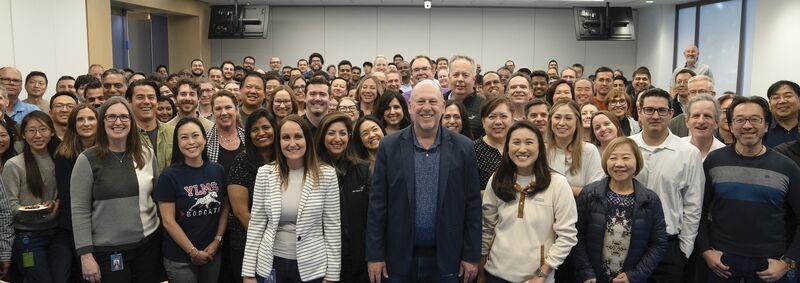
His first-week photograph at Skyworks shows him surrounded by colleagues in Irvine. It is an appropriate image for this part of the story. A business can draw its organisation chart with exquisite care, but the people in it still need to meet, compare notes and decide what happens next.
The deal closes. The work gets bigger.
The Qorvo combination changed the scale of that assignment. Announced in October 2025 and completed the following October, it brought the two semiconductor businesses together under Skyworks. Former Qorvo CEO Bob Bruggeworth joined the board. Brace continued in charge of the combined operation.
The numbers set out at closing were substantial: approximately 8,000 engineers and more than 12,000 issued and pending patents. Skyworks expected annual cost synergies of at least $500 million within twenty-four to thirty-six months after closing. Those savings were a target, with the integration still ahead of them.
The broader portfolio covered RF, power and analog technologies, with opportunities spanning mobile devices, automotive, data centres, networking, defense and aerospace. For Brace, the immediate task was to turn the combination into products and operating results. A patent count cannot schedule a customer delivery. Eight thousand engineers still need priorities.
Targeted within 24-36 months after closing
His earlier return from retirement gives this ending a human scale. He came back because he wanted to learn and contribute. Since then, the assignments have moved from enterprise software to connected devices to a combined semiconductor operation. The desire for more work appears to have been accommodated. Now comes the less photogenic business of getting it done.
Follow the work
- Skyworks ↗
- Phil Brace on LinkedIn ↗
- The return from retirement ↗
- Veritas appointment ↗
- Sierra Wireless appointment ↗
- Sierra operating record ↗
- Semtech acquisition agreement ↗
- Semtech completion results ↗
- Inseego financing ↗
- Inseego executive chairmanship ↗
- Skyworks leadership succession ↗
- BlackBerry board biography ↗
- July 2026 business update ↗
- Qorvo combination completed ↗
- Osaka factory visit ↗
- Brace on his CNBC appearance ↗
- Skyworks videos on YouTube (company channel) ↗