The revealing thing about Oleg Khaykin’s acquisition strategy is how much of it involves declining to acquire anything. Asked about dealmaking at an August 2026 technology conference, the VIAVI chief executive offered a sentence that would make a disappointing slogan for an investment bank: “we walk away from a lot of deals.” He had seen another transaction announced at roughly twice the price his team was prepared to pay. His objection was practical. A forecast can be revised. Borrowed money expects to be repaid.
By then, Khaykin had spent a decade running a business devoted to checking whether other people’s technology actually worked. VIAVI tests networks, optical connections and communications equipment. Its instruments inhabit the less photogenic side of the digital economy, where a promise of speed must survive contact with a measurement. The resemblance to his way of discussing acquisitions is hard to miss. Show the working. Examine the connections. Find out what happens under pressure.
His career supplies an unusually useful tour of that territory. He has been an engineer, a consultant, a corporate development executive, a semiconductor operating chief and the chief executive of two public technology companies. Along the way, he has stood on both sides of an acquisition. The signature is the brief part. Everything that follows is the job.
A circuitous route, with actual circuits
Khaykin studied electrical and computer engineering at Carnegie Mellon, graduating with honors, and earned an MBA at Northwestern’s Kellogg School of Management. Before the consulting presentations and board meetings came Motorola, where he worked as a systems engineer in wireless infrastructure. It is a fitting starting point for someone whose later business would depend on the machinery behind a connection.
He spent eight years at Boston Consulting Group before moving to Conexant in 1999. There, and at Mindspeed Technologies, his remit covered strategy and business development, including acquisitions, investments, divestitures and alliances. Those responsibilities put him close to the decisions that determine what a technology company keeps, what it buys and what it lets go. An org chart can look impressively permanent until someone with that job arrives.
Amkor brought him in during 2003 to handle corporate development, mergers and acquisitions, and intellectual property. He helped lead its purchase of Unitive in 2004 and a long-term alliance with IBM. In January 2006, Amkor promoted him to chief operating officer, giving him responsibility across sales and marketing, product development, and worldwide flip-chip and wafer-level processing operations.
That progression matters. Corporate development asks whether a combination makes sense. Operations asks whether it works on Tuesday morning. Khaykin’s responsibilities had expanded from designing combinations to managing the commercial and manufacturing activities that had to deliver them. His next appointment would put the entire company on his desk.
The photograph before the next chapter
In March 2008, Khaykin became president and CEO of International Rectifier, a power-semiconductor company. He remained through its acquisition by Infineon in January 2015. The agreement, announced in August 2014, valued the equity at approximately $3 billion and offered shareholders $40 a share in cash. Here was the corporate development veteran leading the company being bought.
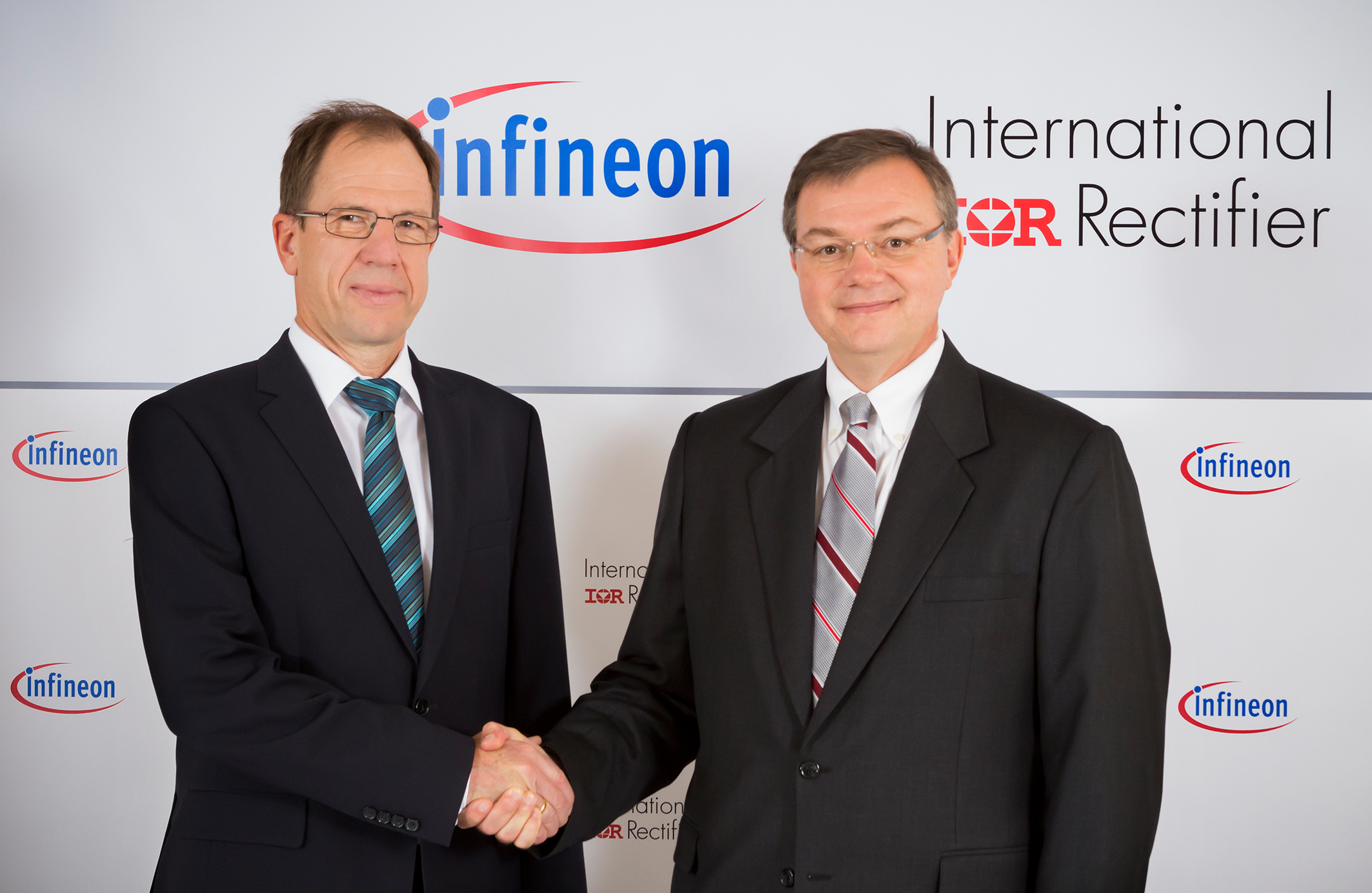
The photograph from the announcement has all the familiar merger ceremony: two executives, two company names, one handshake. On the left stands Infineon chief executive Reinhard Ploss; on the right, Khaykin. Behind the formalities sits a consequential change in scale and ownership. His nearly seven-year tenure at International Rectifier ended with the company becoming part of another semiconductor group.
Khaykin then served as a senior adviser at Silver Lake. A year later, he was back in the chief executive’s chair. VIAVI appointed him effective February 3, 2016, succeeding interim CEO Richard Belluzzo, who remained chairman. Belluzzo explicitly pointed to Khaykin’s experience transforming International Rectifier when welcoming him. The assignment came with a familiar pair of expectations: growth and wider profitability.
Buying the pieces that belong together
VIAVI gave Khaykin a portfolio with an interesting split personality. One part tested and monitored networks. Another managed light through optical technologies, including coatings and products used in currency authentication. The same chief executive could find himself discussing communications software and the optical features that help establish whether money is real. Technology’s back rooms are full of such unlikely neighbors.
In March 2018, VIAVI completed the $455 million cash purchase of Cobham’s AvComm and Wireless Test and Measurement businesses. The addition widened its testing capabilities and brought greater exposure to areas including public safety, military communications and avionics. For Khaykin, it was another exercise in assembling related technical capabilities across customer markets.
The Spirent chapter took a less direct route. In 2024, VIAVI sought to acquire the British testing company, but Keysight made a higher offer. The eventual outcome for VIAVI was narrower: in October 2025, it bought Spirent’s high-speed Ethernet, network security and channel-emulation testing businesses from Keysight for $425 million in cash, subject to customary adjustments.
That sequence is a useful corrective to the tidy way acquisition histories get told. An announced ambition and a completed transaction can be quite different things. Khaykin ultimately obtained particular businesses rather than the whole company originally pursued. The purchased lines extended VIAVI’s portfolio across Ethernet, application performance, security and digital infrastructure. The story’s substance lies in those capabilities and what customers can do with them.
Arizona, with a factory attached
Another decision under Khaykin was geographic. VIAVI announced its move toward an Arizona headquarters in 2021 and opened a production facility in Chandler in November 2022. The manufacturing operation supported its Optical Security and Performance Products segment. There was a factory behind the change of address, which gives the relocation more substance than a new line on the stationery.
The initial capital investment was nearly $100 million. VIAVI also endowed a scholarship at the University of Arizona’s Wyant College of Optical Sciences and contributed to Chandler’s reclaimed-water program. These were concrete connections to the place where it was expanding: optics training, local infrastructure and production capacity.
In a subsequent recruiting video, Khaykin described Arizona as a future growth location and the headquarters move as an initial step. His pitch joined the company’s own expansion to the region’s technology workforce. It also returned him to a familiar part of the country: Amkor, where he had taken on operating leadership years earlier, was based in Chandler.
The cost of finding out
Testing can become an obstacle before a new product ever reaches a customer. A smaller supplier may have a promising design and still struggle to obtain the facilities needed to prove it works alongside other vendors’ equipment. That problem sits close to VIAVI’s commercial interests, but it also shapes who gets to participate in a network market.
In October 2024, VIAVI opened its VALOR Open RAN testing facility in Chandler. Supported by a federal innovation-fund grant, it offered automated testing on a pay-as-you-go basis. Khaykin described the goal as broadening access to testing capabilities, including product development and performance stress tests. The practical proposition was straightforward: access to a sophisticated lab without having to build the entire thing yourself.
This supplies another view of his work. Acquisitions combine businesses. A shared testing facility can connect suppliers that remain independent. Both depend on understanding where an industry’s technical bottlenecks sit. A network assembled from multiple vendors is only useful if the components can cooperate. Somewhere, somebody must arrange a reasonably thorough introduction.
Growth, with the arithmetic left in
By August 2026, Khaykin was describing data centers and aerospace and defense as central to VIAVI’s diversification. Its fiscal-year revenue reached $1.5183 billion, up 40% from $1.0843 billion. The result included acquired operations; the increase should not be read as an organic-growth figure. Its annual GAAP net result was a $30.4 million loss, while adjusted net income was $243.8 million.
Those distinctions belong in the same frame. Revenue, operating performance and the final reported profit answer different questions. A chief executive responsible for changing a portfolio must eventually deliver across all of them. Growth offers evidence that the business is expanding; the accounts show what that expansion has cost.
At the August technology conference, Khaykin described looking for acquisitions whose technology could become more useful inside VIAVI’s existing operations. He pointed to Digital Optical Research Corporation and its interferometry technology as an example. He also recalled that VIAVI’s relationship with Inertial Labs preceded its acquisition. The opportunity could emerge from working with a business and seeing where its capabilities fit.
“we walk away from a lot of deals.”
Oleg Khaykin · August 2026
His caution about debt supplied the sharper edge of the discussion. Plans can anticipate handsome earnings two years from now; a downturn may have its own opinion. Khaykin’s public explanation made the purchase price and near-term usefulness central to the decision. After years buying businesses and running them, he was still talking about the consequences of getting the arithmetic wrong.
That is the continuity in his career, from wireless engineering to semiconductor operations to network testing. The products have changed, as have the employers and the scale of the decisions. The recurring task is to work out how the pieces behave together. For a chief executive selling equipment that checks other people’s claims, it is a sensible habit to keep.
Keep following the connections
- Official websiteVIAVI Solutions ↗
- Personal profileOleg Khaykin on LinkedIn ↗
- Watch · VIAVI videoGrowing Your Career at VIAVI Solutions ↗
- Watch · Rutgers conversationABC’s of Transforming Technology Companies ↗
- Read · August 2026The acquisition discussion at Rosenblatt’s technology summit ↗
- Read · Financial resultsVIAVI’s fiscal 2026 results ↗
- Company blogVIAVI Perspectives ↗
- Company channelsVIAVI on YouTube ↗