Look at the machine in the photograph below. It is orange, heavy and rather difficult to confuse with a cloud. Yet this is one of the places the cloud begins: beside a road, with a crew, a cable route and a considerable amount of dirt. Dycom Industries has made a business of this distance between how we describe the internet and how we build it.
- Dycom designs, constructs and maintains networks for telecom operators and utilities.
- Its family of roughly 40 operating companies works across all 50 states.
- A $1.95 billion acquisition brought data-center electrical contracting into the portfolio.
The revealing detail is the acquisition. In December 2025, Dycom completed its purchase of Power Solutions, a Maryland electrical contractor serving data centers and other critical facilities. A company associated with communications construction had moved further inside the building. The fiber could reach the facility; now Dycom could help wire what happened there.

01 / The difficult part is the handoff
Consider what a broadband expansion actually asks of its contractor. Someone must design the route. Someone must coordinate permits. Someone must establish where existing utilities run before excavation begins. Then come the construction, the splicing, the testing and the connection to the customer. A plan can be excellent at each stage and still stumble between them.
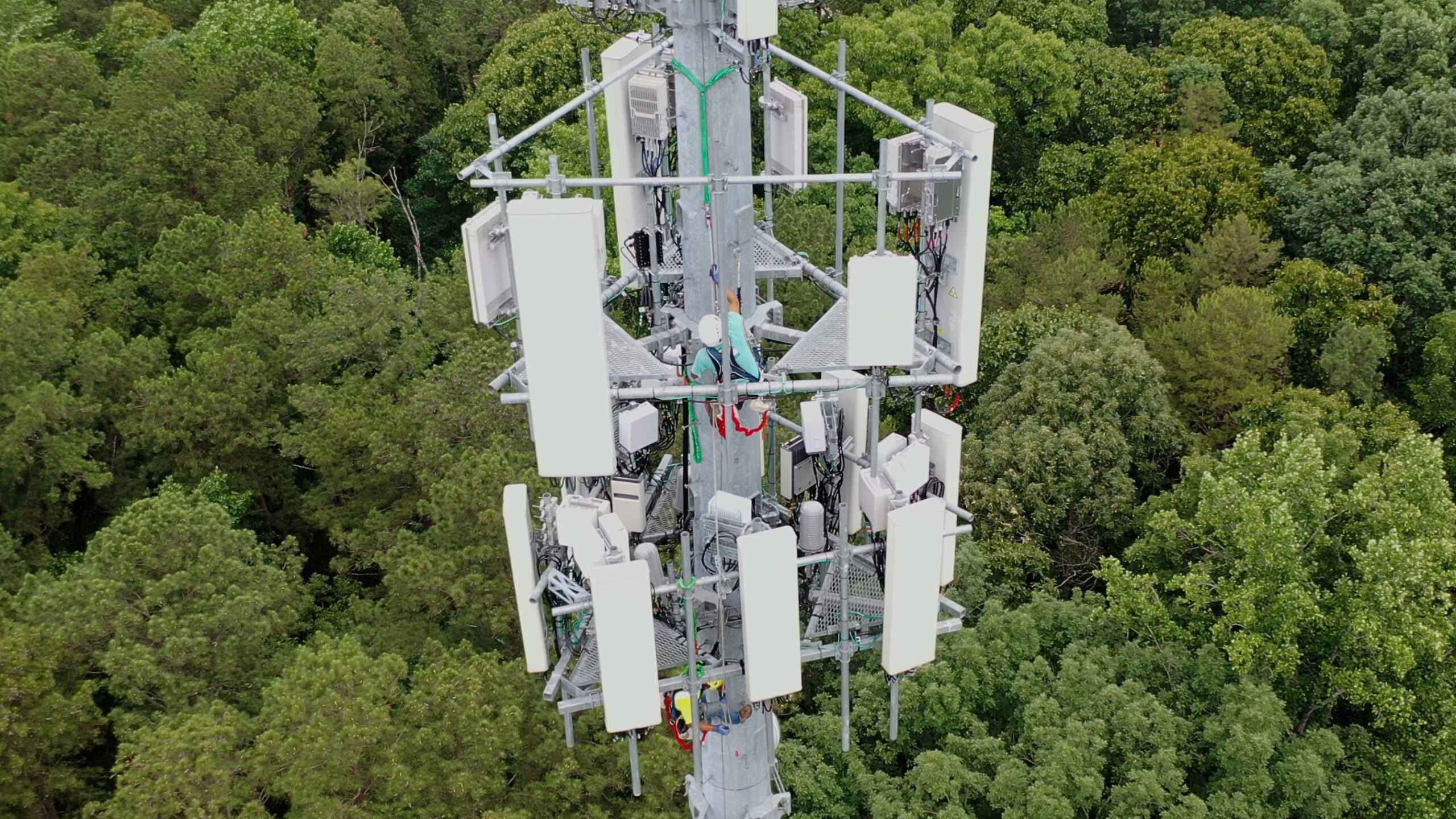
Dycom offers services along that chain. Its engineers use geospatial tools and coordinate with municipalities and field teams. Construction crews install aerial and underground networks. Wireless teams handle macro cells and small cells for 4G and 5G. Fulfillment crews complete drop and in-home installations, activate services and explain the equipment to the people using it.
For a network owner, the attraction is coordination. The same corporate family can handle several connected tasks, while local operating companies bring field experience. Dycom’s footprint includes hundreds of field offices. That arrangement combines a national customer’s need for coverage with the awkward reality that construction happens on particular streets.
02 / A price for the work, not the dream
The business model is correspondingly physical. Dycom performs much of its work under master service agreements, with prices attached to particular tasks and individual work orders. Other assignments arrive as specific project contracts. This is a business selling execution to infrastructure owners, rather than a consumer subscription that households buy from Dycom.
The customers include familiar names: AT&T, Verizon, Lumen and Comcast. In fiscal 2026, AT&T accounted for about a quarter of contract revenue. Dycom reported $5.546 billion in total annual contract revenue. These relationships offer substantial work, but also concentration: decisions made inside a few large customers can travel quickly into a contractor’s schedule.
There are alternatives. MasTec and Quanta overlap in communications and utility infrastructure; EMCOR competes in electrical work. Regional contractors and customers’ own crews also matter. Dycom’s pitch rests on its combination of geographic coverage, technical breadth and labor capacity. For a buyer, those capabilities still have to earn their place through price, quality and delivery.
03 / Following the cable indoors
Power Solutions made the scope change tangible. At the announcement, it had more than 2,800 employees and expected approximately $1 billion in calendar 2025 revenue. Its territory covered greater Washington, Maryland and Virginia. Dycom announced a $1.95 billion valuation for the transaction, on a cash-free, debt-free basis, subject to adjustments.
That price bought an established organization. Power Solutions retained its brand, management and Bowie headquarters. The choice makes practical sense: electrical expertise lives in people and working relationships as much as equipment. This is an editorial reading of the arrangement, but the arrangement itself is explicit.
“This is a milestone acquisition for Dycom”
Dan Peyovich, president and CEO · November 2025
Dycom then agreed to acquire Maryland low-voltage engineering and construction firm National Technology Integrators for $275 million in May 2026, reporting completion in August. Taken together, the purchases extend its role from connections between places to more of the systems inside them. They also explain why a telecom contractor belongs in a conversation about data centers.
04 / The schedule has opinions
Growth does not make the construction calendar obedient. In August 2026, Dycom disclosed that approximately $150 million of wireless-program revenue had shifted into fiscal 2028. The overall program scope remained unchanged. The immediate problem was timing, rather than a disclosed loss of the assignment.
That distinction matters. Crews and equipment must be ready before revenue arrives. A delayed program can leave a contractor carrying capacity ahead of the work. Dycom’s agreements generally do not guarantee specific volumes, and backlog is an estimate. The operational challenge is matching resources to assignments that customers can reschedule.
Safety adds another constraint, appropriately. Dycom’s Headway program includes mandatory training and stop-work authority without reprisal. Training sites include utility pole farms and mock job sites. Its locating teams report millions of successful locates annually. The unglamorous skill is knowing what is already underground before putting something else there.
The work also continues after the launch announcement. Maintenance teams inspect and test networks, expand capacity when requested and restore service after damage. Locating teams provide records and risk assessments as well as marks on the ground. Those services address a different customer problem from expansion: keeping an existing asset usable. The distinction helps explain the breadth of Dycom’s offering. A carrier needs construction when it grows, installation when a subscriber joins, and repair when a connection fails. Each stage calls for its own competence.
05 / Copy the sequence
There is a useful lesson here for anyone managing complicated work: study the handoffs, then build competence around them. Dycom links engineering, construction and installation; its acquisitions add adjacent expertise. The lesson travels more easily than the organization does. Replicating national coverage requires trained people, equipment and customers prepared to give them work.
For telecom buyers, Dycom offers a broad delivery partner. For workers, it offers routes into technical field jobs. For the rest of us, it provides a clearer picture of connectivity. Somewhere between an app opening and a video arriving, somebody obtained permission, checked the ground and made a connection hold.