A New York street is an odd place to look for a business philosophy. It offers parked cars, deliveries, impatient pedestrians and the occasional hole that everyone would prefer someone else to deal with. For Shrihari Pandit, the space underneath it became the answer to a problem that had followed his internet business for years: how much independence can you have when your competitors supply the connections you sell?
Pandit co-founded Stealth Communications in 1995. Its early business served consumers, before pricing pressure pushed it toward business connectivity. Buying capacity from other network owners allowed it to operate, but also placed a rival somewhere inside the transaction. The arrangement had a certain awkward etiquette. A supplier could welcome the revenue and still be reluctant to help a competitor grow.
His eventual response involved getting permission to install fiber in the city's public right-of-way. A franchise agreement sounds like the sort of document that makes a room quieter. In this story, it marks the point when Pandit could begin changing the physical terms of his business. The paper mattered because of what could happen under the pavement.
A business built by two people
“My wife and I started it entirely self-financed,” Pandit recalled. That small sentence puts two people at the beginning of a company whose work would eventually involve city franchises, commercial buildings and network equipment. The business began with money they supplied themselves. Its later construction ambitions would come after years of operating an internet service, rather than arriving fully formed with the first modem.
His professional background was already in networks. Before Stealth, he worked as a network-security consultant for companies including MCI, Sprint and Sun Microsystems. He also consulted independently for NASA and the National Infrastructure Protection Center. Those assignments put his experience across telecommunications, computing and public-sector systems. The founder came to connectivity with an existing interest in how networks behave and how they can fail.
The company's first internet connection was a T1 into MCI's backbone. Its subsequent history includes IPv6 exchange work and voice peering, the practice of letting networks exchange internet telephone traffic directly. These are useful clues to Pandit's professional world. Networks need relationships as well as equipment. A cable can carry a signal; the organizations at either end must still agree on how to exchange it.
The permission slip that changed the job
In 2013, Stealth received New York City information and telecommunications franchises. Its own construction crew began a backbone running from Midtown toward the Financial District. Pandit's job now sat across two quite different kinds of expertise: operating a communications business and getting a physical route through an occupied city. A sales conversation could end with someone needing to open a roadway.
The early scale was modest enough to count building by building. By February 2014, the network had 33 connected sites, and the company was seeking to undercut established broadband providers. That moment is worth keeping in view. A network that later appears on a map as an established presence begins as separate addresses, each requiring access, installation and a reason for a customer to switch.
Pandit's model brought construction work inside the company. Its employees could excavate, install conduit and carry fiber into buildings. Owning the route also meant taking responsibility for it. Independence comes with an inconvenient clause: when the physical network needs attention, someone on your own team has to attend to the physical network. The street does not accept a software update in lieu of a repair.
By 2015, the company had fiber in more than 130 commercial buildings in Manhattan. An underground Brooklyn system followed in 2016. These dates trace the expansion of a founder's responsibilities as clearly as they trace a network. The business had acquired a new kind of permanence, tied to places where it had actually put something in the ground.
Brooklyn required a different tool kit
Moving across boroughs changed the construction problem. In Manhattan, Stealth could use Empire City Subway's existing conduit system. Brooklyn required it to build its own conduit block by block. The contrast made the city's buried infrastructure visible in Pandit's work: the same service could require very different preparation depending on which street, and which borough, stood between the network and the customer.
Stealth's Brooklyn expansion involved the New York City Economic Development Corporation's Connect IBZ initiative for industrial business zones. The project addressed places described as digital deserts. That phrase is particularly arresting in a city so associated with density. Offices and businesses can be close together while the practical route to a suitable connection remains expensive or difficult.
In May 2019, Stealth announced plans for another 8,000 fiber miles. The distinction between fiber miles and route miles matters here. A cable can contain many separate strands, so adding their lengths produces a much larger number than measuring the street route itself. The network then contained more than 27,000 fiber miles across 76 route miles. It was a compact geography containing a great deal of glass.
For Pandit, expansion therefore meant more than extending a line on a map. It meant increasing what could travel along a route and bringing that route within reach of more buildings. His 2019 video interview focused on commercial districts beyond downtown and Midtown Manhattan. The recurring question was where a business could get connected, rather than how impressive a network looked from a distance.
Distance along the network’s routes
Combined lengths of individual strands
His proposal: give competitors somewhere to build
The construction experience became a public argument. In 2021, Pandit advocated a national open-access conduit system, comparing it to the Interstate. Government would build the pathways; providers would choose and install their communications technology. He saw shared access as a way to make entry easier for independent internet businesses. A country wanting more providers could start by making room for their cables.
He acknowledged the scale of the undertaking, suggesting a decade or two and linking construction to planned road and bridge upgrades. Analysts raised objections, including the likely response of companies that had already invested in their own infrastructure. This was a proposal with costs and opponents, rather than a tidy diagram awaiting an agreeable committee.
In his own writing, Pandit developed the distinction between publicly supported infrastructure and privately delivered services. Conduits, poles, rights of way and building entry points could shape competition before a customer ever compared monthly prices. His argument asked policymakers to look beneath the service layer. If another provider cannot physically reach a building, shopping around has a rather short itinerary.
He returned to underserved business communities in an April 2021 podcast appearance. The continuity is revealing: an operating problem became a construction project, and the construction project became a policy position. His preferred intervention grew out of the kind of obstacle his company had encountered. He was asking for a marketplace whose entrances were easier to use.
If another provider cannot physically reach a building, shopping around has a rather short itinerary.
Speed has a security bill
Pandit's technical writing also explored risks within optical networks. In March 2021, he published an article examining how passive optical networks could be vulnerable to denial-of-service attacks through injected optical signals. He called for greater industry attention and countermeasures. The topic fits his earlier consulting background: providing capacity and protecting the system that carries it are connected responsibilities.
In September 2022, Stealth selected Nokia for a core-network upgrade, including routing equipment for 100GE and 400GE business services and Deepfield Defender protection against distributed denial-of-service attacks. Those figures describe the announced equipment and service plans, rather than a universal promise about every customer's experience. At this stage, Pandit's independence depended on partnerships as well as ownership.
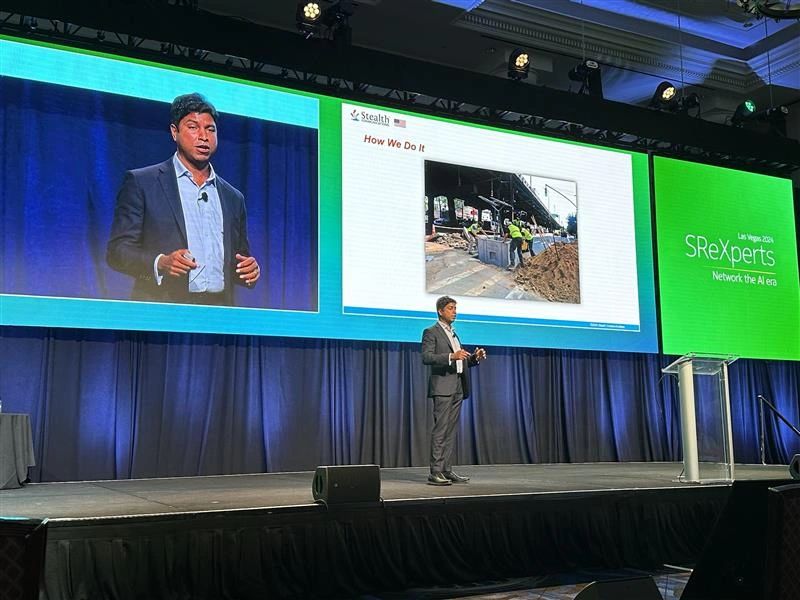
The photograph from his 2024 SReXperts appearance captures the combination neatly. He stands on a conference stage beneath a screen showing a street-construction image. The presentation slide says “How We Do It.” An excavation has made its way into a room devoted to networking technology. For this particular chief executive, the equipment discussion and the hole in the ground belong in the same presentation.
A pager survives the upgrade
Pandit's interests extend beyond his own fiber footprint. In a 2020 conversation about Starlink and terrestrial networks, he discussed latency, construction costs and satellite service for rural areas. He also wrote about the coexistence of 5G and Wi-Fi 6. These appearances show him considering where different technologies fit, rather than treating every connectivity question as an invitation to sell another urban fiber connection.
His public recollections are more domestic in scale. On LinkedIn, he has remembered rotary phones, floppy disks, manually rewinding cassettes and the wait for modem prompts. In a reply to another participant, he added: “I still have my old pager with me.” A chief executive whose working life involves optical networks has kept an object from an earlier era of being reachable.
The pager gives the profile a useful sense of proportion. Telecommunications advances through products whose names and promises change; people retain memories of the tools they actually used. Pandit's recollections are about the experience of operating them, including the small inconveniences. Anyone who has coaxed a cassette back into usefulness with a pencil can appreciate that engineering sometimes begins with whatever is close to hand.
His career now stretches from consulting and a business founded with his wife to a network built beneath New York's streets. The lasting question is who controls the route between an organization and the people it needs to reach. Pandit has pursued that question through contracts, construction, technical writing and public debate. Somewhere in the picture there is still a pager, quietly excused from the upgrade cycle.
Follow the connections
- Stealth Communications
- Twitter / X
- His argument for shared infrastructure
- The national conduit proposal and its critics
- The fiber-building interview
- Optical-network security, in his own writing
- The Nokia network upgrade
- Watch: connecting commercial districts
- Listen: The Divide
- Listen: SPEXcast on satellites and fiber
- 5G and Wi-Fi 6, by Shrihari Pandit