Prem Jain and his partners left Cisco in 2016 with a perfectly respectable idea: retirement. They had spent years building companies, selling them back to Cisco, and helping turn the resulting products into businesses. There was plenty to retire from. Then they began discussing what was happening in the cloud. By 2017, they had another company.
Pensando would develop programmable processors and software for data centers. In May 2022, AMD completed its acquisition of the company for approximately $1.9 billion. Retirement had acquired a rather substantial footnote.
Jain’s career invites a question more interesting than how to repeat an acquisition. How do you recognize when an idea’s moment has arrived? He had learned something about that well before Pensando, through an early venture whose technology excited its builders considerably more than its prospective customers. The lesson stayed with him through several changes of company name.
A professor takes a different call
Before the startups, Jain expected to teach. He earned his engineering degree at BITS Pilani in 1973 and went to UC Davis for graduate study, completing his master’s in 1977. Microprocessors were the subject of his thesis. A doctorate and a professorship looked like the next steps.
Instead, a call came to his adviser’s office from BNR, looking for somebody who knew about microprocessors. Jain was there. He went for an interview and accepted a job. A career spent helping computers communicate began with an ordinary human version of the same activity: somebody asking whether the right person happened to be available.
His education had already involved some departures from the expected route. During his college years, he hitchhiked through Europe four times. Traveling with little money exposed him to different cultures and gave him practice in unfamiliar situations. It is an appealing detail in a career otherwise crowded with business units and network architectures. Before learning how to navigate corporate structures, he had navigated other people’s roads.
At Davis, he valued the practical work of designing circuits. Hardware, software and systems belonged together in that education. Years later, his advice to engineering students would make room for business leadership as well as technical competence. He had followed that route himself, although the original destination had been a classroom.
A clever product meets an empty order book
At David Systems, which he began in 1983, Jain worked on combining telephone and data networking technology. The engineering team believed in the product. The market had reservations.
“No one wanted it!”
Prem Jain, recalling David Systems
Customers were not ready to put voice and data into one product. There was also an awkward commercial complication: the team had to sell the proposition to three buyers. An integrated design could still encounter a divided purchasing process. The diagram on the engineer’s desk and the organization chart at the customer’s office were describing different worlds.
Jain’s later account of the experience is useful because he lets the failure remain a failure. Technical quality had not produced demand. The remedy involved speaking to customers earlier, finding out what they needed, and testing whether a proposed solution belonged in their present circumstances.
He would describe a process of taking customer problems back to the team, developing a solution, then returning for more feedback. The customer did not have to invent the technology. The customer did have to recognize the problem being solved. That distinction gave the engineers room to create while keeping the work attached to an actual market.
A product has to meet two schedules: when engineers can build it, and when customers can adopt it.
Four initials, several companies
David Systems also produced relationships that lasted much longer than its commercial disappointment. Jain began working with Mario Mazzola and Luca Cafiero in 1983. Soni Jiandani joined their working partnership in 1993. Their first initials supplied the name MPLS, conveniently also the name of a networking technology. Even the nickname knew its audience.
Crescendo Communications brought Jain into Cisco in 1993, when Cisco acquired the company. He joined as director of engineering. His work at Crescendo included systems architecture and switching products; at Cisco, the partnership would help the company enter additional markets.
The arrangement became known as a spin-in. Cisco financed a separate startup working on a new business, then acquired it. Andiamo, Nuova and Insieme followed that route. Storage networking, servers and software-defined networking gave the partners successive problems to work on without requiring them to abandon one another.
For the people building the products, the work continued beyond the acquisition announcement. Jiandani described teams joining Cisco and staying for years to develop the technologies into businesses. Jain eventually served as senior vice president and general manager of the Insieme business unit, which developed application-centric networking and data center switches.
There were organizational tensions in the model. Rewarding a separate team to build an adjacent business could provoke jealousy inside the larger company. Jain acknowledged that friction. Familiar partners and a willing sponsor did not remove the difficulty of execution. They supplied a way to organize it.
New companies. Familiar collaborators.
- 1983David Systems
Jain, Mazzola and Cafiero work together - 1993Crescendo → Cisco
Jiandani joins the working partnership - 2013Insieme → Cisco
Software-defined networking - 2017Pensando begins
An independent venture - 2022Pensando → AMD
Acquisition completed May 26
The cloud comes down to a chip
Pensando used a different corporate arrangement. It was independent of Cisco. The partners had seen another shift worth pursuing: cloud operators needed sophisticated infrastructure, and building all of it themselves was a considerable undertaking.
The offering combined silicon with software. Enterprise customers could use it to build private cloud infrastructure; cloud providers could use it in the services they sold. Selling those building blocks gave Pensando a position underneath its customers’ applications, where networking, security and storage work had to happen reliably.
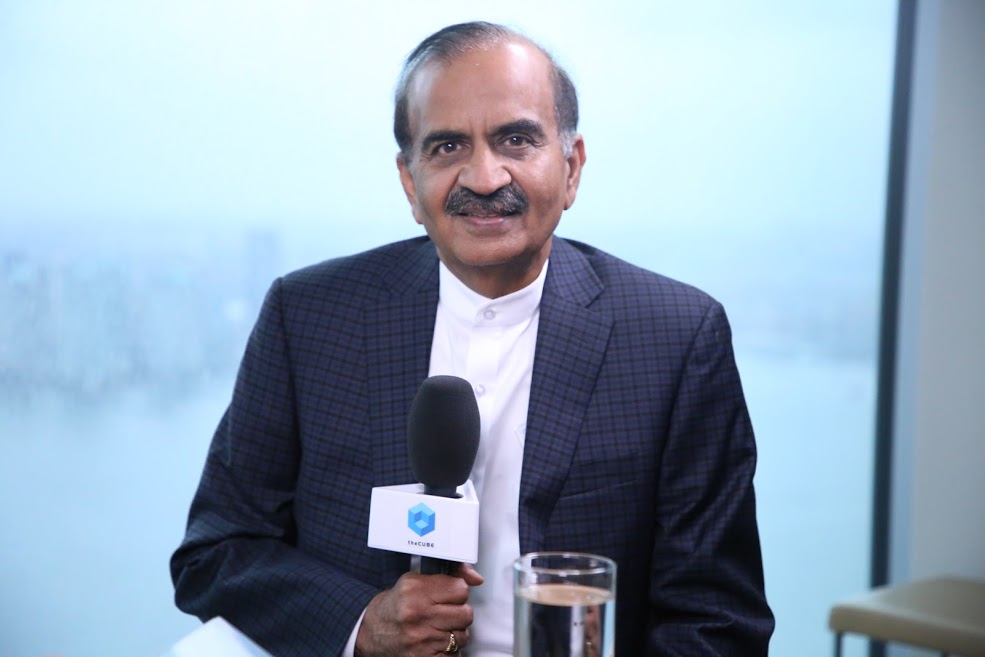
Jain approached the design as a system. A chip alone would leave buyers with substantial integration work. Pensando also provided the software to manage services and interfaces through which customers could connect their own systems. Programmability mattered because infrastructure has to accommodate changes after the hardware has shipped.
The location of the work mattered, too. Services could run close to the server and application rather than depend on a succession of separate appliances. In his explanations of the architecture, Jain repeatedly returned to where the data was and what needed to happen to it. “Cloud” is a pleasingly weightless word for a business full of decisions about physical placement.
Give infrastructure work its own engine
Conceptual view of Pensando’s approach: distribute infrastructure services near the workload and offload work from the CPU.
By April 2022, Jain said customers and partners had deployed more than 100,000 Pensando platforms in production. The named customers included Goldman Sachs, IBM Cloud, Microsoft Azure and Oracle Cloud. The idea had made the journey from engineering proposal to operating infrastructure.
Approximate value of AMD’s completed Pensando acquisition.
AMD gained a data processing unit and its software stack, adding networking capabilities to its data center portfolio. The Pensando team joined the group led by Forrest Norrod. For Jain, who became an AMD senior vice president and general manager, another startup had entered a larger company with customers already using its products.
Keeping your word has a cost
The advice Jain gives about running a company is often less glamorous than the products. Listen carefully. Acknowledge mistakes. Spend money with the care you would apply to your own.
His version of frugality has limits. He has argued against squeezing important suppliers by renegotiating commitments simply because a startup needs to preserve cash. Saving money can damage a relationship that took much longer to build. The spreadsheet may record the saving immediately; the consequences can arrive later.
That concern for trust also appears in his account of mentorship. Mazzola influenced how he examined technology and business problems. John Chambers helped him think about scale, organizational chemistry and recovering from mistakes. Jain had colleagues who could offer advice from inside a long shared history, including the parts that had gone badly.
He also left room for other builders. Discussing Pensando in 2020, he pointed to opportunities for entrepreneurs in security analysis, troubleshooting and integrating hybrid environments. Providing infrastructure could create places where somebody else’s invention might fit. The system did not have to end at the boundaries of his company.
One example was an artificial intelligence engine that could examine a stream of network data and help identify an abnormality. Another was software that could pinpoint the location of a network problem more quickly. These were specific jobs for potential partners, with a place in the architecture already in mind. Jain could describe an opening for another company in terms an engineer could investigate: here is the data, here is the problem, what could you build?
A chair for the next beginning
The prospective professor eventually found another way back to education. Jain and his family committed $1.5 million toward a UC Davis chair in innovation and entrepreneurship. A $500,000 match from the University of California brought the endowment to $2 million. Computer science professor Dipak Ghosal became its inaugural holder in 2020.
The chair supports a faculty role connecting research, teaching and entrepreneurship. Jain also mentored students, advised the university and brought recruitment colleagues to campus. These are practical connections between studying engineering and discovering what one might do with it.
His institutional commitments extend beyond Davis. He served as president of JAINA from 2013 to 2015 and helped establish JITO USA. BITS Pilani recognized his industry and philanthropic work with the BITS Ratna award in 2025. He serves as chairperson of BITSAA International, maintaining another connection to the institutions where his working life began.
There is a pleasing continuity here. A student prepared to become a teacher took an unexpected job, built networking companies, and eventually helped provide resources for other students’ ideas. He knows how much depends on the interval between having a promising design and finding somewhere it can work. An endowed chair is one way of making that interval a little more hospitable for the next engineer.