At Nasdaq on February 24, 2025, David Goeckeler had a bell to ring and a company to explain. Sandisk was beginning life on the stock market as an independent business again. Members of its executive team and board joined him in Times Square. For a few minutes, the work of separating a global storage company could be represented by a button, a photograph and some applause.
The paperwork had been less photogenic. Goeckeler had spent nearly five years running Western Digital, a business spanning hard drives and flash memory. Now he was going with the flash side. The chief executive who had overseen the whole enterprise would lead one of its two descendants. Corporate ambition usually arrives carrying an acquisition agreement. His arrived with a separation plan.
That decision gives his career an interesting shape. At Cisco, he had helped bring networking and security together. At Western Digital, he helped take two storage businesses apart. The apparent contradiction disappears when you ask a practical question: what arrangement gives the engineers, customers and investors a clearer idea of what happens next?
A software developer learns to read the machinery
Goeckeler's education crossed the boundary between technical work and business. He studied computer science and mathematics at the University of Missouri, then earned a computer science master's degree at the University of Illinois Urbana-Champaign in 1986. An MBA through the Berkeley-Columbia Executive MBA Program added another vocabulary to the technical one.
He began his career at Bell Laboratories. Later, at Cisco, his responsibilities spread across products, engineering, security and networking. These were jobs concerned with the largely invisible infrastructure beneath everyday computing. Customers might admire an application; somebody still had to make sure the application could reach another machine.
There is a useful clue in how he describes his beginnings: “I started out as a software developer.” It helps explain why a hardware executive would keep returning to systems. A router, a chip and a storage device each have their own specifications. Their usefulness depends on the larger arrangement in which somebody puts them.
By 2017, Cisco had promoted him to executive vice president of networking and security. He continued to lead more than 20,000 engineers. Chuck Robbins, Cisco's chief executive, singled out the launch of the company's intent-based network when announcing the promotion. The aim was to make networks respond more directly to what businesses wanted them to do.
“Sometimes I say the person who can live with the most uncertainty the longest, wins.”
David Goeckeler, 2022
Twenty-five thousand engineers, one large system
In a 2018 conversation about Cisco's direction, Goeckeler described routers, switches and wireless access points as parts of one large software system. That is a fairly revealing way for an executive responsible for selling network equipment to look at his inventory. The boxes were becoming components of a larger operating idea.
He talked about automation, the growing population of connected devices and the complications of using several clouds. The problem was practical: adding more equipment could make a network harder to manage. A customer did not become less busy simply because the vendor had released another product. Simplification had to be engineered.
His public work also included conversations with the people building those businesses. In 2019, he sat down with Duo Security co-founder John Oberheide to discuss cloud-delivered security and Duo's arrival at Cisco. It is a small but useful view of his job: technical architecture on one side, the people joining the organization on the other.
By the time Western Digital recruited him, his Cisco remit covered a $34 billion business and more than 25,000 engineers. Those numbers describe the organization he managed, rather than a company he founded. His career had become a study in taking responsibility for established technology franchises and deciding how they should change.
- 1986Computer science master's, Illinois
- 2017Executive vice president, Cisco
- 2020Chief executive, Western Digital
- 2025Chief executive, independent Sandisk
The larger job, then the smaller perimeter
Western Digital announced his appointment on March 5, 2020, with a March 9 start date. He succeeded Steve Milligan. The company emphasized his combination of software experience and large semiconductor development projects. Storage needed someone who could understand both the physical product and the applications creating demand for it.
His argument for the move was straightforward. Connected devices, cloud infrastructure and software were making access to data more valuable. Western Digital supplied two important ways of storing that data. The opportunity extended from the device in someone's hand to the infrastructure serving it, with engineering problems at every stop.
Three years later, the question had become how to organize those businesses. On October 30, 2023, Western Digital's board unanimously approved a plan to separate hard drives and flash into independent public companies. The proposal gave each its own strategic focus and capital structure. A shared market for storage did not require a shared corporate roof.
Goeckeler described groundwork already done: separate product business units, operational capabilities and leadership. This matters because a separation is easy to announce and laborious to deliver. The March 2024 progress report described legal entities, customer and supplier contract transfers, filings and executive appointments. Corporate surgery involves a surprising amount of stationery.
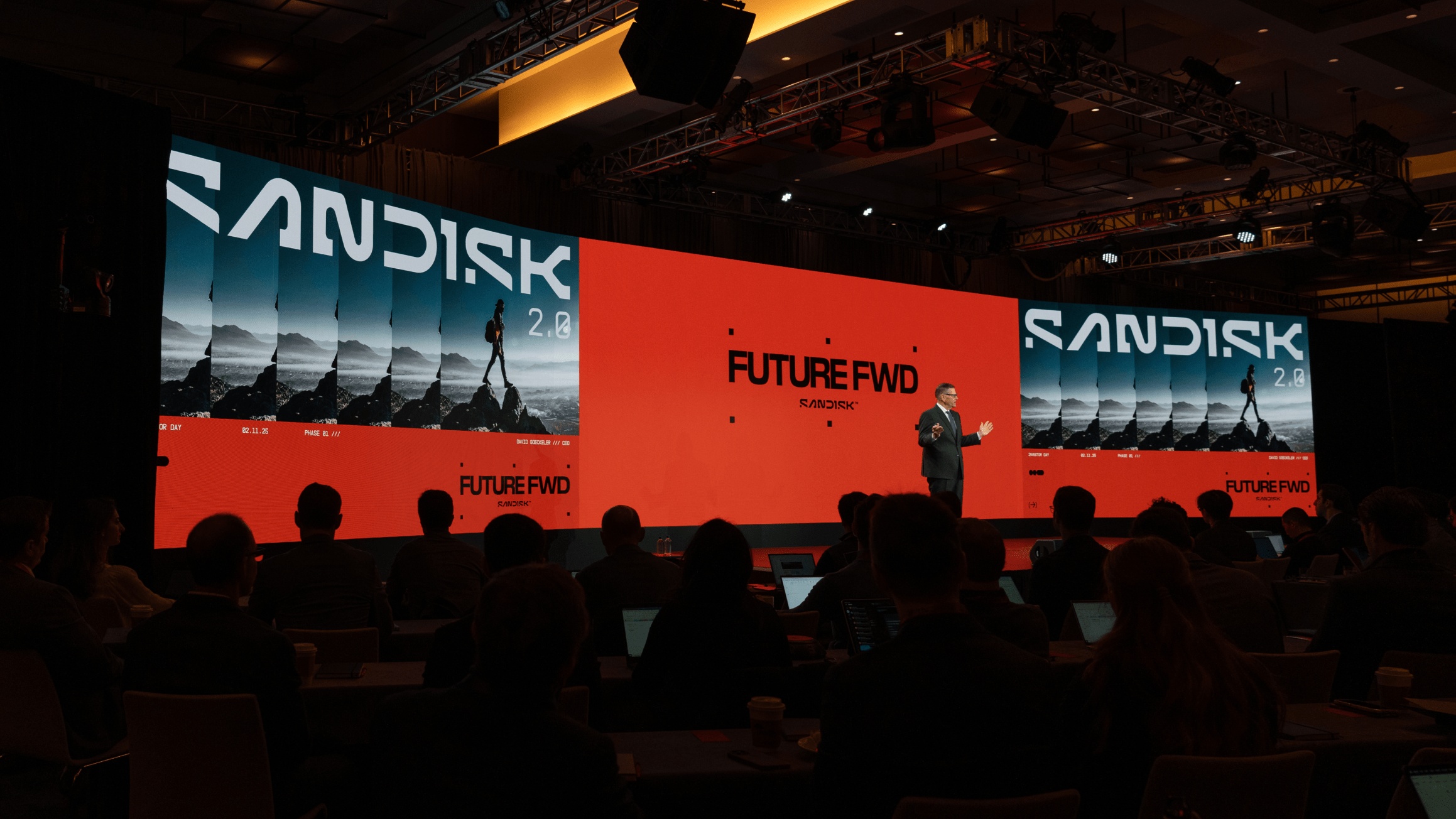
The original target was the second half of 2024. The new Sandisk began independent trading in February 2025. Goeckeler took the chief executive role there. His next chapter would be judged on flash memory, with less room for the performance of one storage business to obscure the other.
Independence has a Japanese partner
For all the attention given to independence, Sandisk's manufacturing story depends on collaboration. Its relationship with Kioxia reaches back more than 25 years. The companies jointly develop and manufacture flash memory wafers in Japan. Goeckeler inherited that relationship and has made decisions that extend it well beyond his first years at Sandisk.
In January 2026, the partners extended their Yokkaichi joint-venture agreements through December 31, 2034. Their Kitakami agreement was aligned to the same date. Sandisk agreed to pay Kioxia $1.165 billion in installments from 2026 through 2029 for manufacturing services and continued availability of supply.
These are useful numbers for understanding the chief executive's time horizon. A quarterly earnings call asks what happens next. A manufacturing agreement running into the following decade asks what the company will still need after several versions of “next” have come and gone. Goeckeler has to answer both questions.
His responsibilities also extend into the relationship between the two countries. In October 2024, he became chair of the U.S.-Japan Business Council, succeeding S&P Global's Doug Peterson. He had previously been its vice chair. In June 2026, he led a council delegation that met Japanese officials to discuss economic ties and public-private cooperation.
Then, in August, Kioxia and Sandisk announced anticipated investment of more than $31 billion in Japan through 2032, contingent on government support. The plan covered continued infrastructure development at Yokkaichi and Kitakami. This was a proposed program with a condition attached, rather than money already spent. Its scale nevertheless showed how much of Sandisk's future required patient coordination.
The memory business gets a different audience
The Sandisk name is familiar to people who buy memory cards and portable drives. Under Goeckeler, the business also has an increasingly consequential audience among datacenter customers. Its financial reports provide a way to watch that change without pretending the consumer products have disappeared.
In November 2025, Sandisk reported first-quarter fiscal 2026 revenue of $2.31 billion. BiCS8, a generation of its flash technology, represented 15 percent of bits shipped. The company described engagement with five major hyperscale customers. These were measures of a business working through product transitions and customer qualifications, the less theatrical companions to a stock-market debut.
By January 2026, quarterly revenue had reached $3.03 billion, and datacenter revenue was up 64 percent from the preceding quarter. Goeckeler pointed to the product mix and enterprise SSD deployments. The familiar memory-card company was asking investors to pay attention to what it could supply inside much larger computing systems.
Fiscal 2026 ended with $20.248 billion in revenue, up 175 percent from the previous year. Datacenter revenue rose 437 percent. Goeckeler described datacenter as a key growth pillar and pointed to deeper customer partnerships. The company also reported additional agreements under what it called its New Business Model.
The figures deserve a little discipline. Sandisk said roughly two-thirds of fourth-quarter sequential revenue growth came from higher pricing, with about one-third from higher volumes. A large revenue increase therefore cannot be read simply as an equivalent increase in chips shipped. Understanding the business still requires the engineer's habit of checking what a number actually measures.
What he carries into the next room
There are quieter measures of Goeckeler's standing. Illinois awarded him its 2025 Distinguished Alumni Achievement Award. He serves on the university's engineering Board of Visitors and on ADP's board. He chaired the Semiconductor Industry Association for 2025. These positions connect the operating executive to education, governance and the policy conditions around chipmaking.
His career offers no tidy rule that companies should always become bigger or always become more focused. Cisco required integration. Western Digital required a separation. Sandisk requires a manufacturing partnership that survives changes in corporate ownership and market demand. Each arrangement asks for a different kind of cooperation.
That is what makes the bell ceremony more interesting in retrospect. The photograph marked a boundary; the work on either side of it continued. Goeckeler had chosen his next responsibility, and it came with factories, engineers, customers and commitments stretching years ahead. The bell could finish on time. The decisions behind it would keep their own calendar.