Rick Wallace sent a hundred résumés to Silicon Valley. A hundred rejections came back. He was living in Michigan, looking for a way into the business of making chips, and the postal service appeared to have delivered its verdict. Wallace reached a different conclusion: he should go there. At 24, he sold his belongings and drove his Camaro T-top to California. As career plans go, it had excellent ventilation.
The destination eventually became KLA, the semiconductor equipment company he joined in 1988 and has led as chief executive since January 2006. But the interesting part of that journey lies between the car and the corner office. Wallace repeatedly put himself in situations where his existing competence would only get him so far. He learned the next thing, then took on work that required him to use it.
That habit helps explain a career spent largely inside one company, in an industry that keeps changing the examination questions. It also offers a useful way to understand the person behind a business devoted to detecting what other people would rather never discover: a mistake.
The electronics enthusiast meets the cleanroom
Long before he managed engineers, Wallace was the sort of youngster who had oscilloscopes in the basement. He operated a ham radio and built a computer before starting at the University of Michigan. He later recalled assuming that other students had done the same. Some people arrive at university with a favorite sweatshirt. Wallace arrived with a rather different notion of ordinary extracurricular activity.
He earned his electrical engineering degree in 1982. Work at Procter & Gamble preceded his move into Silicon Valley. At Cypress Semiconductor, then a startup, he worked in the manufacturing cleanroom. The engineer with a Michigan degree soon decided he needed a deeper education in semiconductors.
Santa Clara University gave him a way to keep working while studying. His interests expanded beyond the devices themselves into finance, marketing and the coordination of a business. He moved into engineering management, earned a master’s degree and later taught global competitiveness as an adjunct lecturer for five years. Explaining a subject to a roomful of students, he found, was useful preparation for getting a company to understand what it was trying to do.
There is something appealingly practical about that sequence. First learn how the thing works. Then learn how the money works. Then stand in front of people who are entitled to ask whether your explanation makes sense. A technical education can start a career; Wallace kept adding to his.
The promotion that felt like a gamble
After experience at Ultratech Stepper, Wallace joined KLA as an applications engineer. His subsequent jobs crossed technical marketing, product management and customer responsibilities. The route to leadership included a task he remembered with considerably less comfort than the phrase “career development” usually implies.
KLA wanted to move from selling one machine into a fabrication plant to selling multiple machines. Wallace already had a team working on the opportunity. His boss wanted something more personal: Wallace should give up his other responsibilities and concentrate on that assignment alone. He had built a career and was doing well. Now he could fail somewhere conspicuous.
Then came the additional instruction: “Don’t worry about the budget.” With competing duties removed and money available, the familiar explanations for slow progress disappeared. Wallace described the assignment as a turning point. He later used the approach with other promising employees: give them a substantial opportunity, a clear responsibility and the resources to pursue it.
His recollection preserves the awkward part of an opportunity. A manager can call it a vote of confidence; the recipient can still feel the floor moving. Wallace’s story makes room for both reactions. The assignment succeeded, and he carried the management lesson forward. Permission to concentrate had been an important part of the offer.
“Don’t worry about the budget.”
The instruction Wallace remembered from a pivotal KLA assignment
A business built around unwelcome discoveries
To understand Wallace’s working world, consider the economics of a chip factory. Manufacturing equipment performs a succession of extraordinarily demanding operations. Inspection and measurement help reveal whether those operations are producing the intended result. Yield describes how much usable output the process delivers. A beautiful design still has to survive manufacturing.
KLA works in that checking and measuring business, supplying equipment, software and services. Its customers need to identify defects, understand deviations and improve production. In this setting, finding an error has value because it gives a manufacturer a chance to act. The defect has no interest in the prestige of the design team or the price of the building.
By 2007, Wallace was already explaining the distinction between customers spending to add production capacity and customers investing to reach the next generation of technology. He argued that the latter helped support KLA’s business through industry cycles. He also recognized that continued progress would demand changes in materials and architecture alongside smaller features. Shrinking things was becoming a more expensive undertaking.
His language about the consequences could be blunt. “Whoever misses a process node in this market is dead,” he said that year. The phrasing carried the urgency of an equipment supplier whose customers were racing their own competitors. Accuracy had a commercial deadline. Wallace’s job was to organize a company capable of helping customers meet it, repeatedly, across successive generations of manufacturing.
Values that have to survive Tuesday
Wallace became CEO on January 1, 2006, succeeding Kenneth Schroeder. He had already served as president and chief operating officer in 2005; his continuing tenure as president began in November 2008. By then, his experience included leading the Wafer Inspection Group and the Customer Group. He had seen the company from several directions before being asked to run it.
He made the executive team and company culture part of his early agenda. The values he emphasized included perseverance, continual improvement, strong teams, candor and being indispensable to customers. Those ideas have remained recognizable in KLA’s later statements of business conduct. The vocabulary is straightforward. The difficulty comes when a schedule slips or somebody has to volunteer an inconvenient fact.
In his 2025 message on business conduct, Wallace tied those expectations to everyday work: solving customer problems, meeting engineering deadlines and helping a colleague. He also reinforced the availability of reporting channels and the company’s commitment against retaliation for good-faith reports. Candor needs a place to go after it has been encouraged.
An audience member once asked him why someone should be forthright when doing so could bring punishment. Wallace’s answer was brief: “Because it’s the right thing to do.” It is a better line than most corporate mottos, partly because it does not require a consultant to explain it. Whether a company lives up to such language is tested in the ordinary decisions employees make, well away from an awards ceremony.
The road bends back toward Ann Arbor
Wallace’s California story eventually acquired a Michigan chapter. KLA chose Ann Arbor for its second U.S. headquarters after considering nearly 400 possible locations. The attractions included engineering talent, an international airport, living costs and quality of life. His university connection gave the decision a personal resonance, but the company also had a recruiting problem to solve.
In 2019, KLA opened a temporary research and development office near the University of Michigan’s North Campus. It had created a $3 million endowment for graduate fellowships. The new operation connected a global equipment business with a university producing people it hoped to employ. A graduate who liked Ann Arbor would have another reason to consider staying.
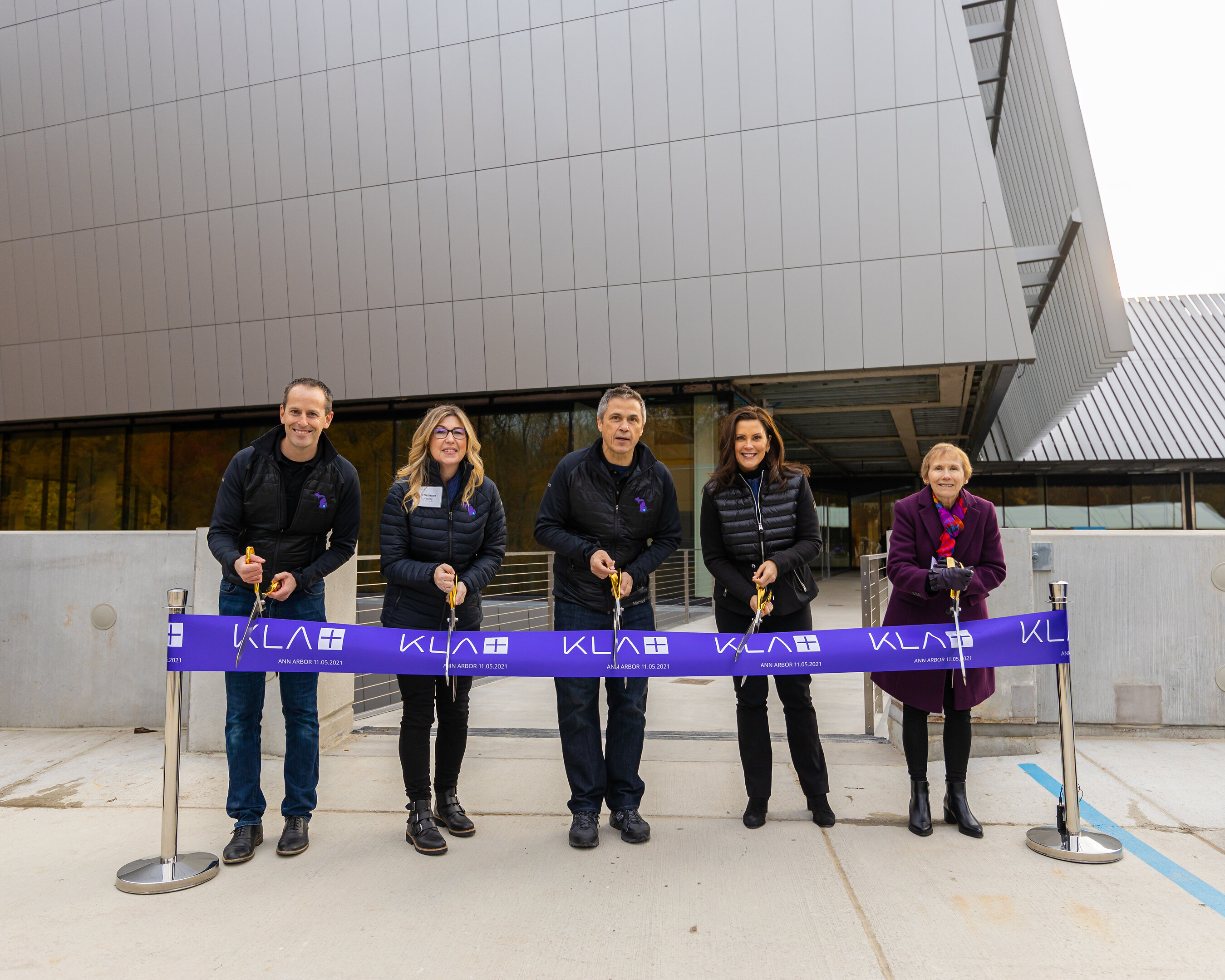
The $200 million headquarters officially opened in November 2021, with more than 300 employees already based locally. Its woodland setting, green roof and walking trail offered a distinctive answer to a familiar recruitment question: where would people want to spend their working days? The building made KLA’s plans visible in a way a vacancy listing could not.
For Wallace, the decision also revisited the geography of his own beginning. He had once driven away from Michigan to find semiconductor work. Decades later, he was helping put more of that work within reach of people who might prefer to remain there. The return trip involved rather more real estate.
The next examination question is AI
His responsibilities extend beyond KLA. In April 2024, Wallace joined Marvell’s board alongside Adobe finance executive Daniel Durn. His earlier board service included NetApp, Proofpoint and Splunk, as well as the semiconductor industry association SEMI. Those roles connect his equipment career with businesses in chips, storage, security and software.
At KLA, the current opportunity reflects another shift in what customers are building. In July 2026, Wallace described AI infrastructure investment as a driver of demand for process control in advanced logic, memory and packaging. Packaging matters because the work of connecting semiconductor components has become part of the performance challenge. The checking continues as the architecture changes.
KLA reported $13.58 billion in revenue and $4.83 billion in GAAP net income for fiscal 2026. Those are company results, produced by a large organization. They give scale to the responsibility Wallace now carries, twenty years into his tenure as chief executive. The assignment has grown; the need to learn has kept pace.
His approach to a bicycle offers a smaller, more personal illustration. Wallace disliked climbing hills, so he signed up for the Death Ride, a demanding Sierra Nevada cycling event. He chose to practice the part he found difficult. The same impulse was visible in the young engineer who answered a stack of rejection letters by getting into his car. Apparently, the harder road has always had a certain attraction.