A chip can be tiny enough to disappear beneath a fingertip and complicated enough to keep several companies occupied for years. Gary Dickerson has spent much of his working life in that discrepancy. The object gets smaller; the coordination gets harder. In October 2026, the Applied Materials chief executive gave his answer a substantial footprint: the EPIC Center in Sunnyvale, a $5 billion investment devoted to bringing semiconductor research closer to production.
There is a pleasing incongruity here. To improve things measured at atomic dimensions, Dickerson is putting people in a very large building. Chipmakers, equipment specialists and researchers will work alongside Applied teams. The wager is that some of the time lost between a promising discovery and a manufacturable chip can be recovered by changing how the people involved work together.
Dickerson approaches this question with a factory operator’s history. Before the chief executive’s job came manufacturing, engineering management, process control and years running equipment businesses. His career follows a succession of places where a clever idea eventually meets a less accommodating question: can you make it work again?
Six years where the chips were made
His education paired a bachelor’s degree in engineering management at the University of Missouri-Rolla, now Missouri University of Science and Technology, with an MBA at the University of Missouri-Kansas City. Engineering and management sit together in the first qualification. The combination would remain useful in a business where the equipment, the customer and the production schedule all require attention.
He began in manufacturing and engineering management at General Motors’ Delco Electronics division and AT&T Technologies. He later recalled spending six early career years in chip factories, mostly working in lithography. Those are useful coordinates for understanding him: he encountered semiconductor production from inside the operation before moving into the companies selling its tools.
A factory gives an abstraction a deadline. Equipment must do its job, measurements must mean something, and a result must be repeatable. Read against that background, Dickerson’s later emphasis on bringing inventions into production has a practical continuity. The laboratory and the factory may admire the same discovery for rather different reasons.
At KLA-Tencor, he spent 18 years in operations and product development, becoming chief operating officer in 1999 and president and COO in 2002. He subsequently led Varian Semiconductor Equipment Associates for seven years. Applied acquired Varian in 2011; in June 2012, Dickerson became Applied’s president, responsible for the day-to-day performance of its four business units.
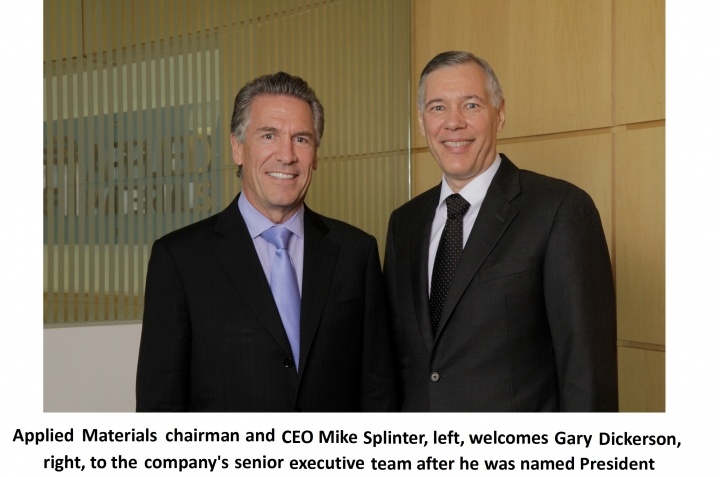
That appointment placed him over semiconductor systems, display, services, and energy and environmental solutions. By September 2013 he was CEO and a board member. The path there had supplied several perspectives on the customer’s problems: running manufacturing, inspecting its results, and leading a specialist equipment company. At Applied, those perspectives met a broader portfolio.
An engine before a building
Years before EPIC, Dickerson was talking about a Product Development Engine. Applied used that name for its approach to spotting changes in customer needs and developing products to meet them. In 2016, he described an organisation that had strengthened its processes and increased research investment so it could recognise opportunities earlier and bring products forward faster.
The language is industrial, which suits the speaker. An engine has parts, a sequence and something useful to turn. It suggests that innovation can be organised and improved, as well as celebrated. For a supplier whose customers are making their own expensive technology transitions, the timing of a new product matters alongside its technical virtues.
His account of customer contact supplies a more human measure of that approach. During a 2019 interview, he estimated he had spent about 20 days travelling in June, meeting customers in Asia, Europe and the United States. Among them were research leaders in Taiwan and South Korea. The calendar sounds less like a corner office than an extended negotiation with airport departure boards.
“I love interacting with customers and working together to figure out how we drive innovation.”
Gary Dickerson, 2019
That is the one conspicuously personal pleasure in this otherwise technical itinerary: working through the problem with the customer. It also helps explain why his strategy keeps coming back to earlier contact. If the equipment maker learns what a customer needs while the technology is still taking shape, both sides have more room to change their approach.
Three executives, one photograph
At Applied’s 2025 Engineering Technology conference, Dickerson hosted Nvidia’s Jensen Huang and Micron’s Sanjay Mehrotra. The event brought together nearly 1,000 Applied engineers and scientists from around the world. A photograph of the three executives gives the discussion a cheerful souvenir: Huang on the left, Dickerson in the middle, Mehrotra on the right, with a Nevada-themed conference backdrop behind them.
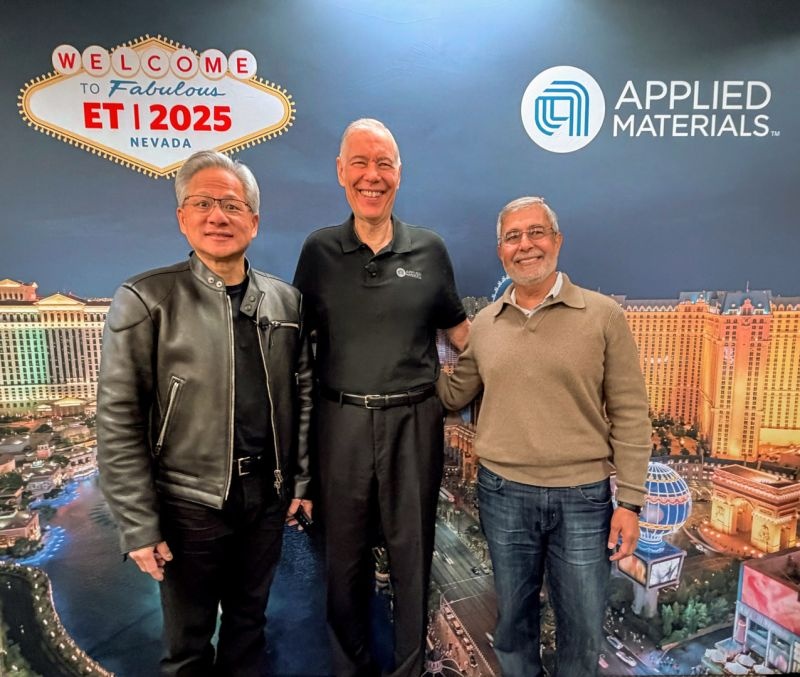
The grouping makes a useful picture of the dependencies in computing. Nvidia designs processors; Micron makes memory; Applied supplies equipment and materials engineering capabilities to chip manufacturers. Their companies occupy different positions in the work required to produce a computing system. Getting them into the same conversation lets questions travel between those positions.
Dickerson and Huang’s fireside discussion ranged across changes to computing, agentic AI and the semiconductor technology needed for more energy-efficient systems. For Dickerson, this is familiar territory with a larger audience. The importance of equipment becomes easier to see when the conversation starts with what the finished system needs to accomplish.
His interest in the connections between chips predates the recent AI investment rush. In a 2020 interview, Dickerson singled out advanced packaging as an area that deserved more attention and was receiving more resources at Applied. Packaging is part of how separate chips become a working system. The choice to discuss it then fits his broader habit of looking across the steps between an individual technology and its eventual use. An equipment executive has to decide where to put people and money before the customer needs the finished tool.
Give the handoff an address
The EPIC initials stand for Equipment and Process Innovation and Commercialization. It is a long name with an unusually revealing final word. Commercialization is where the experiment must learn to earn its keep. A research result has to become a process a manufacturer can use, under conditions far more demanding than a successful demonstration.
Applied unveiled the center on October 12, 2026. The structure covers 600,000 square feet and includes nearly four acres of advanced cleanroom space. Those dimensions make the collaboration argument tangible. The facility gives teams a place to develop materials, process technology and equipment together, with the conditions of manufacturing kept in view.
The partners had been gathering before the doors opened. Samsung’s participation was announced in February 2026, covering work on advanced scaling, memory and three-dimensional integration. In May, Arizona State University, Rensselaer Polytechnic Institute and Stanford were named inaugural university research partners. The arrangement gives academic researchers access to equipment and a setting in which to test how new materials fit with manufacturing processes.
That academic connection addresses a particular difficulty. A promising material must coexist with other materials and the steps used to process them. Access to an industry-scale research environment lets university teams investigate those interactions earlier. A discovery can then develop with a clearer view of the factory it may eventually enter.
researchEquipment
developmentChipmaker
requirements
Manufacturing
There is an obvious complication when several ambitious companies share a research address: some compete with one another. In an interview published on October 19, Dickerson explained that Applied separates the teams working with different customers. Confidentiality is part of the operating model. The floor plan can encourage contact; the information boundaries must preserve trust.
He also made clear how he sees the commercial race. Customers want better performance, lower power consumption and more usable chips from each wafer. The appeal of closer development is the possibility of reaching those outcomes sooner. EPIC’s success will depend on what its working arrangements produce after the unveiling photographs have been filed away.
The business case has explicit targets, too. On October 13, Applied projected that its services revenue would exceed $12 billion in calendar 2030, with growth above 20 percent expected for calendar 2026. These are company forecasts. They place the research investment beside another part of Dickerson’s responsibility: supporting equipment after it reaches customers. A machine’s working life continues well beyond its delivery, giving the supplier an ongoing relationship with the factory and its changing requirements. The journey from discovery to production has a long afterlife in service.
The electricity follows the idea
Dickerson’s attention to manufacturing extends beyond California. In 2024, Singapore awarded him its Public Service Star under the Distinguished Friends of Singapore programme. The citation described Applied’s growth there from a sales and services operation established in 1991 into a hub with more than 2,500 employees. In January 2024, it shipped its 10,000th system from Singapore.
The recognition points to another kind of long collaboration: building manufacturing capabilities, research relationships and a workforce over time. Applied’s Singapore partnership includes work with A*STAR’s Institute of Microelectronics on advanced packaging. A global equipment business needs such relationships to turn technical plans into operations that customers can depend on.
There is an environmental account to settle alongside the production account. SEMI recognised Dickerson with a 2023 Sustainability Excellence Award, citing Applied’s work to reduce the impact of its products and its Net Zero 2040 framework. Those programmes involve customers and suppliers, extending responsibility across the chain of organisations that makes chip production possible.
This gives his focus on energy-efficient computing a second dimension. The electricity used by a finished chip and the resources used to manufacture it belong in the same wider conversation. The ambitions are substantial, and the programmes describe work still to be done. Their practical value rests on changes in equipment, processes and operations.
Across Dickerson’s career, the recurring question is how to connect people who each understand a necessary piece of a difficult problem. The factory operator, equipment executive and customer traveller all appear in that question. Now there is a building devoted to it. After decades helping the industry make smaller things, he has made a very large place in which to work out what comes next.