Kevin Engel arrived at Amkor in the paperwork of an acquisition. In August 2004, the company bought Unitive, a specialist in the processing work that helps connect silicon to the world around it. Engel came with the business. He would spend the next two decades moving through jobs whose titles contained words such as “bump,” “wafer” and “flip chip” before acquiring the rather more familiar title of chief executive.
There is something pleasing about that route. In an industry fond of announcing the future, his career has followed the practical business of making things connect. By January 2026, when he became Amkor’s president and CEO, advanced packaging was increasingly part of the conversation about artificial intelligence and high-performance computing. Engel had been working in its neighborhood for years.
His story is a way to understand an easily overlooked part of electronics. The chip gets the attention. The package has to get it into working order. As more functions and more pieces of silicon share a package, the connections become part of the performance story. A seemingly modest engineering noun can acquire an enormous job description.
The engineer in the acquisition
Engel earned a bachelor’s degree in chemical engineering at Auburn University. Before Amkor, he worked in process engineering at National Semiconductor. His background belongs to the physical side of the industry: the materials and manufacturing steps that must behave reliably for an electronic device to work.
Unitive offered Amkor a way to expand its wafer bumping and wafer-level processing capabilities. Bumps are the small conductive connections used to join a die to another part of a package. The vocabulary sounds almost comically gentle for work with such exacting requirements. A bump is an unassuming thing to put on a business card. It is also a poor place for a connection to fail.
The acquisition brought together technical development and production capacity, including Unitive’s operation in Taiwan. Engel’s later management experience would include both Taiwan and the United States. That international span matters to the story: semiconductor manufacturing is a sequence of specialized activities, and those activities have long been distributed across borders.
His technical work also left a more permanent record than a succession of job titles. Engel is a named co-inventor on a patent concerning metallurgy structures for wire and solder bonding, granted in 2010. Another, granted in 2014, concerns patterned layers on the back sides of wafers. Both were collaborative inventions. They place him among the people working on the material details beneath the finished device.
2010 · Wire and solder bonding metallurgy
2014 · Patterned wafer back-side layers
A career measured in wider responsibilities
At Amkor, Engel’s ascent took place through the operating structure. He became vice president of bump services in January 2013 and senior vice president in August 2016. In January 2020, his remit expanded to the flip chip and wafer-level business unit. In February 2023, he became executive vice president of business units.
Read quickly, the sequence resembles the usual corporate ladder. Read with the technical nouns left in, it tells a more particular story. His responsibilities grew from a processing specialty toward a broader collection of technologies and businesses. The eventual CEO appointment followed years in which the scale of the assignment had already been increasing.
Engel also completed executive education programs at Stanford’s Graduate School of Business and Harvard Business School. These sit alongside his engineering degree as a different kind of preparation. By February 2025, he was Amkor’s chief operating officer. The assignment placed the company’s operations within his remit before the board selected him to lead the whole business.
The succession was announced in October 2025. Giel Rutten would retire as CEO at the end of the year and remain on the board; Engel would take over on January 1 and become a director. Chair Susan Kim emphasized his long experience at Amkor and the importance of continuing close work with semiconductor customers. This was an internal handoff, with an operating executive moving into the top job.
Before the CEO title, an Intel stage
A public glimpse of Engel’s expanding responsibilities came in April 2025. At Intel Direct Connect, he appeared as Amkor’s COO to announce a partnership focused on Embedded Multi-Die Interconnect Bridge assembly, usually shortened to EMIB. Even semiconductor acronyms occasionally seem to be requesting a smaller package.
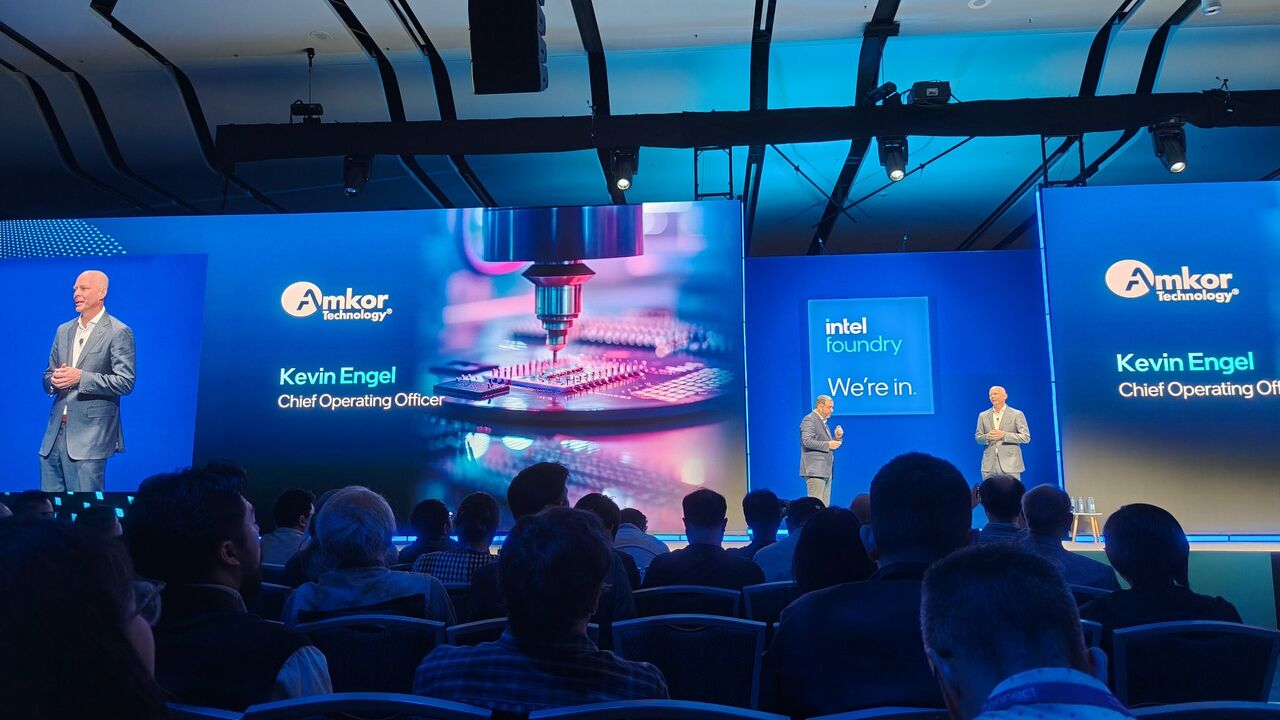
Intel’s technology connects multiple semiconductor dies within a package. The partnership called for Amkor to implement assembly processes in Korea, Portugal and its upcoming Arizona manufacturing operation. For customers building increasingly complex computing products, it offered another route to packaging capacity.
The scene joins several threads of Engel’s career. A technical process is at the center. Manufacturing locations are part of the proposition. A partnership turns specialized engineering into something customers can plan around. His job onstage was to speak for that combination, already a much broader task than leading an individual wafer service.
It also helps explain why his engineering background is relevant to the CEO role. A packaging agreement must become a repeatable production process. The machines, staff, materials and customer programs have to meet at the right place and time. The announcement is the visible moment; much of the work takes place elsewhere.
The geography was already on his mind
Engel had been discussing manufacturing geography well before becoming CEO. In October 2022, he presented “From Global to Local: The Journey to Supply Chain Localization” at an IPC advanced packaging symposium in Washington, DC. He was then responsible for flip chip and wafer services.
The presentation moved from the semiconductor supply chain to regional production, labor costs and Amkor’s geographic footprint. It included the company’s Portugal capabilities and its planned Vietnam campus. That is a useful detail in a career now closely associated with a large Arizona project: his public discussion of localization included several regions.
He also participated in industry discussions about supply chains and future technologies. In 2021, he was listed as a panelist for a Department of Energy and National Nuclear Security Administration production-agency workshop. These appearances put his technical remit in contact with wider questions about manufacturing capability and where it should reside.
For an executive with management experience in Taiwan and the United States, the geography is part of the operating problem. Customers need a production route. A company needs to decide which capabilities to build, expand or connect. Local capacity adds another location to manage within an international business.
Arizona makes the question concrete
By September 2026, Engel was speaking as CEO about phase two of Amkor’s Arizona advanced packaging and test campus. The expanded project carried approximately $12 billion in planned investment. Customer commitments had exceeded the cleanroom capacity planned for the first phase, prompting a larger second phase.
The cleanroom figures describe the proposed scale: 33,000 square meters in phase one, with another 60,000 expected from phase two. Together, the phases would provide about 93,000 square meters. Those are plans for future capacity. The announcement anticipated phase-two construction beginning in late 2027 and completion by the end of 2029.
Engel tied the decision to customers’ needs as chip architectures grow more complex. His argument included technology, quality, manufacturing discipline and the ability to deliver at scale. He also put the location plainly: “it is critical to have that capacity in the U.S.”
For the former bump-services executive, the campus brings the career back to familiar activities on a different scale. The Arizona plan includes wafer bump, probe, assembly and test capabilities. The steps that helped define his early Amkor responsibilities now appear within an investment program he oversees as chief executive.
The work after the announcement
Engel’s first year has also involved the less photogenic business of reporting results. In July 2026, Amkor reported second-quarter sales of $1.898 billion, up 26 percent from the same quarter a year earlier. He highlighted progress on AI and high-performance computing customer programs alongside expansion of advanced packaging and test capacity.
The financial results measure one period. The factory plans stretch across several years. His job contains both clocks: current production and the facilities intended to support later demand. A quarterly call can be over in an hour. A manufacturing campus is considerably less accommodating.
“Our significant capacity means we’re ready to meet the demand for these new solutions.”Kevin Engel · Amkor mission statement
That emphasis on capacity runs through his public role. It connects the process engineer, the business-unit leader and the CEO. Each deals with the practical question of turning a customer’s requirements into a product that can be manufactured, tested and delivered.
Engel entered Amkor with a company it wanted to buy. More than twenty years later, he is responsible for what Amkor chooses to build. Between those points lies a career in small connections, wider responsibilities and the persistent task of making the next device work outside the drawing board.