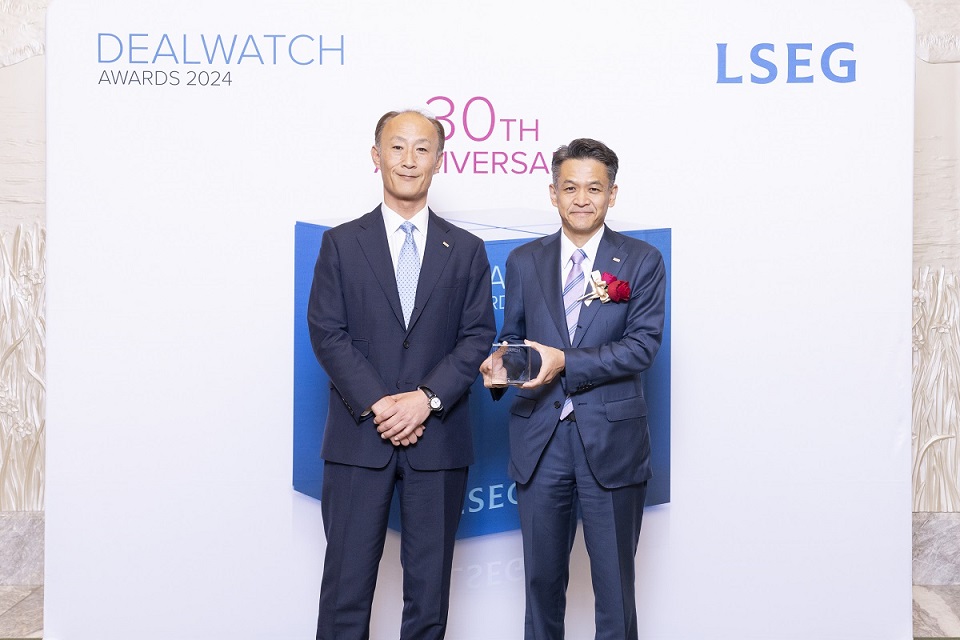
In the photograph, Toshiaki Fujikawa stands on the left. Beside him is Junichiro Yaguchi, Kioxia Holdings' chief strategy officer, holding a trophy. Behind them, the lettering announces the DealWatch Awards 2024 and a thirtieth anniversary. It is May 20, 2025. A company whose products usually disappear inside other people's devices is having a conspicuously public moment.
Kioxia has won IPO of the Year in the Equity category. Its shares began trading on the Tokyo Stock Exchange Prime Market on December 18, 2024. By the time of the awards ceremony, Fujikawa is general manager of the Corporate Communication Division. The former president and CEO of KIOXIA America is now representing the business before a different audience.
The photograph offers a useful way into his career. Semiconductor stories naturally gravitate toward factories, inventions and the dimensions of things too small to see. Fujikawa's work has followed the commercial life around those things: sales, marketing, strategy, regional leadership and, eventually, communication. Memory chips need customers. Public companies need to explain themselves. His career connects those two requirements.
There is a pleasing complication here. The executive whose business concerns memory has spent years moving between places and company names. Toshiba, Toshiba Memory and Kioxia appear along the route. Europe, Tokyo and San Jose supply the geography. The continuity lies in the work of bringing a technically demanding business into conversation with the people who buy from it, work in it and invest in it.
The route runs through customers
Fujikawa's education took him through law at Waseda University and an MBA at the University of Cambridge. Later roles placed him in European memory marketing, sales leadership in Tokyo and strategy in California. The sequence leads to his appointment as president and CEO of Toshiba Memory America in January 2018, followed by the same titles at KIOXIA America from October 2019 until December 2023.
Read that progression as a commercial career. The recurring words are sales, marketing and strategy. They describe a part of the semiconductor industry that happens beyond the manufacturing line, where a component becomes a purchasing decision and a product plan becomes a relationship with a customer. An elegant chip still has to find its place in somebody else's machine.
Those relationships carry their own vocabulary. A consumer may recognize a memory card by the photographs it holds. A company buying storage for a data center has a different set of questions. The product can remain part of the same flash-memory family while the conversation around it changes considerably. Fujikawa's succession of regional and commercial roles sits within that varied market.
His later job in corporate communication therefore makes for an interesting continuation. The audience changes again. Customers, employees and investors approach a semiconductor company from different directions. Each needs an intelligible account of what the business does. A career built around commercial strategy provides one route into that task, even when the newest title sounds far removed from the sales department.
- EuropeMemory marketing
- TokyoSales and strategy
- San JoseAmerican leadership
- TokyoCorporate communication
A new name on a familiar business
By 2018, Fujikawa was leading Toshiba Memory America in San Jose. In October 2019, his employer's name became KIOXIA America. The two entries in his career record sit next to one another, with the same president-and-CEO title. A reader can see both the change in corporate identity and the continuity in American leadership.
The products help explain what that leadership encompassed. In 2022, Kioxia's portfolio included flash memory and solid-state drives for enterprise, data-center and client applications. Consumer storage was part of the picture, too. These are products encountered at very different distances: a removable card can sit in your hand; a drive in a data center may serve you without ever becoming visible.
That distance is one of the peculiarities of the business. People can spend a day using storage while giving it almost no thought. The more conveniently it works, the less likely it is to receive a thank-you. Memory companies operate in that slightly comic predicament: their technology helps preserve the photograph, while their own name may never make the caption.
Fujikawa also held a UK directorship during his American leadership period. The corporate record dates his appointment to November 12, 2018, and the end of that appointment to October 8, 2020. It adds a small, concrete detail to the international outline of his work, alongside the better-known American CEO role.
Giving the invisible a speaking part
In 2022, KIOXIA America marked thirty-five years since the invention of NAND flash memory in 1987. Fujikawa appeared with colleagues in an anniversary video. The subject was a technology whose applications had become familiar even to people who would never use the word NAND in conversation. The anniversary gave that technology an occasion to introduce itself.
The campaign ranged from a historical timeline to films imagining life without flash memory. It also placed the company's history alongside newer products and applications. At the Flash Memory Summit that August, Kioxia brought the anniversary into discussions of mobile computing, the edge, cloud systems, data centers and automotive uses. Looking backward supplied a way to talk about what came next.
Fujikawa's appearance belongs to that effort to make a component's role understandable. The point was accessible: consider the devices and services people use, then consider the memory inside them. It is a useful change of scale for an industry accustomed to discussing layers, interfaces and capacities. The ordinary user begins with the thing they want to keep, rather than the specification that keeps it.
The video also puts a face to the American leadership role he held. Here is a company president participating in a collective explanation of the technology. The anniversary belongs to the company and its engineering history. His place in the film is as one of the people presenting that history to an audience beyond the product sheet.
Who gets heard inside the company?
Another glimpse of Fujikawa's American tenure comes from the KIOXIA Flash LeadHERs group. In July 2021, Amy Dalphy and Michelle Nakano described its growth from six members to thirty-six. Their discussion focused on making women's experience and work more visible, and on creating opportunities to present to management, lead cross-functional groups and take part in outward-facing activities.
Dalphy explicitly included president and CEO Toshiaki Fujikawa among the company leaders supporting the group. She also named Scott Nelson, then senior vice president and general manager of the Memory business unit. The account puts Fujikawa within a specific workplace initiative, with the credit for building and developing the group remaining with its members.
The details are practical. The group discussed training, outside speakers, conferences and broader exposure within the business. Its members wanted colleagues to have more opportunities to exercise their capabilities and have their work recognized. This was a conversation about participation inside a technology company, told by the people doing the organizing.
It is a revealing companion to the anniversary video. One concerns explaining a technology to the outside world; the other concerns helping people inside an organization be seen and heard. Both belong in the account of his tenure, alongside products and titles. A company has an internal audience long before it assembles an investor presentation.
“We are supported by company leadership, president and CEO, Toshiaki Fujikawa”Amy Dalphy, discussing LeadHERs, July 2021
Tokyo, with investors listening
Fujikawa moved into the general-manager role at Kioxia in December 2023. The next year brought the Tokyo listing. In May 2025 came the DealWatch ceremony, where he stood beside Yaguchi. The award recognized the company's equity-market transaction, giving a tangible public marker to this phase of his career.
The award's criteria covered issuance pricing, subsequent market price formation, contributions to capital-market development and innovative approaches. Kioxia's announcement highlighted the pre-approval notification procedure used for its IPO and discussions with institutional investors. The achievement was corporate and collective. Fujikawa's presence at the ceremony documents his role in representing the company at that moment.
On June 25, 2026, another change took effect: Fujikawa became an executive officer at both Kioxia Holdings Corporation and Kioxia Corporation, responsible for the Corporate Communication Division. The updated management lists place him alongside executives responsible for finance, strategy, technology, production and other functions. Communication has its own named place in that leadership roster.
The route from American CEO to Tokyo communication executive makes the career distinctive. It moves through regional management and into the explanation of the wider business. The products still belong to the world of flash memory and storage. The questions around them now arrive from a broader set of people, including shareholders following a listed company.
Return to the awards photograph. It shows two colleagues, one trophy and a backdrop doing its best to fit several institutional names into a single frame. Fujikawa stands at the edge of a public celebration for a business built around components. His career has taken him through the conversations surrounding those components. In Tokyo, that work continues, with the audience plainly in view.