A machine tool has plenty to say. It rattles, hums, cuts and occasionally makes a noise that an experienced operator would rather it did not. For Alain Fanet, that ordinary factory soundtrack has become a business proposition. His company, Bondzai, develops software intended to detect manufacturing problems through sound. The person standing beside the machine has a part in teaching it. After a career spent getting information through processors and attaching digital identities to physical goods, Fanet has arrived at an appealingly practical question: what can a machine learn from the people who know it?
He was a co-founder and the founding chief executive of Arteris, the semiconductor technology company established in France in 2003. Today he is co-founder and CEO of Bondzai. Between those two businesses lie network processors, radio-frequency identification, international investors and a meeting with a mathematician. There is considerable distance between a chip designer’s desk and a noisy production line. Fanet’s working life supplies a route between them.
Three colleagues, another go
Before Arteris, there was a trio. Fanet, César Douady and Philippe Boucard worked at Matra and subsequently built T.sqware, a network-processor company. Their association mattered: the founders of the next venture already had a shared technical history. Starting a company always contains unknowns. In this case, the capabilities of the people around the table were rather more familiar.
T.sqware was founded in 1997 and acquired by Globespan in 2000 in a transaction reported at about $200 million. That figure belongs to the transaction, rather than Fanet’s personal bank account. The engineering work involved processors for communications networks. The next company would take an idea from that world and apply it on a much smaller physical stage.
In February 2003, Arteris announced a $12 million first financing round led by Atlas Venture, alongside Crescendo Ventures, Techno Venture Management and Ventech. Fanet was its CEO. The proposition concerned an increasingly awkward part of semiconductor design: connecting the different functions packed onto a system-on-chip. Making the individual parts capable was only part of the job. They also needed to communicate.
Arteris’s announced first funding round, with Alain Fanet as founding CEO.
The company’s network-on-chip approach brought packet-based communication inside the chip. A useful analogy is a city whose buildings have multiplied faster than its roads. More destinations bring more traffic; eventually the connections demand serious attention of their own. The analogy has limits, but it explains why an interconnect business could be worth starting.
Arteris set out that strategy publicly in March 2004. Its founding team combined different responsibilities: Fanet as chief executive, Douady on technology and Boucard on architecture. This was a commercial undertaking built around a technical problem, with design complexity and the economics of chip development sitting close together. A more elaborate chip still had to be something a customer could afford to design.
The company goes further
Charlie Janac joined Arteris as CEO in 2005. The founding chapter and the company’s subsequent growth belong on the same timeline, with their respective actors in view. Arteris shipped NoCSolution in 2006; Texas Instruments selected the technology for OMAP application-processor development in 2007. That year the company moved its headquarters from France to Silicon Valley.
FlexNoC followed in 2009. Samsung and Qualcomm later licensed it for mobile and wireless chips. Those milestones show how an early engineering proposition found its way into customers’ products. They also put Fanet’s role in proportion. He helped establish the venture and its initial direction; the later business developed through other leaders, engineers and commercial relationships.
- 1997T.sqware
Network processors - 2003Arteris
On-chip connections - 2009Tagsys
Identifying goods - 2021Bondzai
Embedded learning
Selected milestones in Fanet’s career, rather than a scale of company size.
His own next prominent executive appointment came at Tagsys in 2009. The company made RFID infrastructure for tracking individual items. Fanet succeeded Bill Stuek as CEO while Stuek remained chairman. RFID can sound abstract until a missing item becomes someone’s afternoon. The technology gives physical objects identities that systems can read without requiring a person to inspect every label.
The retail applications made that connection tangible. Façonnable adopted Tagsys technology to follow clothing through distribution centres and stores across countries. The intended benefits included better visibility of inventory and theft prevention. In such a setting, a tag’s usefulness depends on the information making its way through the whole business. A clever component has to survive contact with warehouses, stockrooms and existing software.
In 2016, Tagsys sold its textile-services and industrial-and-logistics RFID divisions to Invengo for €6 million. The remaining business would concentrate on retail and luxury. Fanet explained the decision in terms of focus and partnerships. Moving a technology company forward could involve choosing which activities belonged with another owner. By the time his career reached CXIgnited, supply-chain traceability for luxury goods was part of his experience.
These businesses also offered different ways of encountering the same customer difficulty. A chip designer needs communication that fits a design. A retailer needs an item’s identity to remain useful as it moves. Each application gives the technology an unromantic examination: does it help the operation run? Reading Fanet’s career through that question makes the changes of industry less surprising.
A mathematician enters the picture
Fanet’s interest turned toward embedded artificial intelligence in 2018. His eventual collaborator was Bijan Mohammadi, a professor of applied mathematics at the University of Montpellier’s Alexander Grothendieck institute. Mohammadi had been working on a different approach to learning algorithms. Fanet was looking for a scientific idea around which to build an industrial product. SATT AxLR, a technology-transfer organisation, brought them together.
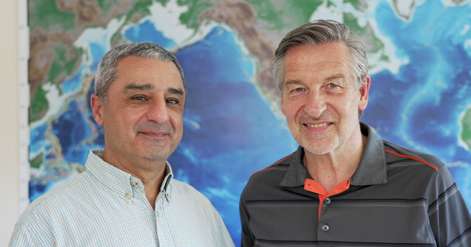
Their preparation included asking whether the partnership itself would work. A preliminary programme began in 2019, followed by a larger maturation effort. Academic research and company building bring different habits and responsibilities. Before asking customers to trust a product, the collaborators needed to establish that they could make one together. The work progressed from an algorithm toward demonstrators and a software proposition.
Bondzai was registered in December 2021. Its earlier demonstrations involved voice recognition and industrial voice commands. The team’s ambition was to let learning happen on the device, using observations from its actual surroundings. It wanted less dependence on preassembled datasets and an ongoing connection to remote computing. The voice command was an early way to demonstrate the idea; factory applications would give it another setting.
The operator gets a say
In industrial production, conditions change. A useful model needs to remain useful as the equipment and its surroundings change. Bondzai’s answer is software designed to keep learning locally, with feedback from people doing the work. Its DavinSy system and Maestro configuration tool were part of the product plan Fanet described in 2023. The business ambition was licensing software to manufacturers.
That choice fits a career familiar with selling technology inside somebody else’s product. The customer needs a working capability and a way to maintain it. An elegant explanation is welcome, but it does not clear a production bottleneck. Fanet’s industrial pitch puts the operator’s knowledge inside the learning process, allowing a person to correct an error and improve the model.
A conceptual explanation of the approach, not a performance benchmark.
His public explanation of his value as an executive was unusually direct. On joining the board of Global Bioenergies in 2019, he pointed to experience in “the industrial and commercial deployment of innovation.” There is little glamour in that phrase. There is, however, a customer, a deployment schedule and a product that must function somewhere beyond a demonstration.
“the industrial and commercial deployment of innovation”
Alain Fanet, describing his experience in 2019
For an operator, a correction is ordinary work. For a software supplier, making that correction useful requires a product decision. Who can provide feedback? Where does learning take place? What happens when conditions shift again? Those questions give Fanet’s interest in deployment its substance. They are also where the proposed relationship between human experience and automated analysis becomes concrete.
From voices to the factory floor
By March 2024, Bondzai was presenting iDetect-4.0 at Global Industrie in Paris, aimed at predictive maintenance and quality control. Fanet also appeared on the programme of SEPEM Colmar that June for a session on industrial AI applications involving Renault. The shift toward sound analysis gave the company a specific job to discuss with manufacturers: spotting signs of trouble during production.
A May 2024 partnership with Linebreak extended that commercial approach. The companies planned to bring Bondzai’s local learning capabilities into Linebreak’s edge platform. Linebreak later combined with New Icon. The partnership announcement described learning from live sound, with potential applications involving vibration and electrical signals. Its focus was the practical movement from sensor data to a useful manufacturing decision.
On 29 October 2025, Bondzai announced iDetect-5.0 as the successor to iDetect-4.0. The company described an acoustic-intelligence product built around operator participation, continuous adaptation and reduced energy demands. These were its stated design priorities. The release kept Fanet’s industrial argument in view: knowledge from the field should help shape the model running in the field.
The company now describes microphones placed near production equipment and connections to familiar industrial automation protocols. The machinery has not acquired a taste for conversation. It has acquired another proposed way to make its operating condition legible. For Fanet, the journey from chip connections to factory sound has kept returning to the same commercial test: can useful information reach the place where someone can act on it?
That is a patient sort of ambition. It asks an entrepreneur to care about the workings inside a chip, the movement of a garment and the knowledge of a machine operator. Fanet’s next chapter is being written close to equipment that has work to do. If the software earns its place there, its most persuasive introduction may be a familiar sound, correctly understood.