Amanda Liu’s career contains a useful detail for anyone tempted to think of startup acceleration as an agreeable succession of coffees. Before founding StarFab, she worked on factory automation and flash-memory products. These are subjects with an inconvenient habit of making promises measurable. A system works in its intended setting, or someone has to explain why it does not.
Years later, discussing the startups her accelerator sought, Liu put technology near the center of the selection process. Teams needed products and a technical core. That requirement gives her story its shape: an industrial career followed by an effort to get younger technology companies into productive relationships with established ones. The interesting distance is between having something to show and having someone willing to use it.
StarFab, founded in 2016, became the vehicle for that work. Liu is its founder and chairperson, after years of public appearances as CEO. Her professional territory includes the quieter parts of entrepreneurship: corporate mentors, product validation, strategic investment and entry into overseas markets. None lends itself quite as readily to a victory photograph as a funding announcement. All can determine what happens afterward.
Before the introductions, there were chips
Her early employment reads like a tour through the practical machinery of Taiwan’s technology industry. From 1993 to 1995, Liu was a senior engineer at Accton Technology, working on network-system design. At Winbond Electronics, from 1995 to 2001, her responsibilities included factory automation. She moved to Macronix for NOR flash product management between 2001 and 2003, then held marketing and IC product-management responsibilities at Skymedi from 2003 to 2011.
Liu earned a master’s degree in management at National Chiao Tung University. Her subsequent experience included the Industrial Technology Research Institute, known as ITRI, where she worked on cross-disciplinary integration. Across those roles, the recurring subjects were connected systems, products and the business of taking technology to market.
That background matters to the work she later chose. A corporate partner brings operating experience as well as a possible budget. A startup brings a technology that may need a place to prove itself. Liu had worked in organizations where those considerations meet. The accelerator would make that meeting an explicit part of its method.
- 1993Network systems
- 1995Factory automation
- 2001Semiconductor products
- 2013CIAT Accelerator
- 2016StarFab
2013: a program before a company
The starting point came before the StarFab name. In 2013, Liu founded the CIAT Accelerator program, developing a thematic approach in which established companies helped mentor startups. At ITRI, she was responsible for carrying out the initiative. The premise was to connect technically capable teams with corporate resources that suited their development.
The program worked with existing incubation centers rather than requiring every team to move into a new physical home. Selection and guidance could travel across an existing network. Taiwan already had research institutions, universities and technology businesses; Liu’s task was to help those assets become useful to a younger company.
StarFab formally followed in February 2016 as an ITRI spin-off. An early description of its purpose used the phrase “Innovation Super Highway.” The metaphor was expansive, but the work underneath was specific: technology development, supply-chain support, intellectual property, investment and international market connections. A highway still needs an exit that leads somewhere a customer wants to go.
The product has to survive the meeting
Liu’s selection criteria were unusually plain in public conversations at InnoVEX. In 2018, she explained that a business model by itself would not make a team suitable for StarFab. The startup needed technology, a product and a core competence rooted in that technology. At the time, she described taking roughly 10 to 15 applicants out of every 100.
By 2019, she was describing four acceleration programs covering AI, retail, connected devices and robotics. Support extended to proof-of-concept facilities, seed funding, sales channels and further technical development. Asked what she looked for, Liu answered: “We look for co-competence, core team capability and model.”
Taken together, these comments reveal the kind of encounter she was arranging. A technical team has to explain what it can do. A larger company has to decide whether that capability belongs in its business. The encounter becomes useful when both sides can get past a general enthusiasm for innovation and discuss a product, an application and a workable relationship.
Applicants accepted, in Liu’s description of StarFab’s selection in 2018. A historical snapshot, rather than a current admission rate.
An office is easy to count. An order means more.
Liu later described StarFab’s development in stages. At its founding in 2016, the emphasis was on business connections and an ecosystem of partners. During 2017 through 2019, the focus shifted toward helping startups expand through commercial orders and strategic investment. In her account, support had to produce a route toward a larger business.
By 2020 and 2021, she described a further ambition: helping promising companies grow toward public markets and international expansion. These were goals for the work, rather than a claim that every participant had reached them. The progression is revealing because the unit of attention keeps moving outward, from a connection to a transaction to the development of a company.
Her argument about ecosystems was also industrial. In 2022, Liu emphasized combining Taiwan’s accumulated hardware capabilities with startups’ application-oriented software. The accelerator’s role included helping experienced companies turn younger firms’ technology into commercial value. Each participant needed a reason to keep participating. Even the friendliest ecosystem eventually has to answer the accounts department.
A partnership needs a passport
Liu was making the case for corporate collaboration early in StarFab’s life. In January 2017, she contributed to the first issue of the Asia Silicon Valley Development Agency magazine. Her subject was the global opportunity in connected devices, approached through cooperation between Taiwanese enterprises and startups: resources with innovation, industry knowledge with technology, software services with hardware products.
Overseas relationships gave that argument a practical test. At InnoVEX 2023, StarFab worked with Mizuho Bank and the Japan External Trade Organization, JETRO, on a seminar about entering Japan. Liu emphasized technology-driven partnerships and trust. She noted that even large Taiwanese companies could take three to five years to establish commercial collaborations there.
Startups InfinitiesSoft and Turing Certs shared their experience at the session. StarFab also organized discussion of Singapore with FocusTech Ventures’ Raymond Choong and Evercomm’s Kao Xuemei. Liu’s message was that expanding a market required international resources. A promising product crossing a border still encounters a new set of people who need reasons to trust it.
“Starting a business cannot be done alone.”
At CIAT’s tenth-year demo day in November 2022, the partnership idea had a record behind it. The program reported having helped more than 154 startups obtain business orders and investment. Three teams that year, TAC Dynamics, Turing Certs and LEDA Technology, received investment intentions totaling NT$40 million. An intention is an intermediate step; it belongs in the account with its proper name.
The event also included the first Tech-Startup Japan Award. Aemass, Turing Certs and KeyXentic were selected to visit Japan and meet companies and the Tokyo city government. The domestic mentoring network was acquiring an international extension.
“Starting a business cannot be done alone,” Liu said. She credited support from partners in different fields for the program’s ten-year run. The sentence has the advantage of being short enough to remember and broad enough to apply to her own company. StarFab itself depends on organizations willing to contribute something beyond their names to an event banner.
“Starting a business cannot be done alone.”Amanda Liu · CIAT’s tenth-year demo day, 2022
The AI chapter returns to the factory
In March 2026, Liu led six Taiwanese startups at a Silicon Valley showcase. The teams had been selected in partnership with NVIDIA. Her emphasis remained collaboration between established corporations and startups, drawing on Taiwan’s industrial strengths. The geography had changed; the business question remained familiar.
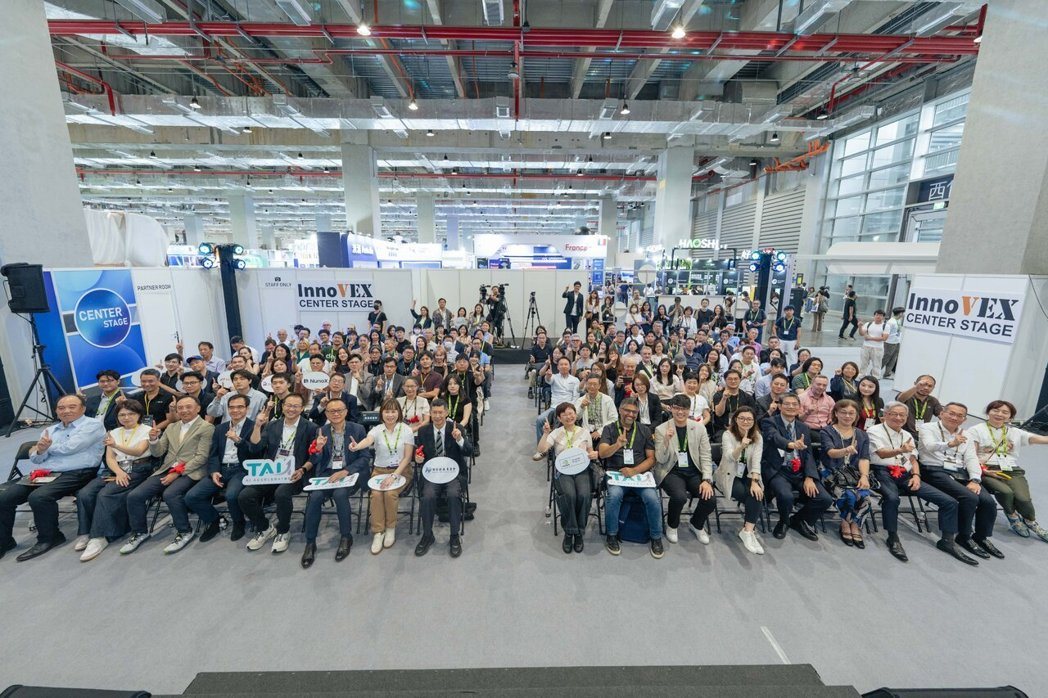
At StarFab’s June 4 TAI1 summit during InnoVEX, Liu appeared alongside NVIDIA executives and Taiwan’s industry representatives. She argued for connecting Taiwan’s supply-chain capabilities with AI innovation, and announced that preparations for a TAI1 AI fund would begin. The announced purpose was to connect capital, strategic investment, industrial resources and market opportunities.
Preparations describe work ahead. They do not establish a completed fund or a pool of money already invested. For Liu, the proposed fund extends an existing direction: help applications undergo validation in Taiwan and then seek international markets. Industrial AI brings fresh technical demands to a problem she has been approaching for years: making a new capability useful inside an existing business.
A career can begin with a crossed-out option
There is a more personal version of Liu’s approach in her advice to students. At Lunghwa University of Science and Technology in 2026, she encouraged interdisciplinary learning, reading and a willingness to take on challenges. Technical awareness, she argued, could be cultivated even without a science or engineering background.
For students uncertain about their futures, she suggested elimination: first understand what kind of person you do not want to become, then use your strengths and do each job well. It is a modest starting point. Nobody has to announce a destiny before getting to work.
The advice sits comfortably beside her professional record. Her career moved through networks, factory systems, semiconductor products and industrial research before she founded an accelerator. Now she helps other teams negotiate the steps between a technical possibility and a business relationship. At its most concrete, that work ends with two organizations deciding they can do something useful together. After the photographs and introductions, there is still a product to test, a partner to understand and an order to earn.