A karaoke song seems like a small thing to store. Add a video, improve the picture, repeat the exercise thousands of times, and eventually somebody has to find another place to put the songs. At Japan’s XING, that ordinary sequence produced an extraordinary collection: 27 storage systems from four suppliers. The music business had acquired a second occupation. It was managing boxes.
- The job: consolidate enterprise data without making critical applications wait.
- The trick: use software and memory to get more work from the underlying storage.
- The stakes: keep data available, and keep a recoverable copy when trouble arrives.
The first thing to become untenable was the complexity. Each short-term capacity fix left another device to maintain. Infinidat’s published customer account describes XING choosing InfiniBox in 2018, consolidating four racks into one. The useful result was fewer moving parts in the organization as well as in the room.
The case study reports 80% annual storage cost savings and five times the previous input/output operations per second. Those are XING’s results, with its particular starting point. Still, the example captures Infinidat’s appeal: buy enough engineering to stop spending so much attention on storage.
reported in the customer case study
The expensive part is the wrong question
Founder Moshe Yanai arrived at this problem with a long memory. He had helped architect EMC’s Symmetrix and later founded XIV, acquired by IBM in 2008. Infinidat, founded in 2011, returned to the awkward bargain that enterprise buyers know: more speed, more resilience, or less expense. Choose carefully.
Its original hybrid InfiniBox challenged the assumption that faster storage required putting everything on flash. The alternative was to become much better at anticipating which data an application would request. Keep that data in fast memory. Use flash behind it. Let disks supply economical capacity.
Infinidat calls the predictive software Neural Cache. Its architecture paper describes flash as a cushion for memory misses and changing access patterns. That detail matters. A cache earns its keep through the requests it can satisfy; the behavior of the workload determines how persuasive the economics become.
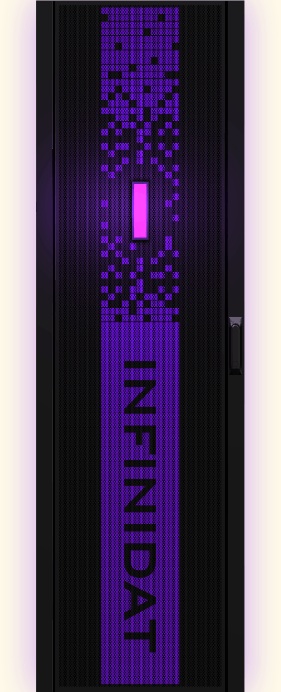
Underneath sits InfuzeOS, the software foundation. Three active controllers share the work. Infinidat sells availability and performance guarantees, subject to service-level terms, rather than asking buyers to infer reliability from a drive specification. The proposition belongs in a workload test, where applications can put it under pressure.
One architecture, several jobs
Today, Infinidat sells both hybrid InfiniBox and all-flash InfiniBox SSA systems. Offering both is a useful admission that one hardware recipe cannot settle every purchasing decision. A latency-sensitive production database and a sprawling collection of less frequently accessed records place different demands on the same budget.
InfiniGuard handles another job: enterprise backup. It combines the InfiniBox foundation with deduplication engines, reducing repeated data while supporting backup and restoration. It works with major backup applications; it does not remove the need to design the backup process.
InfiniVerse supplies monitoring, management, and consumption services. The Mobius program adds a controller-upgrade subscription, extending the useful life of an installed array. In September 2025, Infinidat also announced smaller F24 all-flash configurations and native S3 object support, broadening where its software could fit.
The audience is enterprises and service providers with demanding workloads: banks, hospitals, telecom operators, manufacturers, and cloud businesses. Integrations with VMware, Red Hat, SAP, Veeam, and others matter because a storage array enters an existing neighborhood. It has to get along with the residents.
The clock starts before the comeback
Speed acquires a different meaning after a cyberattack. InfiniSafe combines immutable snapshots, logical isolation, and a fenced forensic environment. The sequence lets teams preserve copies, examine candidate recovery points away from production, and restore access to a suitable copy.
Here, a small distinction prevents a large misunderstanding. Infinidat’s InfiniBox guarantee concerns storage recovery from eligible immutable snapshots in one minute or less. InfiniGuard’s corresponding promise is 20 minutes or less. Neither number is a stopwatch for reopening an entire company.
Storage recovery guarantees under applicable terms. Application validation and business recovery require their own plan.
Servers, networks, credentials, applications, and security investigations have their own dependencies. An immutable snapshot may preserve damaged data if the attack preceded it. The practical task is finding a clean recovery point and rehearsing the complete return to service. Storage speed helps; preparation decides what happens next.
The bill has more than one line
Infinidat’s commercial choices include capital purchases, capacity on demand, and storage as a service. XING used preinstalled reserve capacity, allowing expansion without another hardware installation. That flexibility can be valuable when growth arrives faster than procurement.
“Annual cost savings amounted to 80%.”
Akihiro Sakai, XING · published customer case study
Configuration and contract terms determine the bill. Compare usable capacity, required performance, support, power, cooling, and migration work. Effective capacity assumes data reduction; already compressed or encrypted data may not cooperate. A small deployment may struggle to justify enterprise-scale infrastructure. A poorly matched workload can weaken the hybrid caching advantage.
The competitive field includes Dell, Pure Storage, NetApp, IBM, Hitachi Vantara, and HPE. Infinidat’s argument rests on common software, controller resilience, caching, and consolidation economics. A sensible buyer measures those against the alternatives using representative applications, including unpleasant days.
Lenovo completed its acquisition on April 9, 2026. Later financial disclosures put the cash consideration at approximately $410 million. That followed a $95 million Series C in 2017 at a $1.6 billion valuation, and additional financing in 2020. A historical fundraising valuation and a later acquisition price measure different transactions.

The lesson readers can copy starts before the purchase. Count the systems. Measure the working set. Price the administrative burden. Rehearse recovery. XING’s karaoke collection makes the point unusually well: sometimes the next capacity problem is an invitation to reconsider everything already plugged in.
Open the cabinet
Explore the technology, meet the people, or watch it work.