There is a peculiar bargain at the heart of enterprise storage: do the job perfectly and almost nobody notices you exist. Files open. Databases answer. Backups sit quietly in their appointed corners. The applause arrives only in reverse, when something breaks and the silence becomes expensive. Mo Tahmasebi has spent roughly four decades working inside that bargain. He is an engineer who became a serial founder, a serial founder who became a storage executive, and a storage executive who appears unusually comfortable with being less famous than the systems his companies protect.
Tahmasebi's public career begins at Sun Microsystems, where he worked as an enterprise engineering manager from 1982 to 1990. Sun was barely out of the garage when that stretch began. Networked workstations were moving computing out of the glass room, and the idea that useful machines should speak fluently to one another was still becoming commercial reality. Storage followed the same migration. Information once tethered to a particular machine would increasingly live on networks, shared by more users and exposed to more points of failure.
He carried that systems instinct into Dynamic Network Factory, or DNF, founded with Macy Tafreshian in 1989. The business began as a United States subsidiary of Japanese conglomerate CSK Electronics and became privately held. By the late 1990s, its focus had settled on storage hardware and software. The pairing endured: Tahmasebi as president and CEO, Tafreshian as chief financial officer, with both also involved in other ventures.
A company bought at the awkward moment
The defining corporate turn came through a company Tahmasebi did not originally start. StoneFly Networks was born in San Diego around 2000 and helped commercialize iSCSI, a way to carry storage traffic over ordinary Internet Protocol networks. It owned the conspicuously useful domain iSCSI.com and raised tens of millions of dollars. Yet technological foresight does not guarantee commercial timing. By 2005, sales trailed younger rivals and StoneFly was looking for a buyer.
DNF first invested, then acquired StoneFly's assets in 2006 for a reported $205,000. Contemporary reports could not quite agree on whether the arrangement was rescue, partnership or takeover. Tahmasebi initially insisted StoneFly would remain independent. Asked if he planned to run it, he offered a line dry enough to survive two decades: “I haven't applied for a job there. I already have one.”
He got the additional job anyway. When the acquisition closed, he became CEO of both DNF and StoneFly. His stated plan was practical rather than sentimental: retain StoneFly's field-tested IP storage work, expand the product range, and push further through resellers and overseas channels. The deal gave DNF a recognized storage technology and gave StoneFly time, which distressed startups tend to need more than another slogan.
“I can close deals in 45 minutes.”Mo Tahmasebi, speaking to an IT Press Tour audience in 2024
The quiet-company playbook
By Tahmasebi's account, StoneFly later built a customer base exceeding 10,000, with more than 50,000 deployments and over 2.5 exabytes of storage capacity in service. Those figures span consumers, small businesses, universities, financial institutions, government agencies and large companies. StoneFly equipment has also been deployed aboard United States Navy Littoral Combat Ships and Virginia-class submarines.
The interesting part is how little public noise accompanied that footprint. Tahmasebi told a trade-press audience that StoneFly spent virtually nothing on marketing and gained business through referrals and word of mouth. For years, the company also sold technology through original-equipment manufacturers who put their own names on it. The arrangement explains both the reach and the obscurity. StoneFly could be inside the room while its logo waited outside.
This is less romantic than the modern founder's direct relationship with an audience, but it is a coherent distribution choice. An OEM or reseller already owns trust, procurement access and support relationships. The technology company supplies the difficult machinery. The price is anonymity. Tahmasebi seems to have accepted it cheerfully, perhaps because a storage appliance is not improved by a personal brand.
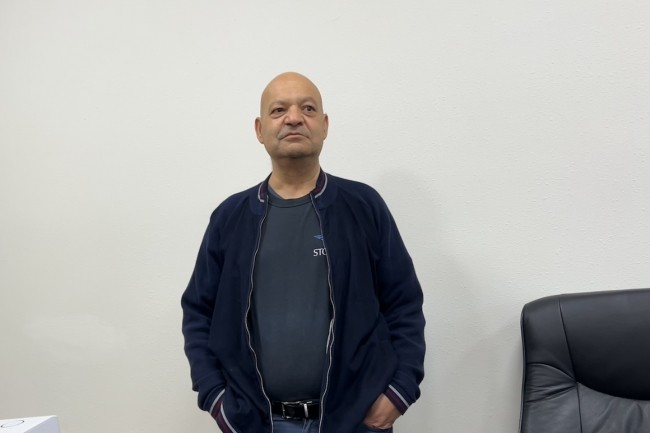
Selling the consequence, not the cabinet
At a 2024 presentation, Tahmasebi said, “I can close deals in 45 minutes.” The boast is revealing because enterprise storage is not an impulse purchase. A buyer must consider capacity, throughput, recovery objectives, security, compatibility, support and cost. Compressing that discussion into three quarters of an hour requires either breathtaking impatience or a very practiced map of the customer's worries.
StoneFly's map starts with consolidation. Its Fusion software presents block storage, file storage and S3-compatible object storage, allowing one system to serve the roles commonly described as SAN, NAS and object. The same software underpins hyperconverged, backup and disaster-recovery products. StoneFly integrates with virtualization and backup platforms rather than asking customers to abandon them.
Then comes isolation. StoneFly describes three layers of air gapping: at the backup repository, the storage controller and the physical node. A protected copy can be detached from the network; a controller can be taken offline; at the most literal layer, a chassis can be powered down. Each step removes another path by which malicious software might reach a backup. The architecture turns “air gap” from a single feature into a sequence of increasingly solid doors.
Tahmasebi has made an expansive claim for the result: “None of our customers have suffered from ransomware-corrupted data.” It is a company assertion, not an independently audited universal law, but it reveals the sales argument. Customers are not buying metal boxes or a charming acronym. They are buying a less catastrophic Monday morning.
One problem, translated across eras
Tahmasebi's résumé contains more companies than his low public profile suggests. He co-founded Pars, active from 1990 until its acquisition in 1998. In 1997 he founded Tzone Corp & Research and Computer Training Academy, both acquired in 2000, and established Salesforce1.com, acquired in 2014. He later founded Trundl in 2014; it was acquired in 2019. He is also identified as a managing partner at Pars Capital Group, a technology incubator and investor focused on software and infrastructure.
Across that list, the repeatable unit is not a particular product. It is practical systems work: engineering, infrastructure, training and the businesses around them. Even StoneFly has repeatedly translated its core capability into the language of the moment. IP SAN became unified storage. Virtualization led to hyperconverged infrastructure. Ransomware put immutability and recovery at the center. AI has created another appetite for large, accessible data stores and another reason to care about who controls them.
In 2026, CRN placed StoneFly on its Storage 100 list of software-defined storage vendors. StoneFly's own roadmap now points toward AI-assisted threat detection, automated response, storage optimization and links to operational tools. There is fashionable vocabulary in that agenda, but the old question remains visible underneath: where is the data, and can the owner get it back?
The answer has occupied Tahmasebi from the workstation age to the AI buildout. It may also explain his longevity. A founder chasing a trend must keep finding new trends. A founder attached to a durable failure mode gets to watch the world invent fresh ways to need the same expertise.
Storage is a promise made in advance, paid for quietly, and judged on the worst day.The operating idea behind a four-decade career
The useful obscurity of infrastructure
There is something almost comic about the contrast. StoneFly says its products sit across tens of thousands of deployments, including military vessels and large corporate environments, while many buyers may never have heard its name. Tahmasebi can describe caged colocation space in Fremont, Oregon and Massachusetts, but has left almost no conventional founder mythology behind. No public origin speech, no carefully polished life philosophy, no parade of personal updates. Just the companies, the systems and a handful of wonderfully blunt quotes.
That absence does not need to be filled with legend. The public record already contains a useful lesson. Tahmasebi entered computing when networks were a frontier, built around storage when IP was changing its economics, acquired a promising company after the market punished its first attempt, and kept rebuilding the offer as customers' risks changed. He favored partners over fame and continuity over novelty.
The result is a career shaped like the product: layered, persistent and easiest to appreciate when you inspect what might otherwise have disappeared. In infrastructure, obscurity can be an occupational hazard. It can also be evidence that the machinery is doing its job.