One evening in Tartu, Estonia, Margo Martis was tidying up Jira assets. He meant to remove an object. The deletion targeted an object type. About 2,000 assets vanished. According to HYCU’s account of the incident, the city spent two weeks recovering only 70-80 percent of the data. The application had not disappeared. Its contents had. That distinction is where HYCU’s business begins: in the gap between a service being available and your work being recoverable.
- HYCU backs up supported cloud, SaaS and on-premises workloads through one platform.
- Its differentiator is application-specific recovery, developer-built integrations and customer-controlled copies.
- The useful test: restore a real item, including the settings that make it usable.
01 One click, two weeks
We tend to imagine data loss as an event with a villain. An attacker arrives; a ransom demand follows. Tartu offers a less theatrical possibility: a maintenance task and a confirmation button. A business can buy dependable software and still make a ruinous assumption about what happens after somebody clicks OK.
HYCU, pronounced “haiku,” stands for Hybrid Cloud Uptime. Its early technology was developed at Comtrade for Nutanix infrastructure; it became a separate company in 2018. Co-founders Simon Taylor and Goran Garevski brought commercial and engineering experience to a deceptively awkward problem: giving different environments comparable protection without making administrators learn a different backup routine for each.

The company describes its purpose as making data safer and management simpler. Its workplace vocabulary is equally compact: AGE, for Authenticity, Grit and Empathy. Those are stated values; the more revealing expression of its philosophy is architectural. Customers should be able to choose their software and storage, then protect what they chose.
02 A map before a safety net
Consider the modern office as a collection of rented rooms. Sales works in Salesforce. Engineers work in GitHub. Someone keeps decisions in Confluence, someone else in Microsoft 365. The files, permissions and configurations that make the business function are spread among landlords. Keeping track of the rooms becomes a protection problem of its own.
R-Graph, HYCU’s free discovery and visualization service, uses identity-provider connections such as Okta and Microsoft Entra ID to reveal applications and protection gaps. R-Cloud supplies the backup and recovery machinery. Administrators set policies and select supported storage targets; backups can live in accounts and regions the customer controls.
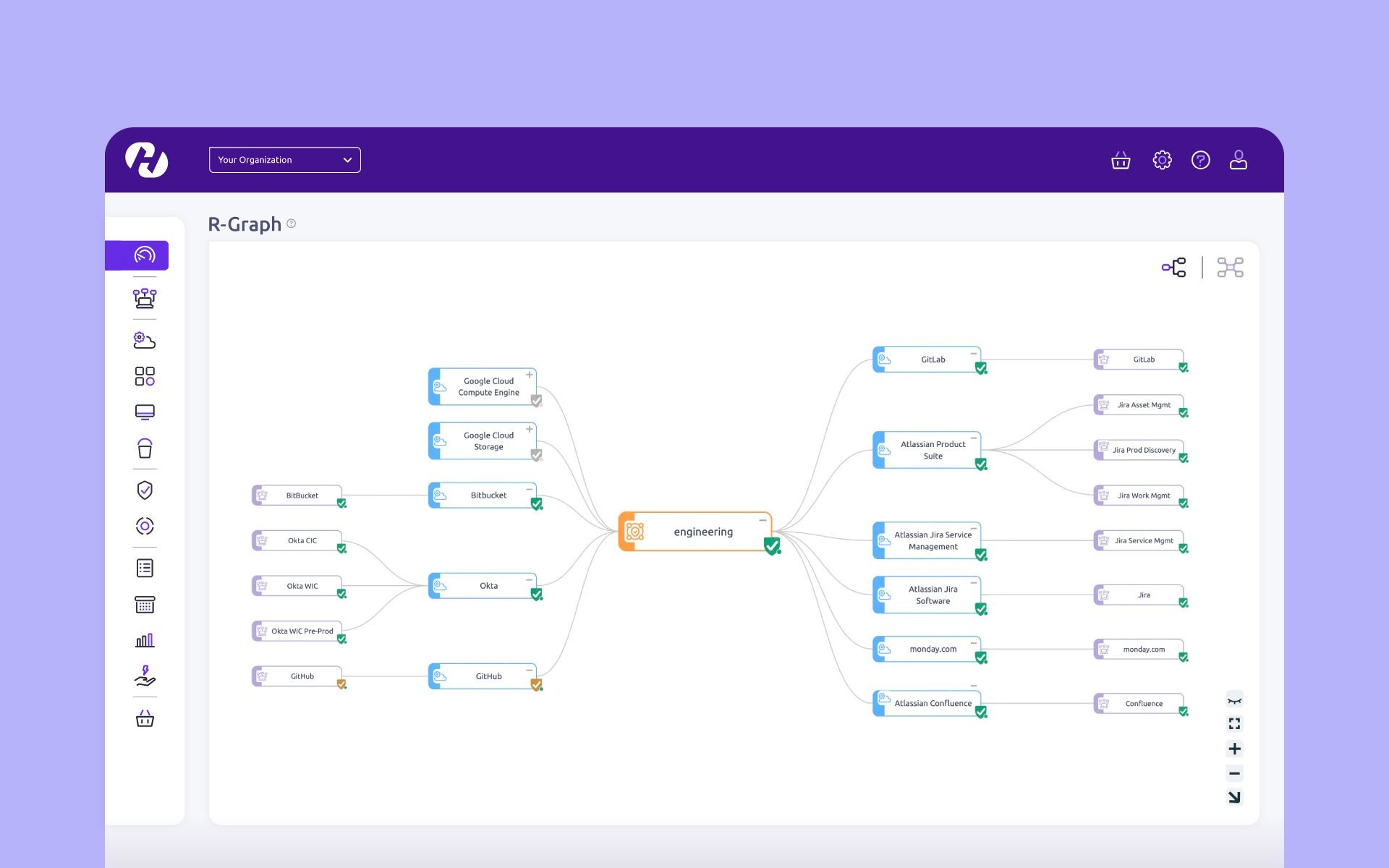
For Jira, that can mean recovering a particular issue, attachment or automation rather than replacing an entire environment. The significance is practical: the mistake may be small even when the database is large. Recovery ought to respect the difference.
- DiscoverFind the applications
- ProtectSet policies and storage
- RestoreReturn the needed item
03 Let the application experts build
Every SaaS application has its own idea of what an object is. Building a connector for each one creates a queue that grows whenever another application appears. HYCU’s February 2023 R-Cloud launch attacked that queue with a low-code development platform: let software vendors contribute their knowledge of the application, while HYCU supplies shared orchestration, policies, security and validation.
That makes HYCU both a backup supplier and an integration platform. Its marketplace gives customers a place to subscribe to the resulting services. The approach helps explain its expansion from infrastructure into SaaS. HYCU now advertises coverage of more than 100 workloads, a count of supported integrations rather than a promise to protect every application imaginable.
There is plenty of company in this market: Veeam, Rubrik, Commvault, Cohesity and Druva all compete for protection budgets. HYCU’s case rests on combining application depth, a common management experience and storage choice. Google Cloud named it its 2024 Technology Partner of the Year for Backup and Disaster Recovery. The award recognizes the partnership; buyers still need to examine their own workloads.
04 The price of retiring the scripts
Ice Travel Group, behind TravelSupermarket and Icelolly, had accumulated GitHub scripts, Google Workspace utilities and AWS functions. A move toward Google Cloud added another layer. In HYCU’s published customer account, the difficulty was scheduling, monitoring and validating the scattered backups. The group chose HYCU and completed onboarding in two weeks.
“We needed an ongoing centralized place to schedule, monitor, and validate backups.”Gohar Hameed · Lead DevOps Engineer, Ice Travel Group
HYCU sells subscriptions, including through cloud marketplaces and partners. Its pricing page currently displays Microsoft 365 at $2.25 per user monthly and the Atlassian and DevOps suites at $4. User count and contract terms matter. Infrastructure, databases and some applications require quotes. A sensible budget also includes the chosen storage, retention and recovery traffic.
per user / month
per user / month
The company raised $87.5 million in March 2021 and $53 million in June 2022. Bain Capital Ventures led the first round; Acrew Capital led the second, joined by returning and strategic investors. That is $140.5 million across those announced rounds, funding a bet that managing protection can become a service rather than another infrastructure project.
05 A copy with more than one job
Recent products extend what a backup is for. R-Shield combines cyber resilience capabilities such as threat detection and immutable copies. In May 2026 HYCU announced aiR, which applies AI to protected data for security and compliance questions; its current product page labels it early access. In August, R-Serve added independent, read-only access to protected iManage Cloud documents for eligible customers.
September’s Azure DevOps integration makes another useful distinction. Source repositories are part of the delivery system, alongside pipelines, work items and settings. Saving the code alone can leave a team with files but without the working project around them.
06 Try the restore before the emergency
The lesson is portable: inventory applications, assign responsibility, choose retention and independent storage, then rehearse a representative restore. Check permissions and configuration, not merely whether a file reappears. HYCU needs supported integrations, working credentials and successful backup jobs. Changes never captured cannot be recovered from those copies. A polished dashboard earns its keep when an ordinary mistake stops being a two-week reconstruction.