There is a particular indignity in buying a brilliant person an expensive desk and then asking them to sort the mail. This, in miniature, is what happened inside the modern data center. The central processor - the CPU - was hired to run applications. Increasingly, it found itself moving packets, applying firewall rules, encrypting traffic, watching telemetry and tending storage. The chores were essential. They were also stealing the attention of the most expensive general-purpose worker in the room.
The short version
- Pensando puts networking, security and storage services on a programmable data processing unit, or DPU.
- Its repeat-founder team raised about $313 million and sold the company to AMD for approximately $1.9 billion in 2022.
- Microsoft Azure, IBM Cloud, Oracle Cloud, Goldman Sachs and HPE Aruba are among its named customers or partners.
- The play to copy is co-designing with demanding customers before the market's architecture becomes fixed.
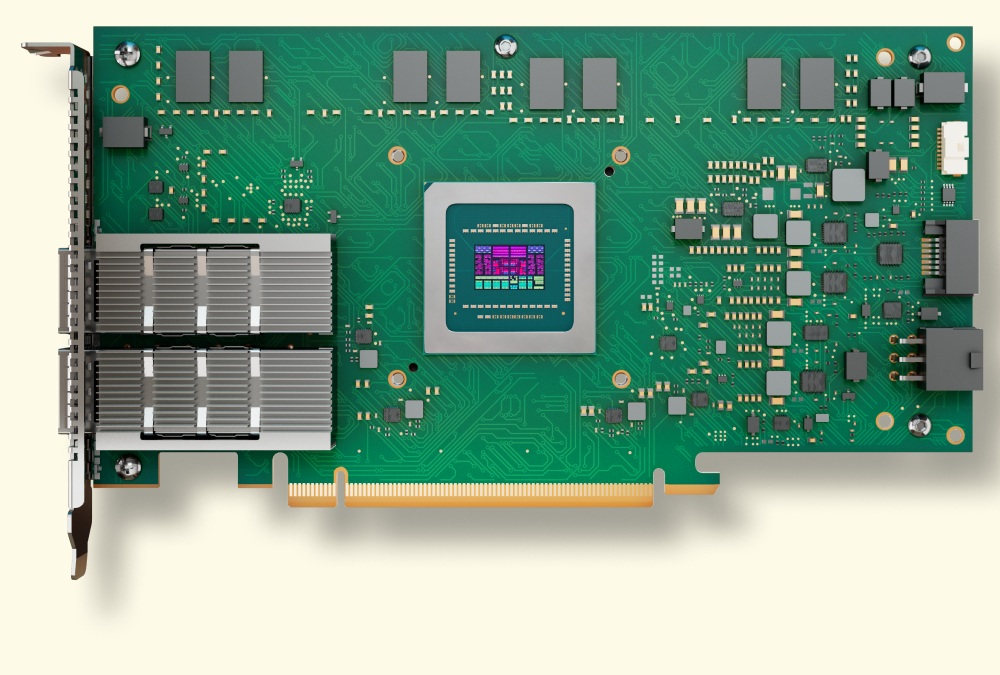
Pensando's answer was a card with its own programmable processor and software stack. Slide it into a server, or build it into a switch, and the infrastructure work moves closer to the wire. The CPU gets its desk back. In an AI cluster, where a stalled network can leave a fleet of costly GPUs waiting, that division of labor matters even more.
One more transition
The company began in 2017 with four people who were conspicuously bad at retirement: Prem Jain, Soni Jiandani, Mario Mazzola and Luca Cafiero. They had worked together for decades, first around Crescendo Communications - the startup that helped give Cisco its Catalyst switching line - and later through Andiamo, Nuova and Insieme. Their initials produced the nickname “MPLS team,” which happens to be the name of a networking protocol. Silicon Valley rarely gets a joke this tidy.
After leaving Cisco, Jain said the group thought it was finished. Then it noticed another architectural turn. Amazon's acquisition of Annapurna Labs had helped AWS place custom infrastructure silicon inside its cloud. The Pensando team saw the asymmetry: the largest hyperscalers could build specialized processors for themselves, while enterprises and other clouds were still asking ordinary CPUs to carry the infrastructure load. The founders changed their minds about retirement because the gap looked both large and technically interesting.
“When we designed this silicon, every single gate had to be programmable.”Soni Jiandani, Pensando co-founder
That programmability is the important word. A fixed-function network card can be fast but inflexible. A general-purpose processor can be flexible but inefficient at line-rate packet work. Pensando aimed for the middle: a P4-programmable data path capable of changing services in software while retaining the determinism of purpose-built silicon. Its system keeps state for individual traffic flows, which makes services such as firewalling, encryption, network address translation and observability possible close to the workload.
A customer list with opinions
Pensando did not emerge from stealth in 2019 with a lonely development board and a promise to find buyers later. Its Series B was described as customer-led. Its Series C, announced at up to $145 million, was led by Hewlett Packard Enterprise and Lightspeed, with strategic participation around the company from Oracle, Goldman Sachs, NetApp and Equinix. The public launch took place at Goldman Sachs. Customers were not merely the people at the end of the funnel; they were financiers, design partners and evidence.
The resulting platform appeared in several forms. Microsoft Azure used Pensando DPUs to offload software-defined networking for its Accelerated Connections service. Microsoft later reported a 100-fold improvement in connections-per-second performance over its prior solution. IBM Cloud selected the technology for bare-metal and virtual server infrastructure. Oracle Cloud became a customer and investor. HPE Aruba put the silicon inside the CX 10000, a switch that can deliver stateful firewalling, segmentation, encryption and telemetry across the rack instead of hauling every east-west packet to a distant security appliance.
What $1.9 billion bought
AMD announced the acquisition in April 2022 and closed it on May 26. Its filings value the transaction at approximately $1.9 billion. That price bought more than a chip. It bought a tested software stack, a group of networking architects and a position next to CPUs and GPUs in the data center. Pensando had reportedly put about 100,000 chips into active service by the time of the deal.
It also solved a scale problem. Pensando's product thesis had not visibly failed first; the older architecture had. General-purpose CPUs were losing too many cycles to infrastructure, while centralized appliances imposed cost and traffic detours. But a venture-backed chip company trying to satisfy hyperscale demand during a global semiconductor shortage faced a different bottleneck: supply, distribution and the capital required for successive silicon generations. John Chambers, Pensando's chairman, said AMD's resources could help it grow faster. A team that once discussed an IPO accepted that a large semiconductor owner could shorten the road from good architecture to available product.
From cloud plumbing to the AI traffic jam
Inside AMD, Pensando moved from a discrete cloud-offload story into a larger system. EPYC CPUs run general compute. Instinct GPUs run accelerated workloads. Pensando handles the network around them. The product names now sound like stations on an Italian rail map: Elba and Giglio DPUs, the Pollara 400 AI NIC, the Salina DPU and the Vulcano 800 AI NIC.
Pollara, commercially available in 2025, targets GPU-to-GPU communication over 400 Gbps Ethernet. It can spread traffic across paths, retransmit only what was lost and detect failures quickly enough to reduce the time GPUs sit idle. Vulcano doubles the headline link rate to 800 Gbps and is slated for AMD's Helios rack-scale system. Salina works at the front end, where users, applications and storage enter the AI environment. The through-line is not merely speed. It is software-defined behavior on open Ethernet, pitched as an alternative to committing the network to one proprietary fabric.
The obvious competitors are NVIDIA's BlueField DPUs and ConnectX adapters, Intel's infrastructure processing units, and networking silicon from Broadcom and Marvell. Pensando's difference is the combination: programmable packet silicon, stateful services, a common software approach across generations and placement inside AMD's CPU-GPU-network portfolio. The tradeoff is equally plain. A programmable DPU adds another operating environment, another policy surface and another component to debug. At small scale, a conventional NIC and a well-utilized CPU may be cheaper and simpler.
What an operator can copy
- Measure the infrastructure tax before buying an accelerator. CPU utilization, packet rate, latency and security-appliance hairpins make the case.
- Move a coherent bundle of work, not one tiny function. Networking, policy, telemetry and storage offload reinforce one another.
- Co-design with demanding customers early. Pensando's investors doubled as users and distribution partners.
- Keep the data path programmable. Protocols and congestion behavior change faster than a silicon replacement cycle.
The condition hidden in the success story
Pensando works best where scale makes the tax visible: hyperscale clouds, dense enterprise fabrics, heavily segmented environments and AI clusters where underfed GPUs are extraordinarily expensive. It is less persuasive when traffic is modest, security can be centralized without painful detours, the operations team cannot support another programmable layer, or workloads cannot use the available offloads. Hardware acceleration rewards repetition. If the work is neither large nor repeatable, flexibility elsewhere may win.
The broader lesson is about organizational attention. The glamorous processor is rarely the whole system. As computing becomes more specialized, the valuable company may be the one that notices what the star performer should stop doing. Pensando saw a CPU sorting mail. Then it built the mailroom.