A cell tower is a peculiar place to look for a lesson in patience. It stands there while everything attached to it becomes obsolete. Phones change. Equipment changes. The next generation of wireless arrives, announces itself with a number and a letter, and eventually makes room for another. The tower remains. Steve Vondran has spent much of his working life learning the value of that arrangement.
In 2000, he joined American Tower's corporate legal team. In February 2024, he became president and chief executive officer. Between those dates came leasing operations, the general counsel's office, responsibility for the U.S. tower business, and a short spell as global chief operating officer. The climb took roughly twenty-four years. There are faster ways to acquire a business card. There are fewer ways to know quite so much about the business printed on it.
His story makes a useful change from the familiar account of the founder with an idea and a garage. Vondran arrived at an existing company and kept taking on different parts of it. His route to the top ran through the agreements that make the structures earn their keep. For a business built around sharing physical space, that is a consequential place to begin.
The distinction matters because American Tower sells something less visible than the phone in your hand. Wireless carriers put equipment on its sites. The company owns, operates, and develops the real estate underneath that activity. An executive can talk about the digital future all afternoon; sooner or later, somebody has to agree on the rent.
Before the antenna, the argument
Vondran's education began with economics and business at Hendrix College, followed by a law degree earned with high honors at the University of Arkansas at Little Rock School of Law. The combination placed prices, incentives, and legal obligations in the same professional toolkit. Each would have a place in his later career.
Before American Tower, he worked as an associate at Lewellen & Frazier, as a telecommunications consultant at Young & Associates, and as a law clerk to Judge John Stroud on the Arkansas Court of Appeals. Those jobs belong to different corners of the same working world: interpreting rules, understanding an industry, and helping people make decisions within constraints.
It would be too tidy to treat those early roles as a secret plan for becoming a chief executive. What they establish is the breadth of his preparation. The future tower operator had already worked in legal practice, consulting, and a court. His later responsibilities would require him to move between commercial questions and legal ones without treating the boundary as somebody else's problem.
He can also take a joke about the training. At a June 2025 investor conference, Vondran described himself as a lawyer by training. Analyst Ric Prentiss offered to hold that against him. “Some people do. It's all right,” Vondran replied. It is a brief exchange, but a welcome one in a setting where the nouns usually come wearing a suit.
“Some people do. It's all right.”
Vondran, after a joke about his legal training · June 2025
The education inside the company
In August 2004, Vondran became senior vice president of U.S. leasing operations. Six years later, in August 2010, he became senior vice president and general counsel of the U.S. Tower Division. In August 2018, he was appointed executive vice president and president of that division. Legal work and operating work kept exchanging places on his résumé.
The sequence gives his career its particular shape. Leasing is where a tower's physical capacity becomes a commercial relationship. General counsel work puts obligations and exposure under examination. Running a division brings responsibility for what actually happens after the agreement is signed. Vondran moved through all three, accumulating a view of the business from several desks.
By the time the succession was announced in October 2023, the U.S. and Canada business included nearly 43,000 sites and a data center platform across ten U.S. markets. Its 2022 property revenue, including data centers, was nearly $5.8 billion. Those figures describe the scale of the operation he had helped lead; they are not a claim that one executive produced it alone.
The board named him to succeed Tom Bartlett after a succession process conducted over several years. For the transition, he became global chief operating officer on November 1, 2023. On February 1, 2024, he became CEO and joined the board. A long internal career ended in a carefully dated handover, rather than a sudden arrival from elsewhere.
- 2000Corporate legal team
- 2004U.S. leasing operations
- 2010U.S. division general counsel
- 2018U.S. division president
- 2023Global chief operating officer
- 2024President & CEO
An office building turned on its end
Vondran has described towers as vertical office buildings. It is a pleasingly practical image. Different customers occupy a structure, each using it to conduct its own business. Once you see the tower that way, the word “technology” stops obscuring the property underneath. The antenna may be sophisticated; the agreement to occupy space is recognizably real estate.
He has also watched the meaning of that space change. Reflecting on his tenure in late 2024, he recalled the shift from comparatively limited 2G phones to the much broader role of mobile connectivity. Banking and everyday communication now travel through devices whose usefulness depends on a network being available when somebody reaches for them.
That helps explain why the operating work rarely ends with a new generation's launch. Vondran's priorities for 2025 included helping customers extend 5G into rural areas and add capacity in urban ones. Coverage and capacity create different tasks. One concerns reaching a place; the other concerns serving more activity in places already reached. Both send an apparently weightless digital service back to physical infrastructure.
For Vondran, the attraction is sufficiently durable to invite affection. Speaking at an investor conference in September 2026, he said, “towers are my first love.” It is an unusually romantic line for communications real estate. Somewhere, a tower lease may be blushing.
A bell, a boardroom, and a wider brief
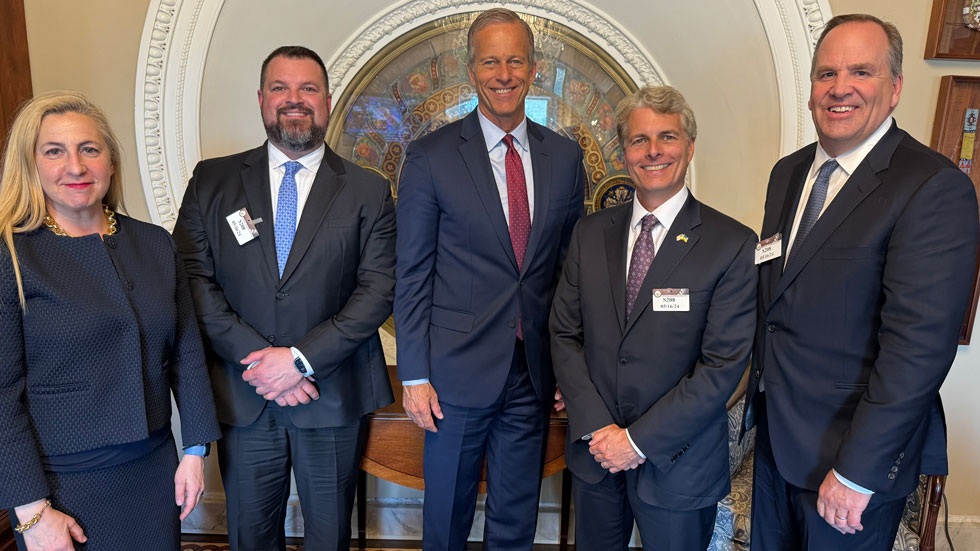
His first years as CEO also put him in rooms beyond the tower business. At Nareit's May 2024 Advocacy Day, he appeared with fellow real estate executives and lawmakers in Washington. Photographs show him with Representative Katherine Clark and, in another meeting, Senator John Thune. The industry's infrastructure has a public-policy life as well as a commercial one.
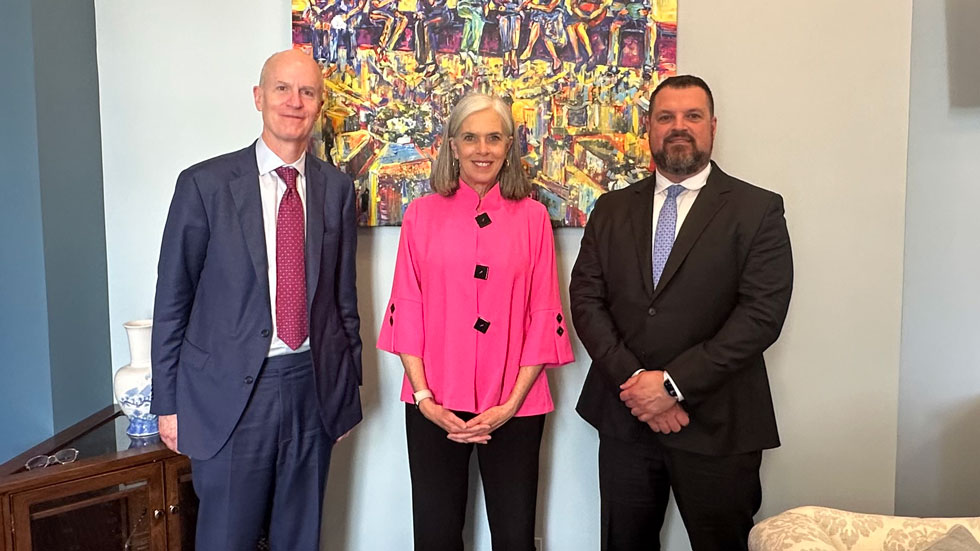
On January 1, 2025, he joined Ameren's board of directors. The utility's announcement specifically pointed to his experience in real estate and data center infrastructure. The connection is concrete: the buildings and networks that support digital activity also need the basic services that allow physical infrastructure to operate.
His affiliations span that overlap. The 2026 American Tower proxy identifies him as a member of Business Roundtable and Nareit's executive board. His industry service has included CTIA's board and a term on the Wireless Infrastructure Association board from 2018 to 2024. These are connections across wireless policy, real estate, and corporate leadership, rather than a single professional lane.
In 2025, he joined American Tower colleagues at the New York Stock Exchange to mark the company's thirtieth anniversary by ringing the opening bell. He then spoke with Judy Khan Shaw on Floor Talk. The occasion offered a neat pair of clocks: thirty years for the company, twenty-five since Vondran had joined. He had been there for most of its life.
The CEO gets to choose where the money goes
The job now asks him to decide what deserves the next dollar. American Tower's portfolio includes CoreSite, the U.S. data center business, alongside its towers. Vondran's U.S. leadership remit had already included data centers before he became CEO. The broader brief therefore expanded an existing responsibility, bringing that experience into decisions about the whole company.
One useful way to understand the relationship is to follow a connection rather than a building. Towers provide locations for wireless equipment. Data centers provide places for networks, cloud services, and enterprises to connect. The commercial work differs, but both businesses make other people's digital activity possible by supplying physical space and infrastructure.
Vondran's public ambitions have remained rooted in that work: expand connectivity, support customers' network investment, and earn durable returns from the portfolio. The appeal is less theatrical than the vocabulary around artificial intelligence or the next wireless generation. A useful location, occupied on workable terms, can remain valuable through several changes in what customers want to do there.
Results offer a checkpoint. For the second quarter of 2026, American Tower reported revenue of $2.749 billion, up 4.7% from a year earlier. Property revenue rose 6.3% to $2.688 billion. Vondran pointed to leasing demand and record leasing activity at CoreSite. These are company results during his tenure, a measure of the operation he leads rather than a personal scorecard.
Knowing when to stop talking
There is a small moment from September 2026 that suits a former general counsel. Asked about the following year's organic growth outlook, Vondran spotted the invitation to give guidance early. “I don't think so. Nice try,” he said. He explained that more visibility into carriers' plans would be needed before the company gave its outlook.
The exchange supplies a more useful glimpse of his public manner than a list of flattering adjectives would. He can be expansive about the business and precise about the boundary of a commitment. The humor keeps the conversation moving. The boundary stays where it belongs.
That is an apt ending for a career that began inside the agreements. Vondran spent years working on how customers use towers, what the company promises, and how an operating business delivers. The chief executive's title widened his field of responsibility. The underlying questions still sound familiar: who needs the space, what will they do with it, and what makes the arrangement last?
A tower is easy to overlook until a connection fails. Vondran has built his career inside that gap between the ordinary structure and the extraordinary amount of daily life passing through it. The long way up gave him time to learn the structure. His task now is to keep it useful while the world around it keeps changing.