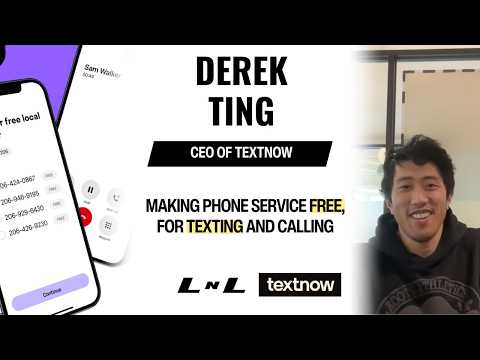
The iPhone launched in 2007. Every carrier immediately started charging extra for text messages - a technology so cheap to transmit it might as well cost nothing. Derek Ting, then a first-year computer engineering student at the University of Waterloo, looked at his phone bill and decided that was insane. Two years later, he and classmate Jon Lerner built TextNow in student housing and started giving away what carriers were charging for.
The company's logic was simple: if you serve enough users for free, advertising revenue covers the costs. What neither Derek nor anyone else predicted was just how many people would come. TextNow found its most fervent users not in dorm rooms but among a population carriers had written off entirely - iPod Touch users, people who could buy hardware but couldn't afford a monthly plan, families priced out of even the cheapest contracts. TextNow was free. That was the whole pitch.
By 2010 - twelve months in - the company was profitable. By March 2011, it had sent a billion messages. By 2012, when Derek was named Ernst & Young's Emerging Entrepreneur of the Year, TextNow had 30 employees generating $13 million in revenue. Today that number is $160 million, and the app has been downloaded more than 200 million times worldwide. TextNow is now the only mobile provider in the United States offering unlimited talk, text, and free essential data on a nationwide 5G network.
None of this was built on venture capital. TextNow has raised a total of $3.42 million over its entire life - a number that most Silicon Valley startups burn through in their first month of office furniture. Derek's model is product-first and permanently profitable: grow because users love the experience, monetize through ads, reinvest in the mission. The mission is to make phone service free - not as a loss-leader strategy, but as a permanent business model built on what carriers ignore.
Derek grew up watching his mother, who had immigrated from communist China to Hong Kong, build a successful company before eventually relocating the family to Canada. Entrepreneurship wasn't a lifestyle choice in his household - it was a family language. He started his first company, WoolNet LLC (a web hosting service), while still in high school. His second, TorrentReactor, he sold before graduating. When he got to Waterloo, founding something was the obvious next step.
What's less obvious is how he's run it. TextNow is structured around a core value Derek calls "be respectfully candid" - a phrase that, in practice, means the company doesn't tolerate what Derek terms "brilliant jerks." High performers who wreck team culture don't last long, regardless of their output. The company offers unlimited vacation, runs a remote-first culture, and has made a point of hiring for diversity and inclusion long before those became PR priorities. Derek's wife is a teacher who has worked across a range of socioeconomic contexts - and her front-row view of the digital divide sharpened his sense of who TextNow is actually for.
There's an early story Derek tells that became foundational. In TextNow's first year, he made a change directly to the live production database - a move any senior engineer would have stopped him from making - and accidentally deleted the entire user table. The company's user data, gone. He rebuilt the systems from backup and built a culture of testing and staged rollouts around that mistake. Every new feature now rolls out to a small percentage of users first. The database incident became company policy.
The $100,000 Domain
Before TextNow, while working at an early startup building a chat-based social network called Touch, Derek purchased a domain name for $100,000 - a significant bet for a twenty-something engineer. He later turned down a $5 million offer for it. Whether the domain still sits somewhere in his portfolio or was eventually sold for something else is unclear - but the willingness to make asymmetric bets, and to hold them, is a consistent pattern in how he operates.
TextNow's next frontier is free mobile internet. Unlimited talk and text was the first step. Free essential data on 5G came next - an industry first. Making mobile internet broadly free for Americans who can't afford carrier data plans is where Derek says the company is heading. The ad-supported model scales with data consumption in a way it couldn't scale with calls and texts alone - which means the business case is stronger now than it was in 2009, not weaker.
Derek works out of San Francisco, though TextNow remains headquartered in Waterloo, Ontario, where 420 Wes Graham Way still houses the company's Canadian operations. He is a Toronto Maple Leafs fan, a hockey player whose oldest son now plays, and someone who describes himself as living to eat - particularly fond of food that's hard to find in suburban Ontario. He identifies as having ADD, which he says affected his academic performance at Waterloo, though clearly not his output. He follows Elon Musk, Jack Dorsey, and Aaron Levie on Twitter (now X), and recommends the book "Rework" by 37 Signals to anyone asking about how he runs the company. Both recommendations reveal something: he is less interested in the story of startups than in the mechanics of running them well.
The plan has always been the same - bring the cost of a phone number to zero. Carriers laughed at the idea in 2009. Today, 200 million people have downloaded the app. The laugh got quieter a long time ago.