The Mississippi Telco That Ran Google's Fiber Playbook - And Kept the Whole State
How a Gulf Coast cellular start-up became the biggest privately held wireless carrier in America - by making towns compete to get fiber first, then wiring the rest of the state anyway.
In 2013, C Spire did something that sounds more like a marketing stunt than a network strategy: instead of deciding which Mississippi towns would get gigabit fiber, it made the towns ask for it. Communities that rallied enough residents to pre-register won earlier installs. Everyone else waited. It was, more or less, the same "fiberhood" competition Google Fiber was running in Kansas City at the time - except the company running it in Mississippi was one most of America has never heard of.
That company is C Spire, headquartered in Ridgeland, Mississippi, and privately held under a holding company called Telapex. It began in 1988 as Cellular South, a Gulf Coast cellular start-up launched by the Creekmore family, whose telecom roots in rural Mississippi telephone lines trace back to the late 1940s. Today it describes itself three ways at once - a wireless carrier, a fiber internet provider, and a business technology partner - and all three descriptions are accurate.
01 / What it actually isThree companies wearing one logo
Most telecoms pick a lane. C Spire runs three, and they feed each other. The wireless business sells 5G and 4G LTE service across Mississippi, the Memphis metro, and parts of Alabama - and it is, by the company's account, the largest privately held wireless carrier in the United States. The home fiber business sells gigabit and multi-gigabit internet, TV, and phone across Mississippi, Alabama, and Tennessee. And C Spire Business sells managed IT, cloud, cybersecurity, and data-center colocation to companies in 49 states.
C Spire Wireless
Regional 5G and 4G LTE across Mississippi, Memphis, and parts of Alabama. The largest privately held wireless carrier in the U.S.
C Spire Home Fiber
Symmetrical gigabit and multi-gig internet, TV, and phone with no data caps - launched in 2013, live across three states.
C Spire Business
Managed IT, cloud, cybersecurity, colocation, and unified communications backed by 200+ certified engineers.
The thread tying them together is the thing you cannot see: more than 20,000 route miles of buried fiber optic cable. Own the physical network, and every layer above it - a phone plan, a home internet subscription, a hospital's cloud backup - becomes a product you can sell without renting someone else's pipes.
02 / The customersFront porches and Fortune-list back offices
On the consumer side, C Spire's customers are households across the rural and mid-size South - the places where a symmetrical gigabit connection with no data cap is a genuine upgrade over what the incumbents offer, and where in plenty of towns the incumbents never showed up at all. On the business side, the customer list gets more institutional: the company points to Protective Stadium, the Alabama Department of Transportation, and Radiation Business Solutions among the organizations that trust it to run networks and secure data.
03 / The problem it solvesBroadband the giants skipped
The problem C Spire keeps aiming at is coverage. National carriers built out the profitable metros and left long stretches of the Deep South underserved. In January 2021 the company announced a three-year, $1 billion investment to close that gap with 5G and fiber - a plan aimed at bringing all-fiber service to more than 200,000 homes and businesses, and putting fiber infrastructure within 1,000 feet of half of Mississippi's residential front doors.
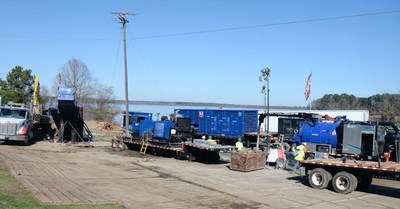
By April 2026, that push reached a milestone that reads like a rounding error until you look closely: under the Mississippi Capital Projects Fund - a slice of federal U.S. Treasury broadband money - C Spire extended home fiber to more than 14,000 residences and 18,530 undeveloped lots. Undeveloped. Land without houses on it yet. The company wired where Mississippi is going to grow, not just where it already had.
04 / What makes it differentPrivate, and in no hurry to sell
The most important fact about C Spire is structural: it is privately held. Where regional carriers across the country got bought up and folded into AT&T, Verizon, and T-Mobile, C Spire stayed independent under parent company Telapex. That ownership is the whole personality. A privately held operator can pour a billion dollars into buried fiber and empty lots without a public market asking why it isn't showing up in next quarter's numbers.
The brand promise - two words, "customer inspired" - is easy to file under corporate slogan until you notice the 2013 fiber rollout literally let customer demand decide which towns got wired first. The slogan is the strategy.
05 / The business armA regional telco that sells IT nationwide
The part of C Spire that surprises people is C Spire Business. It is not a side hustle. It fields more than 200 certified engineers and sells managed IT, cloud, cybersecurity, data-center colocation, and unified communications to customers in 49 states. The recognition is real too: it has landed on CRN's Tech Elite 250 for more than a decade running, was ranked the No. 1 healthcare managed services provider in North America by ChannelE2E two years in a row, and was named Cisco Partner Summit 2025 Collaboration Partner of the Year - a title you would expect on a coastal systems integrator, not a Mississippi carrier.
06 / The handoffA CEO change a generation in the making
In June 2024, C Spire changed chief executives for effectively the first time in a generation. Hu Meena - who joined in 1987 to run the company's very first market on the Gulf Coast and later led the start-up of the fiber business that became C Spire Fiber - moved to chairman of Telapex. Suzy Hays took over as president and CEO on July 1, 2024. What she inherited is one of the more vertically integrated telecoms in the country: towers, trenches, data centers, and a nationwide IT practice, all under one privately held roof.
07 / The timelineFrom cell towers to empty lots
The Creekmore family launches wireless service on the Mississippi Gulf Coast using AMPS technology.
Cellular South becomes C Spire Wireless on September 26, 2011.
Communities compete to be wired first; C Spire acquires Callis Communications.
The state's first gigabit residential fiber customer goes live.
A three-year plan for 5G and fiber; Harbor Communications and Troy Cablevision deals follow.
Suzy Hays becomes president and CEO; Hu Meena moves to chairman of Telapex.
Capital Projects Fund buildout reaches 14,000+ homes and 18,530 undeveloped lots.
08 / Where it fitsThe regional that acts national
Line C Spire up against its competitors and the picture clarifies. On the consumer side it goes head to head with AT&T, Verizon, T-Mobile, Comcast, and even Google Fiber in the markets where they overlap. On the business side it competes with national managed-service providers and systems integrators. Its edge in both is the same: it owns the fiber, it is privately held, and it is willing to build in the places bigger players treat as a rounding error. It is a regional carrier that behaves like a national technology company - and it has spent almost four decades proving that a company in Ridgeland, Mississippi, can do both.
What can you take from it if you run anything? Own the layer everyone else rents. Let demand pick where you build. And if you are private, use it - patient capital is a moat the public giants can't match. Where it wouldn't work: this is a capital-heavy, decades-long game with thin margins and real dirt-moving. It rewards operators who can wait, not ones who need a quick exit.