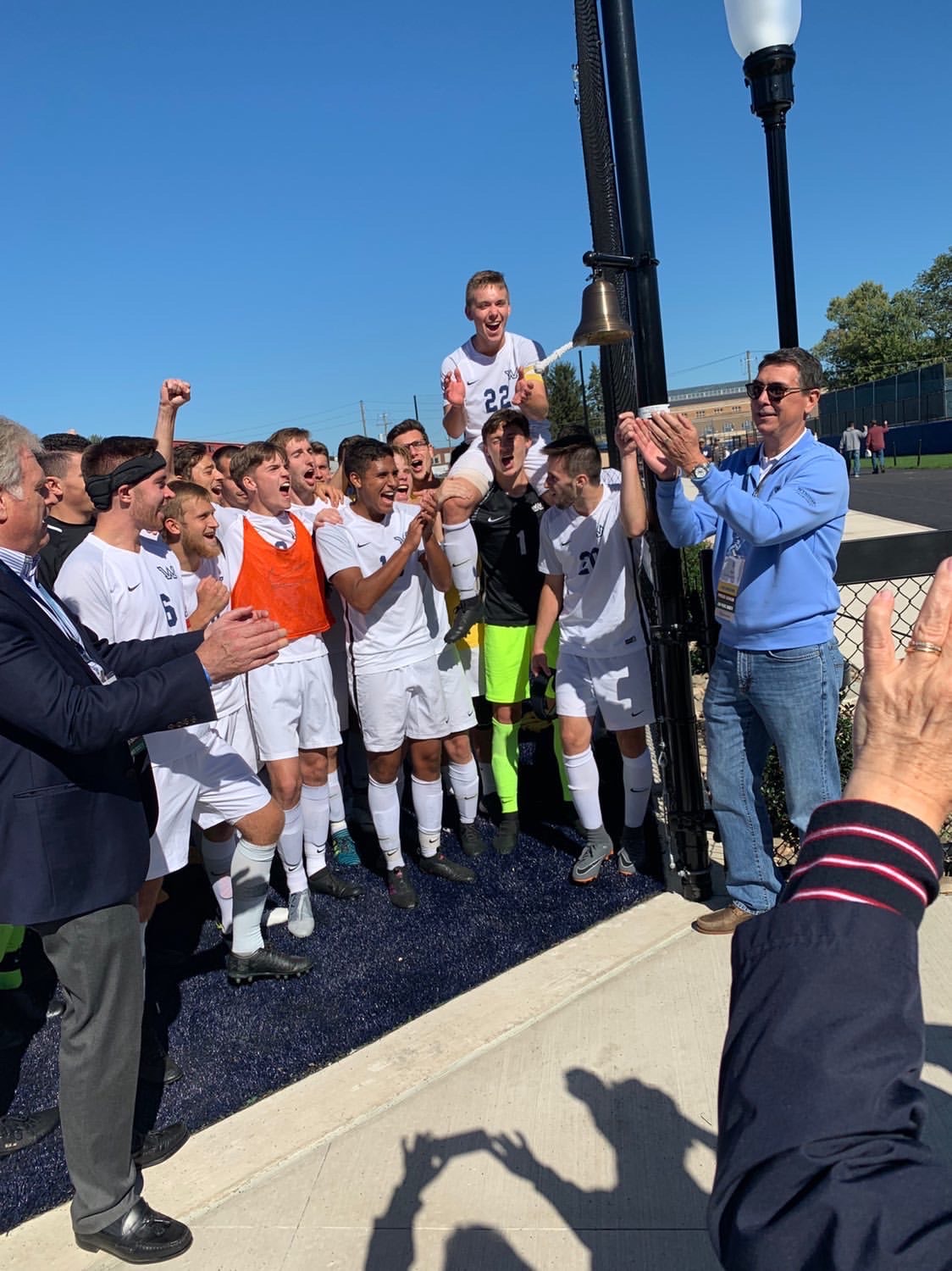
The bell is a pleasingly uncomplicated piece of equipment. There is no software to update, no frequency band to negotiate. At Wilkes University, a winning team pulls the rope, and everybody nearby gets the message. In October 2019, Bob Bruggeworth stood beside the soccer players celebrating at the field bearing his name. For someone whose working life involved getting signals through the air, this was an unusually visible connection.
Bruggeworth had played goalkeeper at Wilkes. Decades later, he helped pay for a place where other students could play. The field was dedicated in honor of his mother. There is a useful way into his career here: people assembled around a shared undertaking, with a result everyone can recognize. The photograph is cheerful. The underlying question would occupy much of his professional life. How do you make a collection of capable people work together?
A new seat, after two combinations
On October 5, 2026, Qorvo completed its combination with Skyworks. Bruggeworth, Qorvo’s former president and chief executive, joined the Skyworks board. Phil Brace continued as president and CEO of the combined business. That distinction matters. After years spent running Qorvo, Bruggeworth now participates in overseeing the company into which it has combined.
The shift gives his career an unusual symmetry. He led RF Micro Devices before its combination with TriQuint created the operating business known as Qorvo in January 2015. More than a decade later, Qorvo itself entered a larger combination. For Bruggeworth, corporate integration has become a recurring professional assignment. Every agreement produces an organization that must learn how to function after the announcement has left the news cycle.
His comment at the Skyworks closing was brief: “This next chapter begins with an immense amount of pride.” The next chapter also carries a change in responsibility. A director evaluates management, strategy and execution from the boardroom. The daily operating decisions belong to the executive team. His experience of running a previous combination will now be available from that different seat.
The engineer gets a different assignment
Bruggeworth graduated from Wilkes in 1983 with an electrical engineering degree. His professional apprenticeship at AMP included factory work before engineering. At 26, he was offered responsibility for a plant with 350 employees. The invitation was a considerable promotion in the number of people who could have a question for him.
He later described management in wonderfully practical terms: “I get really smart people to play well together.” That sentence makes room for the engineer without making him the inventor of everything around him. It assigns him responsibility for the conditions in which other people do their work. Technical knowledge remains useful; deciding who works on what becomes part of the job.
“I get really smart people to play well together.”
Bob Bruggeworth, reflecting on his work in 2018
At Wilkes, a materials science lab gave him an early taste of the semiconductor work that would shape his career. Students made transistors using donated equipment. There is a satisfying connection between that hands-on beginning and the businesses he later ran. A component becomes easier to understand when you have had to make one. The laboratory offered a reason to be interested in the subject before it became a market to manage.
His AMP career lasted from 1983 to 1999 and included manufacturing and engineering management. By its later stages, he was based in Hong Kong as divisional vice president of global computer and consumer electronics. The progression crossed several kinds of work: making products, organizing production and managing across markets. Those are different vantage points on the same business, and a useful preparation for a company whose customers and operations cross borders.
He joined RFMD in September 1999. Roles in its wireless products group preceded the company presidency in June 2002 and the chief executive position in January 2003. The sequence is worth keeping intact. Qorvo’s eventual leader arrived with years of operating experience, then moved through responsibility for a product business before taking responsibility for the whole company.
Why the parts needed each other
When RFMD and TriQuint were preparing to combine, Bruggeworth’s explanation was rooted in customer demands. More mobile data required better performance and greater integration. Phone makers needed specialized technologies to cooperate inside devices with severe constraints on space and power. Having a collection of good components was one part of the problem. Making those components work together was another.
In his November 2014 interview, he described portfolios with relatively little product overlap. TriQuint’s premium filters and power amplifiers complemented RFMD’s amplifiers, switches and tuning technologies. Both companies also worked with gallium nitride. The proposed combination offered a way to put more of the required capabilities within one organization, while sharing manufacturing and research resources.
Coordinating the parts is central to RF integration.
Conceptual illustration - not a circuit schematic.
The logic is easier to appreciate if you put yourself on the customer’s side of the table. A product team must bring a complete device to market. Its suppliers’ individual achievements have to fit that larger task. Bruggeworth’s argument for the combination was that a broader set of technologies could make the customer’s design process simpler, while helping reduce size and conserve power.
RFMD and TriQuint announced completion on January 2, 2015. Ralph Quinsey, formerly TriQuint’s CEO, became non-executive chairman; Bruggeworth became president and CEO of the combined operating company. The division of roles gave the new organization leadership drawn from both predecessors. Qorvo’s incorporation dated to December 2013, ahead of the business combination, which explains the earlier starting date in formal biographies.
The opening announcement targeted at least $150 million in cost synergies. Such a number gives investors something to measure. Inside the business, it translates into choices about facilities, duplicated costs and how work is organized. A merger has a financial model, but it also has a Monday morning. The model can be signed off before the people have learned one another’s names.
Qorvo’s subsequent history extended the range of technologies under that roof. It acquired ultra-wideband specialist Decawave in 2020, silicon-carbide power business UnitedSiC in 2021 and active-array antenna chip supplier Anokiwave in 2024. These were company decisions during Bruggeworth’s tenure, rather than inventions to credit to one executive. They show how the organization he led kept adding capabilities beyond its starting portfolio, and how the work of connecting those capabilities kept changing.
A short instruction about expensive mistakes
Back at Wilkes in spring 2017, Bruggeworth took part in President Patrick Leahy’s leadership seminar. His advice to students included the instruction to “fail fast.” He explained the expense of learning too late. For him, innovation included creating something and getting it to market commercially ahead of competitors. The clock was part of the definition.
There is little romance in that formulation, which is part of its appeal. An unsuccessful experiment can still supply useful information. Continuing to spend after the lesson should have become clear is harder to defend. His emphasis was on the timing of discovery and the cost of delay. For students preparing to enter business, that is a more demanding idea than simply being told to welcome mistakes.
The seminar also put a practicing executive in conversation with students, rather than leaving his career as a distant alumni success. In May 2019, Wilkes awarded him an honorary doctorate of business at its spring commencement. The electrical engineering graduate had returned with a career that now reached well beyond the discipline printed on his original degree.
The field has a practical purpose, too
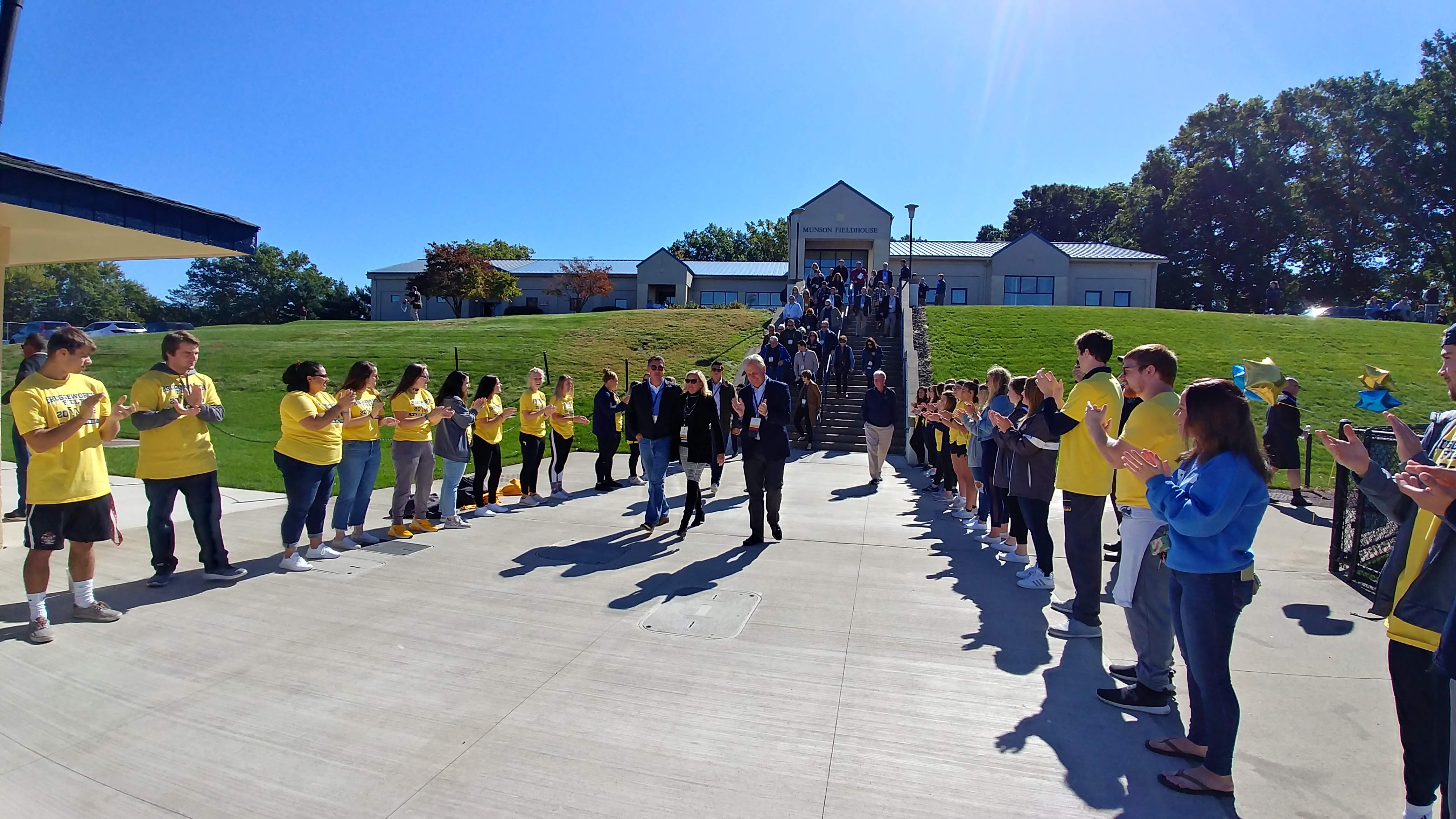
Bruggeworth Field was dedicated on October 5, 2019, during homecoming weekend. His leadership gift helped make possible a nearly $8 million project, including a multipurpose turf field, a turf baseball field, scoreboards, press boxes and lighting. Soccer, lacrosse and field hockey were among the sports served. The physical details matter: a gift becomes useful through the games and practices that can take place because of it.
On the new field’s opening day, the Wilkes men’s soccer team beat FDU-Florham 2-1. A ceremony can promise future memories; the team supplied one immediately. The victory bell gave winning teams a way to celebrate together. It is an agreeable piece of campus planning to provide both somewhere to compete and something to ring afterward.
From running a company to representing an industry
In November 2020, the Semiconductor Industry Association elected Bruggeworth its chair for 2021, with Qualcomm CEO Steve Mollenkopf as vice chair. Bruggeworth’s stated priorities included public awareness of semiconductor technology’s economic and national-security importance. The assignment expanded his audience from customers and employees to policymakers and the wider public.
His board work also extended beyond Qorvo. Seagate appointed him a director in 2022, with a place on its Audit and Finance Committee. In May 2026, he became chairman of MSA Safety, having served as a director since 2007 and lead independent director since 2017. That is a long stretch of institutional involvement before taking the chair, and another example of a role built through accumulated responsibility.
The Skyworks combination now adds a fresh setting for that experience. Its announcement describes a business with about 8,000 engineers and more than 12,000 issued and pending patents. Those are company-wide resources, belonging to many people’s work. Bruggeworth’s career offers one way to think about the task ahead: assemble the capabilities, give talented people a workable organization, and judge what they accomplish together. At Wilkes, someone can ring a bell when the result arrives. In semiconductors, the test keeps running.
Follow the connections
Interviews, career milestones and the places in this story.