Brett Cope had a perfectly respectable plan for his working life: become an engineer, and avoid becoming his father. His father worked in Ohio’s glass business, selling to Detroit’s Big Three automakers. Cope graduated from Miami University in 1990 with an applied science degree and joined ABB. Sales belonged to the previous generation. Three years of engineering later, he changed his mind. A career can begin with a declaration of independence and still arrive, rather sheepishly, in the family business of understanding customers.
Today he is chairman, president and chief executive of Powell Industries in Houston, where understanding a customer means understanding what happens to electricity inside a refinery, utility installation or data center. His early reversal offers a useful introduction. Cope has spent much of his career moving between technical work, commercial responsibility and running an organization. Each move has required a larger view of the problem. The engineer’s question follows him: how do the parts fit together?
The customer becomes the assignment
At ABB, Cope spent twenty years in engineering, project operations and sales management. His eventual assignment as group vice president involved ABB’s global business with ExxonMobil. That is a different scale of responsibility from selling one item of equipment. A global account brings operations, purchasing decisions and competing priorities into the same conversation. Technical knowledge supplies the vocabulary; the work also requires learning how another organization makes decisions.
His official career history gives that ExxonMobil role particular prominence. It helps explain the combination he later brought to Powell: familiarity with electrical products alongside experience coordinating business across an international industrial customer. There is little separation between the commercial and technical sides in that description. A proposal needs to make sense to the people who buy the equipment and the people who will eventually operate it.
Powell’s customers include utilities, oil and gas producers, petrochemical plants and transportation facilities. These are places where an electrical system has a job to do for years after the sales conversation ends. Cope’s route into leadership passed through the practical relationship between a promise made to a customer and the organization responsible for delivering it. That relationship would become the center of his next job.
A succession measured in years
Cope joined Powell as vice president of sales and marketing in December 2010, according to the filing announcing his later appointment as CEO. He became senior vice president and chief operating officer in December 2015. In September 2016, the board chose him to lead the company, effective October 1. Thomas W. Powell stepped down as interim president and chief executive while remaining chairman. Cope also joined the board.
The sequence matters. He had worked in the business for almost six years before becoming chief executive, with time in both commercial leadership and operations. The appointment placed responsibility for the whole company with someone who had already been responsible for bringing in work and helping run its delivery. It was a succession through several jobs, each with a different view of the same enterprise.
In September 2019, Thomas Powell became chairman emeritus and Cope took the chairmanship. Powell had held that office since 1984. The transition preserved his involvement as a director while giving Cope the combined responsibilities of chairman and CEO. For Cope, it meant leading a company with a history already stretching back decades, and doing so alongside people who had helped write it.
That history begins in Houston in 1947, when William E. Powell founded a metalworking business serving local petrochemical facilities. By 1968, the company was developing its Power Control Room concept for a Union Carbide project in Puerto Rico. Cope inherited an organization accustomed to assembling solutions around a particular customer’s requirements. Its long habit of customization is part of the setting for his decisions today.
The appeal of an unfashionable box
Powell designs, manufactures and services equipment that distributes, controls and monitors electrical energy. Its range includes switchgear, circuit breakers, bus systems and integrated electrical packages. These products rarely receive the attention given to the facilities they support. A data center makes the announcement; the electrical equipment does its work behind the scenes. For an executive with Cope’s background, those supporting systems are a substantial business in their own right.
The company’s integrated packages bring several parts of an electrical installation together. That helps explain why its work reaches across so many industries: the end product may differ, but a refinery, railway and utility all have electrical systems to manage. Cope’s career sits in this less photographed part of industrial life. His decisions concern the organizations and equipment that make other people’s projects possible.
Back to Oxford, with the team
In January 2025, Cope brought Powell’s leadership team to Miami University for a two-day retreat. The destination was his alma mater in Oxford, Ohio. The agenda went well beyond a nostalgic return to campus: the visitors met university president Gregory Crawford and engineering dean Beena Sukumaran, heard faculty presentations and discussed the future of electrical infrastructure. Faculty and students met with the team during the January 28-29 visit.
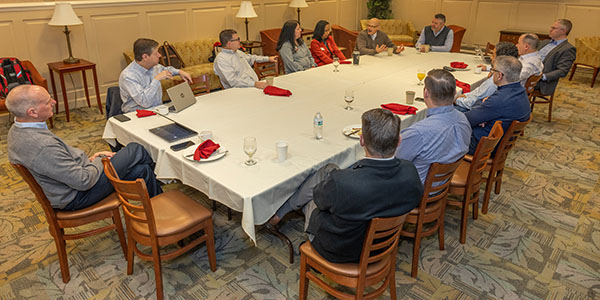
The subjects included artificial intelligence, cybersecurity, power engineering and signal processing. A university could bring research and a view of the next generation of engineers; Powell could bring questions from industry. Cope, a member of the college’s advisory board, had been impressed by the students he met. The exchange gave his colleagues a chance to see that work themselves, and gave faculty a direct conversation with a potential user of their research.
“I hope this spurs new ideas for both sides.”Brett Cope, at Miami University · January 2025
It is a modest ambition for a leadership retreat, and a useful one. An established company has routines and experience. A university has people investigating what those routines may eventually need to accommodate. Putting the two around a table creates the possibility of a question neither would have asked alone.
The classroom keeps turning up
The retreat was part of a continuing relationship. In April 2022, Cope had appeared on an engineering executive panel with fellow Miami alumnus Jon Olson, then Schneider Electric’s senior vice president of industrial automation. Both were members of the class of 1990. The event addressed their journeys as engineers, the skills they had acquired and what engineering work might require in the future.
That pairing put two long industrial careers in front of an alumni audience. Cope’s own experience covered engineering, project operations, account leadership and executive management. The panel’s premise allowed room for all of those jobs within an engineering career. For someone beginning with a technical degree, his record supplies a concrete example of how widely the work can spread.
He returned to the student conversation on February 26, 2026, appearing with KKR partner Dinesh Paliwal in Miami’s Leadership in Technology Speaker Series. Sukumaran moderated. Their discussion covered mentorship, interpersonal skills and career development, with a substantial portion devoted to AI. Students asked about creative problem solving when answers are immediately available, and about advice the speakers wished they had received before graduation.
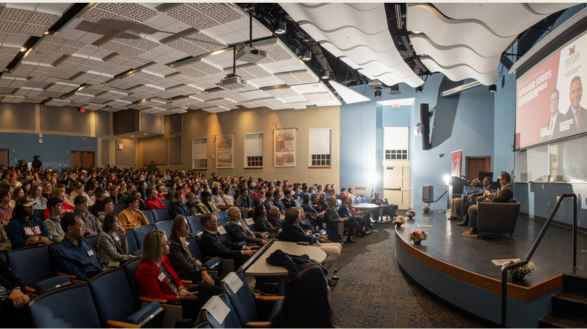
Cope and Paliwal emphasized judgment, the value of mentors and maintaining a network. On AI, they argued that jobs were changing and encouraged students to engage with the technology. These were their views, offered to an audience preparing to enter the workforce. Cope’s presence gave the discussion an industrial perspective: the person considering what engineers should learn also runs a company that needs their work.
When the order book meets the AI conversation
By the summer of 2026, data centers had supplied a very tangible development at Powell. During its fiscal third quarter, the company received a data-center order worth more than $400 million, connected to a design using on-site generation. It was one of three large orders highlighted in the quarter, alongside approximately $75 million of petrochemical work and $60 million of LNG work.
Company figures for the quarters ended June 30. Orders represent bookings, not recognized revenue.
Total new orders reached $934 million; revenue was approximately $312 million. Backlog at June 30 stood at $2.4 billion. Those figures describe different stages of the business. An order is a commitment to future work, while revenue reflects work recognized during the period. For Cope, a growing backlog places the commercial achievement beside an operational obligation: the company must execute the projects it has won.
In his August results commentary, he pointed to demand from LNG, utility generation, grid investment and data centers supporting AI capacity. These markets give Powell several places to seek work. They also keep the CEO’s attention on the familiar connection between a customer’s plan and the electrical systems required to carry it out.
Another boardroom, the same questions
In May 2026, Cope was elected to the board of Rogers Corporation alongside former National Instruments CEO Eric Starkloff. Rogers makes engineered electronic and elastomeric materials used in applications including industrial equipment, renewable energy and wireless infrastructure. Its chairman, Armand Lauzon, welcomed the two executives as additions to a board pursuing growth and profitability.
The appointment extends Cope’s work into a related manufacturing business. Rogers highlighted his experience in manufacturing, project operations and international business across industrial, utility and commercial markets. Those are responsibilities accumulated over decades, rather than a new professional identity. Alongside his university advisory role, the directorship gives him another setting in which to apply them.
His own ambitions for Powell remain expansive. In a 2025 interview, he considered whether the company could take on something of Westinghouse’s former place in the North American electrical market. He presented it as a possibility. The task between that possibility and a future result runs through customers, products and the people who make them. Cope began his career with a firm idea about the job he wanted. He has since made considerable use of the willingness to reconsider.