Olivier Le Peuch’s first work at Schlumberger involved electronics that had to tolerate heat. Nearly four decades later, the company he leads wants a larger role in keeping data centers cool. In August 2026, SLB agreed to acquire Kelvion, a maker of thermal-management and heat-exchange technology. Between those two points lies a career in which software and physical machinery have rarely been far apart. The fashionable subject is artificial intelligence. The older, rather stubborn subject is making equipment work.
Le Peuch joined the business in 1987 as an electrical engineer. He became chief executive in August 2019, after 32 years inside the organization. His path passed through software, regional operations, manufacturing and oilfield equipment. To follow it is to see why an executive associated with drilling might consider the infrastructure around a computer a plausible next assignment. The link becomes clearer when the career is read from the beginning.
An engineer before the title
His training was in Bordeaux: an electrical engineering degree from Bordeaux Engineering School and a research master’s in microelectronics from the University of Bordeaux. These were qualifications for the innards of technology, where the interesting question is often whether a device will perform under the conditions in which someone actually intends to use it. In Le Peuch’s case, the work soon included high-temperature electronics for wireline applications and custom software integration.
That combination matters to the story. His early job placed code alongside equipment. Later, he managed technology development in Europe and the United States. The public career begins with technical work, rather than an early claim to corporate destiny. Read against his current brief, those beginnings offer a useful point of continuity: technology has to connect to an operating environment before it can do much for a customer. His engineering background remains visible in the kinds of businesses he now oversees.
A career with several addresses inside one company
Staying with one employer can sound like staying still. Le Peuch’s résumé makes that description awkward. He became president of Schlumberger Information Solutions, then held responsibility for the North Sea as GeoMarket manager. He moved from a software business to regional operations, two settings with different daily demands. One asks how information can be made useful. The other has customers and operations waiting for the answer to arrive.
From 2010 to 2014, he was vice president of Engineering, Manufacturing, and Sustaining. He then led Completions from 2014 to 2017 and the Cameron Group from 2017 to 2018. Responsibility for Reservoir and Infrastructure followed. In February 2019, he became chief operating officer. These were distinct pieces of a large industrial enterprise, giving him experience across how technology is developed, built, sold and put to work.
The board announced his appointment on July 19, 2019, effective August 1. He succeeded Paal Kibsgaard and joined the board himself. The succession was an internal one, with a long operating record attached. It also came with a distinction worth keeping: Le Peuch became CEO while Mark Papa became non-executive chairman. The 2019 appointment placed management and board leadership in separate hands.
The early period at the top was financially difficult. Full-year revenue fell 28% in 2020 to $23.6 billion. A career built across the organization did not remove its exposure to the oilfield cycle. That number belongs beside the later expansion plans. A chief executive in this business inherits technical capability and customer relationships, along with a market that can sharply reduce the work available to both. The 2020 results supplied an immediate reminder.
The advice he gave the next generation
In 2021, Le Peuch met Aramco’s Young Leaders Advisory Board in Dhahran. The discussion covered energy, leadership and the role of younger people in an industry undergoing change. His advice was direct: “If you keep learning, you’ll be ahead of the disruption.” Coming from someone whose working life had crossed several parts of the same company, the sentence had a career behind it.
He also emphasized listening, being accessible and caring about people. He argued for a clear purpose and vision when attracting younger employees, and encouraged authenticity. These are the leadership values he chose to articulate in a public discussion. They provide a more useful glimpse of his approach than an invented account of what he is like away from work. The emphasis fell on staying receptive while carrying responsibility for decisions.
There is a practical tension in that advice. Seniority can reward certainty, while engineering keeps presenting reasons to revise an assumption. His conversation with the young leaders returned to learning as a continuing obligation. For someone now considering customers outside the traditional oilfield, it is an especially relevant obligation. A long career supplies experience; a different market supplies the questions experience has yet to answer.
Three letters, several obligations
On October 24, 2022, Schlumberger introduced the SLB name. Corporate renaming is a ceremony at which a great deal is asked of a small quantity of lettering. Le Peuch’s explanation was broader than typography. He described the need to provide reliable, accessible and affordable energy while reducing emissions. The company was presenting itself as a technology business with ambitions across a changing energy system.
Some groundwork preceded the new identity. Schlumberger had launched its New Energy business in 2020. In a June conference presentation that year, Le Peuch discussed ventures including geoenergy for heating and cooling, and hydrogen technology. His 2020 presentation framed expansion beyond oil and gas as a long-term opportunity. The later brand change gave that direction a more visible public expression.
The challenge was that several obligations would have to coexist. Customers still needed oilfield services and equipment. Investors needed a business capable of producing returns. Lower-carbon technologies needed development and deployment. The SLB announcement placed those activities under a shared identity; it did not make their economics identical. For Le Peuch, the question became how to build connections between them that could survive contact with budgets, schedules and customer demand.
The difficult journey from pilot to practice
At the 2024 Digital Forum in Monaco, Le Peuch pressed for digital technology to move beyond proof of concept and into operations. That is where corporate enthusiasm encounters the everyday difficulties of implementation. A demonstration can be arranged around a problem. A working system must deal with the problems that arrive uninvited, including information held by different teams in different forms.
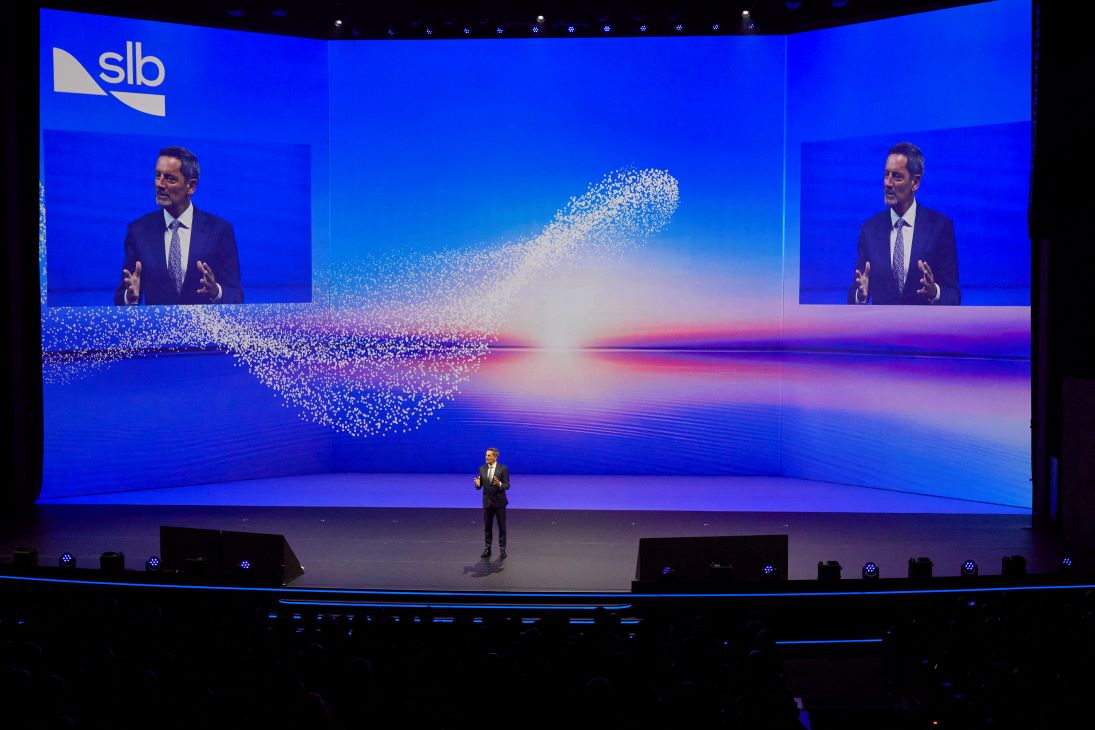
SLB launched Lumi on September 17, 2024. The data and AI platform was designed to connect information across subsurface, surface, planning and operations. Its open, modular architecture was intended to support both traditional and generative AI. The Lumi launch addressed a familiar industrial difficulty: the organization may possess useful data without making it readily usable across the organization.
“AI will be the X factor for our industry.”
Olivier Le Peuch · Digital Forum 2024
The same week, SLB expanded its collaboration with NVIDIA to develop generative AI solutions for energy. The companies described models tailored to technical work, including exploration, production operations and data management. NVIDIA’s NeMo technology would support the development of those models. The collaboration connected a computing company’s tools with SLB’s industry knowledge, making the proposed division of labor fairly concrete.
For Le Peuch, this brought an old professional subject into a new setting. His career began partly in software integration. Now the discussion concerned connecting information and applications across much larger systems. The scale had changed, and so had the available computing tools. The central difficulty remained recognizable: separate capabilities have to work together before the person making a decision can benefit from them.
The server room still needs plumbing
The acquisitions under his leadership show two directions at once. In July 2025, SLB completed its purchase of ChampionX, adding production chemicals and complementary artificial-lift, digital and emissions technologies. Le Peuch described production and recovery as a less cyclical market for the business. The completed transaction deepened SLB’s involvement in helping customers get more from producing assets, extending work within the industry it already knew.
Kelvion points toward another customer base. Announced on August 31, 2026, the proposed acquisition carries approximately $3.4 billion in cash consideration plus about $0.7 billion in assumed debt. The expected closing is in the first half of 2027, subject to regulatory approvals and customary conditions. Its thermal-management capabilities would strengthen SLB’s data-center offering. That remains a proposed combination, with execution still ahead.
Expected closing: first half of 2027. Subject to regulatory approvals and customary closing conditions.
The physical needs behind AI help explain the move. SLB describes its data-center work in terms of modular manufacturing, offsite construction, engineering and digital capabilities. Cooling belongs in that collection. Computers have achieved many things; exemption from heat is still pending. Le Peuch’s proposed Kelvion acquisition applies an industrial company’s experience to infrastructure whose customers may be thinking first about computing capacity.
There was already business behind the ambition. In July 2026, Le Peuch reported that Data Center Solutions revenue had grown 63% year on year during the first half. He also said SLB had been selected as a delivery partner for Meta’s planned one-gigawatt data center in Canada. Those second-quarter remarks gave the expansion an operating context, rather than leaving it entirely in the realm of future acquisitions.
Meanwhile, the energy software work continued. On October 8, 2026, SLB announced a 15-year agreement with TotalEnergies for DrillPlan well planning and engineering solutions. The agreement connects subsurface information with well design and planning workflows. It is a reminder that the digital strategy remains attached to the detailed work of the existing energy business, even as the company pursues new infrastructure markets.
Le Peuch’s public story can be followed through the systems he has worked on: electronics, software, manufacturing, oilfield operations and now data-center infrastructure. The next chapter will be judged through delivery, integration and the economics of the work. His career began with engineering inside an industrial company. At the moment, that beginning looks less like a distant prelude than a useful guide to the questions on his desk.