In November 2009, Lorenzo Simonelli was celebrating the arrival of two locomotives in Britain. They were GE PowerHaul machines, built for Freightliner, and their appearance on British rails marked an entry into a new market. Simonelli, then running GE Transportation, spoke about a partnership two years in the making. There is something usefully literal about this early scene in his career: the strategy had arrived on wheels.
Seventeen years later, the objects have changed. As chairman and CEO of Baker Hughes, Simonelli deals in compressors, turbines, equipment for liquefied natural gas and the machinery behind industrial production. The recurring question is familiar: how do you turn a promising piece of technology into something a customer can actually use? His career has moved through enough industries to make that question more revealing than any single job title.
The route began in finance, passed through household appliances and railways, and led to a company assembled through a major merger. It now includes another substantial acquisition. Along the way, Simonelli has developed a public argument about energy that keeps returning to the physical world. A growing appetite for electricity eventually requires equipment, factories, contracts and people who can make the whole arrangement work.
A business degree, then the machinery
Simonelli comes from Tuscany and studied business and economics at Cardiff University in Wales. His family had a vineyard producing wine and olive oil. He moved to London as a child and attended Highgate School. Those details give his biography an international geography before the corporate assignments begin. Italy, Britain and, eventually, Houston all belong to the story.
He joined General Electric’s Financial Management Program in 1994. His early assignments included GE International, shared services, oil and gas, and insurance. Later roles took him into financial planning and the Americas finance leadership of GE Consumer & Industrial, followed by product management across appliances, lighting, electrical distribution and motors. These were businesses where a spreadsheet ultimately described something manufactured, shipped and installed.
There is an instructive distinction in his education. The undergraduate qualification was in business and economics. The University of Florence later awarded him an honorary master’s degree in chemical sciences, recognizing his managerial support for research with technological applications. The recognition arrived in January 2016, while he was leading GE Oil & Gas. The connection between management and engineering had become part of his public identity.
That connection matters because Simonelli’s authority rests on running technical organizations rather than claiming to have invented their products. A manager moving from motors to locomotives cannot carry every specialist answer in his briefcase. He can, however, learn which questions need an engineer, which need a customer and which need somebody willing to approve a factory investment.
- 1994GE Financial Management Program
- 2008President & CEO, GE Transportation
- 2013President & CEO, GE Oil & Gas
- 2017CEO of the combined Baker Hughes business
- 2026Chart Industries joins Baker Hughes
The railway years were an education in scale
Simonelli became president and CEO of GE Transportation in 2008. The business covered rail, mining, marine applications and energy storage. He stayed for five years. When GE announced his next appointment in 2013, Jeff Immelt credited him with turning a business centered on North American rail into a broader global equipment and solutions provider.
The evidence included some very tangible journeys. In February 2011, GE and Transnet marked the arrival of the first two locomotives in a 100-machine South African order. The arrangement included local assembly, linking equipment sales to production capability in the customer’s country. Simonelli described the project in terms of hauling capacity, fuel consumption, employment and infrastructure. A locomotive order could contain several different arguments at once.
GE’s stated comparison was specific: three of the new C30ACi locomotives could haul a load requiring four older machines. That is the sort of proposition industrial customers can interrogate. How much freight? How much fuel? Under which operating conditions? The appeal of better technology depends on its behavior after the speeches have ended.
His railway period also brought early recognition. Fortune included him in its 40 Under 40 lists in 2009 and 2010. Such lists preserve a particular corporate moment: the promising young executive, photographed before the next complicated assignment. In Simonelli’s case, that assignment arrived on October 1, 2013, when he took charge of GE Oil & Gas.
First combine the businesses. Then find their identity.
In July 2017, GE Oil & Gas combined with Baker Hughes. Simonelli became president and CEO of the resulting company; he added the chairmanship that October. The appointment put him in charge of bringing together organizations with different histories and capabilities. His task had grown from running a division to determining how a combined business would operate.
The name itself recorded the arrangement: Baker Hughes, a GE company. By October 2019, that had changed to Baker Hughes Company. GE’s ownership had fallen below half of the voting power after a secondary offering and a share repurchase. The new ticker was BKR. For an executive who had joined GE a quarter of a century earlier, the change carried an unusually personal professional significance.
The administrative consequences were less photogenic than a new sign. Separation involved supporting systems and functions such as technology, human resources and treasury. These are the things that make a corporation feel solid until somebody has to disentangle them. A logo can be replaced in an afternoon. The organization underneath it requires considerably more patience.
By 2022, another reorganization had brought the company into two operating segments: Oilfield Services & Equipment and Industrial & Energy Technology. The distinction made the range of the business more legible. One side served the construction and production of wells; the other encompassed industrial and energy equipment. Simonelli’s expanding brief was becoming visible in the corporate structure.
The year also brought hard choices. Baker Hughes exited its Russian operations, including selling the Russian oilfield services business to local management. His account of the period described supply-chain disruption, inflation and the consequences of Russia’s invasion of Ukraine. The business was being reshaped while the conditions around it were changing, too.
Three demands, one awkward equation
Simonelli’s public discussion of energy repeatedly puts three concerns together: security, affordability and sustainability. Each sounds agreeable in isolation. The difficulty arrives when governments and companies have to make decisions that satisfy all three. An energy system has to keep operating while its equipment, emissions and sources of supply change.
At Baker Hughes’ 2023 Annual Meeting, he emphasized that countries begin from different positions and have different needs. He argued for attention to emissions reduction, including methane and nitrogen oxides alongside carbon dioxide. His preferred conversation concerns what equipment and collaboration can accomplish across those differing circumstances.
By June 2026, he was describing the relationship between energy sources and industrial activity as an “energy equation.” The framing connects rising expectations for prosperity with the industrial capacity required to meet them. It also explains why his remit reaches beyond oilfield services. A company selling essential equipment can find customers wherever energy is being converted, transported or put to work.
A conceptual diagram, not a numerical score or forecast.
In September 2026, speaking at Gastech in Bangkok, Simonelli discussed additional pipelines, alternative supply routes and more secure infrastructure. The practical language is characteristic of his public case. Resilience needs somewhere to live. Often it lives in an installation that takes years to approve, manufacture and commission.
A larger portfolio comes with a longer to-do list
On July 16, 2026, Baker Hughes completed its acquisition of Chart Industries. The agreement announced the previous year valued Chart at $13.6 billion, including debt. Chart brought equipment and expertise in gas and liquid handling, thermal management and services. Its applications reached across energy and industrial markets, including LNG, data centers and carbon capture.
The size of the addition changed the organization again. Chart became a third operating segment, led by Jim Apostolides. Baker Hughes set a target of $325 million in annualized cost savings by the third year after closing. That number describes an ambition with a deadline; it does not describe money already saved.
There is a useful check on the celebratory language of acquisitions in the company’s September 2026 outlook. The Chart assumptions included LNG project timing, softer hydrogen demand and the margin effects of first-of-a-kind projects. Equipment businesses retain their complications even when their end markets are fashionable. A large addressable market still has to become orders, deliveries and satisfactory work.
For Simonelli, the purchase extends the industrial direction of his career. It also returns him to a familiar managerial problem: making the capabilities of different businesses work together. The scale has increased since those two locomotives reached Britain. The requirement to deliver something useful remains stubbornly recognizable.
The CEO who asks for a correction
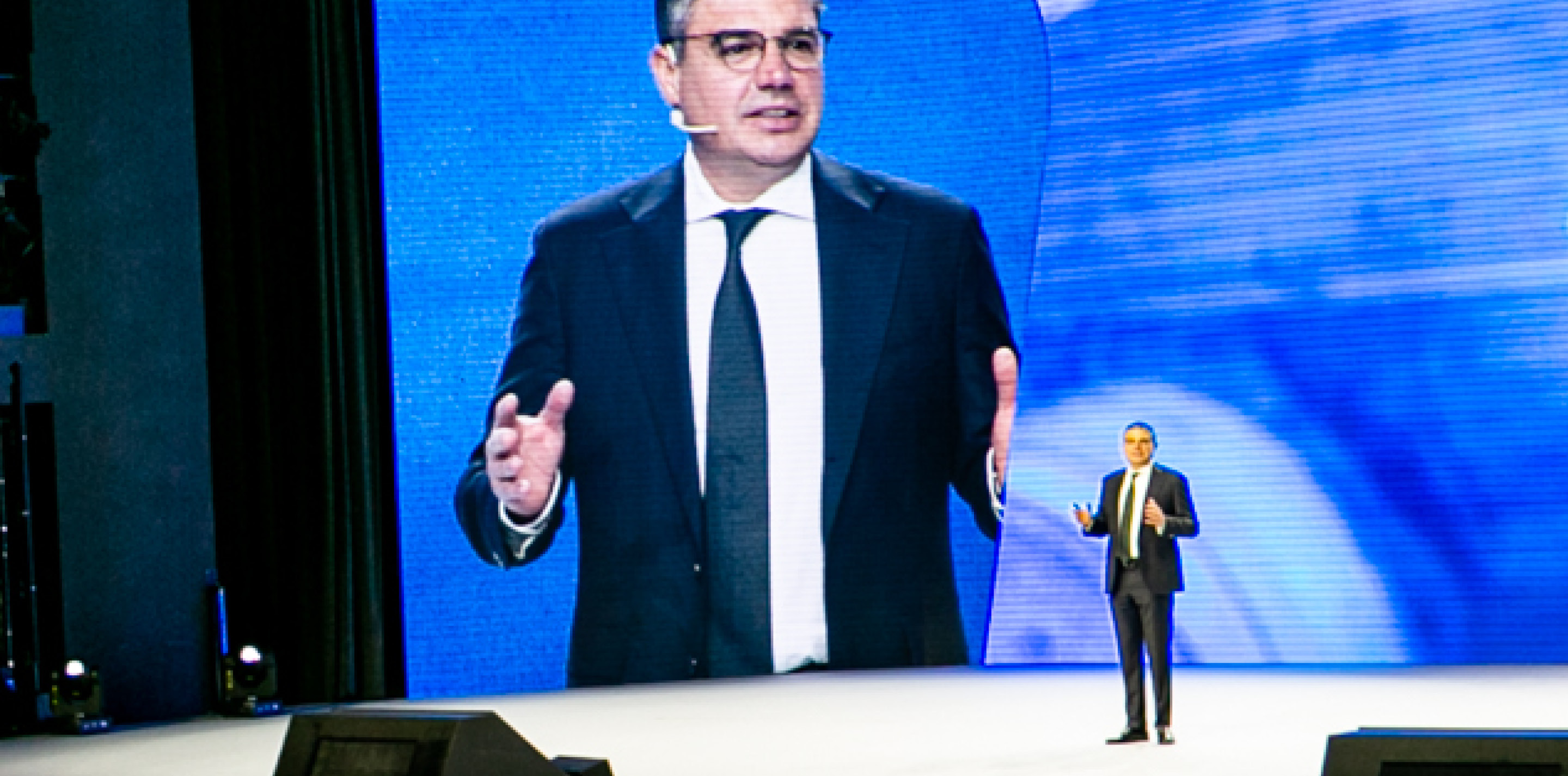
His leadership interviews add a quieter ambition to the corporate one. Asked what he looks for in younger people, Simonelli emphasizes curiosity, the desire to achieve an outcome and the wish to accomplish something beyond oneself. He says he always wanted to run something that would benefit others. The interest extends to leaders throughout an organization, rather than only future chief executives.
“Definitely, I get feedback. You have to make it a safe zone”
Lorenzo Simonelli, 2025 leadership interview
He also acknowledges that making feedback welcome does not mean everyone will feel comfortable giving it. People close to the work see him preparing meetings and presentations, and can offer corrections. That admission makes his leadership account more credible than a frictionless description of universal openness. The person at the top still has to create the conditions for disagreement.
There is a pleasing connection here with the railway years. Industrial equipment has operating conditions, tolerances and feedback. So do organizations, though the manuals are considerably less satisfactory. Simonelli’s career puts both kinds of system in the same frame: the machines that customers need and the people who have to make decisions about them. His next chapter will be judged in the same place as the earlier ones - where a plan becomes something that works.
Continue the conversation
Profiles, interviews and the decisions behind the story.
- Simonelli’s official biography Baker Hughes
- Lorenzo Simonelli on LinkedIn His public posts and articles
- The endless value of feedback 2025 leadership interview
- When PowerHaul arrived in Britain GE, 2009
- The Transnet locomotive project GE, 2011
- The Baker Hughes name change October 2019
- The 2023 closing keynote Energy security, affordability and emissions
- The energy equation, in his words June 2026 interview
- Chart acquisition completed July 16, 2026
- The updated 2026 business outlook September 2026
- Watch: Bloomberg’s energy sector interview YouTube · 2024
- Watch: ADIPEC Energy Dialogues YouTube · 2020
- Watch: infrastructure and energy security CNA · September 2026
- Baker Hughes · Company X · Company Instagram · Company YouTube