Wil VanLoh had spent his early career helping other people get money. He worked in energy investment banking, then established Windrock Capital, arranging financing and advising energy businesses. In 1998, at 28, he founded Quantum. The change was simple to describe and rather more demanding to live with: he would now have a stake in what happened after the transaction.
There is a particular temptation in telling the story of an investment firm. Start with a small number, end with a large one, insert a photograph of a confident person in between. VanLoh’s career offers the required arithmetic. It also offers a more interesting question. What does an investor do when the sensible answer is to do nothing?
That question runs through his public account of Quantum. He has described enthusiasm for entrepreneurs, an expanding interest in different forms of energy, and a willingness to wait when he cannot make sense of the risk. Each sounds reasonable on its own. Keeping them together is harder. Entrepreneurs need encouragement. Investment committees need reasons. Markets have an unfortunate habit of making impatience look clever, right up until they stop.
His formal preparation was a finance degree from Texas Christian University, where he graduated in 1992. His work took him through NationsBank and Kidder, Peabody & Co. before Windrock. These were jobs in the machinery of transactions: acquisitions, financing, the agreements that turn a business plan into something people can actually fund. They put him close to energy companies without making him their owner.
In a later podcast conversation, he recalled admiring his mother’s attempt to start a clothing business, even though it failed. The example he remembered was the willingness to try. That is a useful detail in a career otherwise easy to flatten into dollars and dates. A failed business can still leave something valuable behind; the balance sheet does not record every inheritance.
TCU
Capital
founded
The first cheque needed more than a banker
Quantum’s first fund closed in July 1998 with $101 million. VanLoh’s account of its beginning includes Toby Neugebauer, A.V. Jones Jr. and Jeff Jones. Financial knowledge was joined to experience in operating energy businesses. The arrangement reflected a specific conviction: an oil and gas property could change in value because of what a capable team did to it.
The distinction matters. Anyone considering a producing asset can examine today’s income. Someone who understands the reservoir and the operations can ask different questions about tomorrow. What could be developed? What could be improved? What looks economical on paper but becomes troublesome in the field? An investment decision becomes a conversation among people who know different things, rather than a competition to produce the tidiest spreadsheet.
VanLoh wanted to back entrepreneurs who could use that conversation. For him, the team and the asset belonged in the same decision. A promising property with the wrong people could disappoint; experienced people might see possibilities that a purely financial assessment missed. The attraction of owning the business was precisely that it left room to build, rather than simply arrange the introduction and collect a fee.
That early choice also explains why his title alone tells only part of the story. A founder establishes the firm. A capital allocator decides which ambitions receive backing. VanLoh’s work has involved both, along with leadership of investment committees. The second job repeatedly tests the first: it is possible to believe strongly in entrepreneurship and still decide that a particular entrepreneur’s next project costs too much.
THE FOUNDING QUESTIONWhat could a capable team do with the asset after buying it?
The pause that complicates the growth story
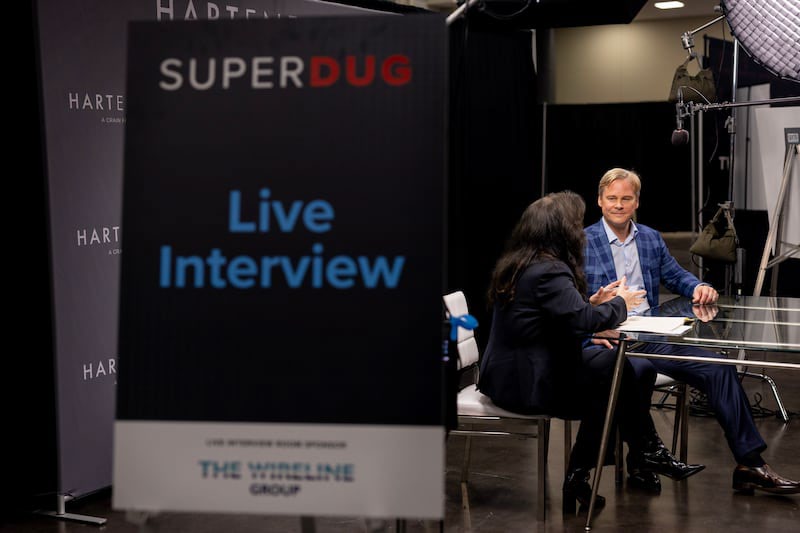
At a September 2026 conference interview, VanLoh recalled a stretch after the 2008-2009 downturn when Quantum went about two and a half years without making an investment. Shale had changed the risks, and the firm did not yet understand them well enough. He also emphasized hedging and restrained borrowing. His explanation gave the long career an unusually revealing punctuation mark: a pause.
In the usual founder narrative, every obstacle becomes an invitation to move faster. Here was an investor describing a period in which learning took priority over buying. The admission is useful because it allows uncertainty into the story. Experience in a sector does not guarantee understanding of its next technological change. Having money available does not settle the question of whether to spend it.
Waiting carries its own discomfort. Deals happen without you. Other investors can appear to have understood something you missed. The pressure is particularly awkward for a firm whose business depends on finding places for capital. A pause can look like hesitation from outside and discipline from inside. The distinction eventually depends on the decisions that follow, rather than on how reassuring the explanation sounds.
“It is a lot of art versus science,” he said in that 2026 conversation. It is a modestly untidy description for a business built around financial analysis. It acknowledges that numbers need interpretation. Price, contracts, geology, operating skill and the likely buyer all enter the judgment. Even a careful process leaves the investor making a choice about a future that has declined to submit a final draft.
A bigger fund, a slower conversation
On October 29, 2024, Quantum announced more than $10 billion in aggregate commitments across several energy strategies, including co-investment. The headline figure covered multiple pools of capital. It included $5.25 billion for the flagship Quantum Energy Partners VIII and $2.8 billion for Quantum Capital Solutions II, with approximately $2 billion for other associated funds.
The following day, VanLoh described the effort behind the announcement. Raising the money had taken almost two years, compared with six months to a year in earlier periods. He pointed to investors’ retreat from fossil fuels. The announcement and the explanation belong together: Quantum had secured substantial backing, and securing it had become slower.
For a founder, that is a different kind of patience from waiting to buy an asset. It means repeatedly explaining why the strategy deserves a place in someone else’s portfolio. Energy investing arrives with questions about commodity prices, emissions, regulation and the future of demand. An investor can have a strong answer to one question and still face a difficult conversation about the others.
The separate funds show another way his work has changed. An energy company may need ownership capital, a structured financing arrangement or credit. Those tools come with different obligations and different claims on the business. Quantum’s expansion gives VanLoh more ways to approach an opportunity, while adding more choices about how the risks should be shared. The cheque has become more versatile. The judgment still has to come first.
An electricity bill for the digital future
VanLoh’s public discussions increasingly connect energy with technology. In a 2024 interview, he spoke about established oil and gas companies adopting artificial intelligence and using their data. The subject gives an energy investor two things to consider: what new tools can do inside a portfolio company, and what the wider digital economy asks of the power system.
The first question fits the original Quantum idea of helping a business improve after the investment. Better analysis can change decisions about an asset or an operation. It also requires practical implementation. A tool has little value if it produces an elegant answer to a question nobody needs answered. The conversation eventually returns to the people making decisions and the consequences of those decisions.
The second question has a very physical expression. In January 2026, Quantum announced agreements to sell approximately 90 percent of Cogentrix’s natural gas generation assets to Vistra for about $4.7 billion. The announcement described a platform with roughly 5.5 gigawatts of capacity and cited rising electricity demand from data centers, industry and electrification. It was an agreement to sell, subject to approvals, rather than a completed transaction at announcement.
That deal places a power station in the same story as the algorithm. The digital future still comes with an electricity bill. For VanLoh, the connection broadens the investment map from resources in the ground to the infrastructure that turns them into usable power. It also gives his interest in technology a double significance: software can help run the business, while demand for software can create business for the generator.
Innovation, with the invoice attached
His interest in energy’s future extends beyond conventional fuels. Quantum’s stated focus includes power and renewables, decarbonization and energy technology. VanLoh’s comments about geothermal in 2023 showed how he approaches an emerging technology: interested in its relationship to drilling expertise, attentive to its cost, cautious about assuming how much electricity it would eventually supply.
He offered a compact caution of his own: “be careful betting against innovation in this country.” It leaves room for technical progress without treating every proposal as an investable business. A technology can be intriguing and expensive at the same time. It can be useful in particular places without answering every energy question. Those distinctions tend to disappear in a slogan and return promptly in a budget.
This is also where his perspective deserves to be read as an investor’s perspective. Quantum backs businesses that must earn returns. VanLoh’s argument for affordable, reliable energy accompanies that commercial responsibility. Claims about future costs or the pace of a transition remain judgments to be tested. Enthusiasm for innovation does not remove the need to examine the economics, or the environmental consequences, of an individual project.
What survives the transaction
The less numerical part of his story concerns whom he believes the work should serve. In an earlier interview about leadership, VanLoh placed faith and family ahead of business in his definition of success. He described service to employees and clients as part of running a worthwhile company. He also put unusual weight on reputation: “Your reputation is the most important thing that you have.”
In his stakeholder letter published in Quantum’s 2021 ESG report, he reminded colleagues that their investors include teachers, first responders and public servants, alongside endowments and other investment pools. The reminder gives institutional capital a human destination. The person approving a commitment and the person eventually relying on its returns are often far apart. His formulation asks the firm to remember both.
His public connections include an advisory role at TCU’s Ralph Lowe Energy Institute and a board role at the Bettering Human Lives Foundation. In 2024, he was inducted into Hart Energy’s Hall of Fame. The university connection is particularly fitting: the finance graduate now returns to a setting where students are making their first decisions about the industry he entered through banking.
The arc is long enough to resist a single moral. VanLoh has raised capital, built a firm, backed entrepreneurs and broadened his attention across energy. He has also described periods of uncertainty and restraint. The interesting continuity is the act of choosing: a partner, a financing structure, an asset, a moment to leave. Sometimes a founder’s ambition shows itself in the company he builds. Sometimes it shows itself in the deal he lets pass.